Gero Shane, Whitehead Hal
Zoophysiology, Institute for Bioscience, Aarhus University, Aarhus, Denmark.
Dept. of Biology, Dalhousie University, Halifax, Canada.
PLoS One. 2016 Oct 5;11(10):e0162019. doi: 10.1371/journal.pone.0162019. eCollection 2016.
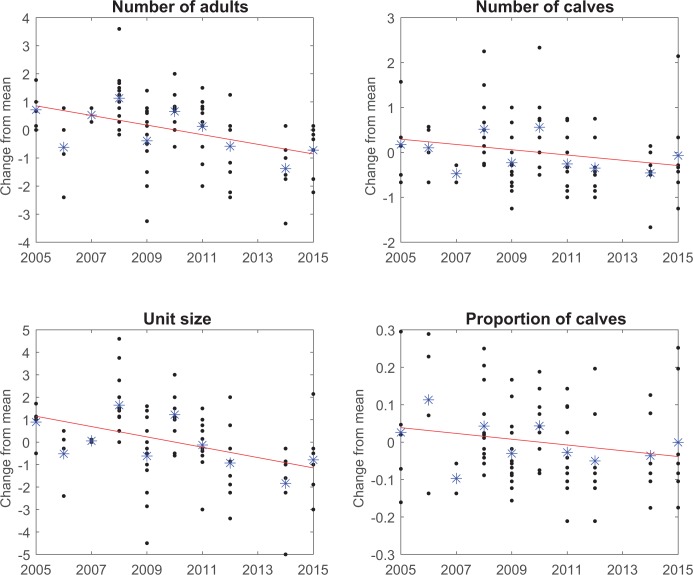
Sperm whale (Physeter macrocephalus) populations were expected to rebuild following the end of commercial whaling. We document the decline of the population in the eastern Caribbean by tracing demographic changes of well-studied social units. We address hypotheses that, over a ten-year period of dedicated effort (2005-2015), unit size, numbers of calves and/or calving rates have each declined. Across 16 units, the number of adults decreased in 12 units, increased in two, and showed no change in two. The number of adults per unit decreased at -0.195 individuals/yr (95% CI: -0.080 to -0.310; P = 0.001). The number of calves also declined, but the decline was not significant. This negative trend of -4.5% per year in unit size started in about 2010, with numbers being fairly stable until then. There are several natural and anthropogenic threats, but no well-substantiated cause for the decline.
商业捕鲸活动结束后,人们曾期望抹香鲸(Physeter macrocephalus)种群数量能够得以恢复。我们通过追踪经过深入研究的社会单位的人口结构变化,记录了东加勒比地区抹香鲸种群数量的下降情况。我们探讨了一些假设,即在为期十年的专项研究期间(2005年至2015年),单位规模、幼崽数量和/或产犊率是否均有所下降。在16个单位中,有12个单位的成年抹香鲸数量减少,2个单位数量增加,2个单位数量无变化。单位成年抹香鲸数量以每年-0.195头的速度减少(95%置信区间:-0.080至-0.310;P = 0.001)。幼崽数量也有所下降,但下降并不显著。单位规模每年-4.5%的负增长趋势始于2010年左右,在此之前数量相对稳定。存在多种自然和人为威胁,但尚未找到导致数量下降的确凿原因。