Faculty of Veterinary Medicine, Department of Pathobiology, Utrecht University, Utrecht, The Netherlands.
Institute for Terrestrial and Aquatic Wildlife Research, University of Veterinary Medicine Hannover, Foundation, Büsum, Germany.
PLoS One. 2018 Aug 7;13(8):e0201221. doi: 10.1371/journal.pone.0201221. eCollection 2018.
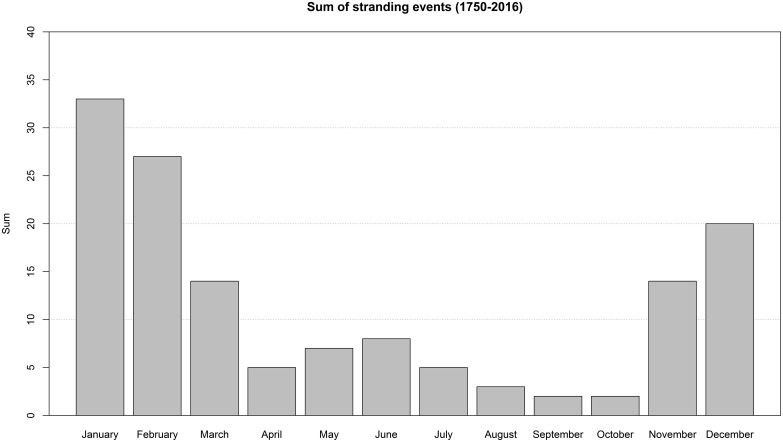
Between the 8th January and the 25th February 2016, the largest sperm whale Physeter macrocephalus mortality event ever recorded in the North Sea occurred with 30 sperm whales stranding in five countries within six weeks. All sperm whales were immature males. Groups were stratified by size, with the smaller animals stranding in the Netherlands, and the largest in England. The majority (n = 27) of the stranded animals were necropsied and/or sampled, allowing for an international and comprehensive investigation into this mortality event. The animals were in fair to good nutritional condition and, aside from the pathologies caused by stranding, did not exhibit significant evidence of disease or trauma. Infectious agents were found, including various parasite species, several bacterial and fungal pathogens and a novel alphaherpesvirus. In nine of the sperm whales a variety of marine litter was found. However, none of these findings were considered to have been the primary cause of the stranding event. Potential anthropogenic and environmental factors that may have caused the sperm whales to enter the North Sea were assessed. Once sperm whales enter the North Sea and head south, the water becomes progressively shallower (<40 m), making this region a global hotspot for sperm whale strandings. We conclude that the reasons for sperm whales to enter the southern North Sea are the result of complex interactions of extrinsic environmental factors. As such, these large mortality events seldom have a single ultimate cause and it is only through multidisciplinary, collaborative approaches that potentially multifactorial large-scale stranding events can be effectively investigated.
2016 年 1 月 8 日至 2 月 25 日期间,北大西洋发生了有记录以来最大规模的抹香鲸 Physeter macrocephalus 死亡事件,在六周内有 30 头抹香鲸在五个国家搁浅。所有搁浅的抹香鲸均为未成年雄性个体。根据体型对搁浅的抹香鲸进行了分组,体型较小的搁浅在荷兰,体型最大的搁浅在英国。对大多数(n = 27)搁浅的抹香鲸进行了解剖和/或采样,以便对这次死亡事件进行国际和全面的调查。这些动物的营养状况良好,除了搁浅造成的病理变化外,没有明显的疾病或创伤证据。发现了一些传染性病原体,包括各种寄生虫、几种细菌和真菌病原体以及一种新型α疱疹病毒。在 9 头抹香鲸中发现了多种海洋垃圾。然而,这些发现都没有被认为是搁浅事件的主要原因。评估了可能导致抹香鲸进入北海的人为和环境因素。一旦抹香鲸进入北海并向南移动,海水就会变得越来越浅(<40 米),使该地区成为抹香鲸搁浅的全球热点地区。我们的结论是,抹香鲸进入北海的原因是外部环境因素复杂相互作用的结果。因此,这些大规模的死亡事件很少有单一的最终原因,只有通过多学科、协作的方法,才能有效地调查潜在的多因素大规模搁浅事件。