Sugioka Daniele Kazue, Gonçalves Carlos Eduardo Ibaldo, Bicalho Maria da Graça
Departamento de Genética, Laboratório de Imunogenética e Histocompatibilidade (LIGH), Universidade Federal do Paraná, R. Cel. Francisco H. dos Santos S/N, Centro Politécnico - Jardim das Américas, CEP 81.530.990, Curitiba, PR CP 19071 Brazil.
BMC Hematol. 2016 Sep 29;16:25. doi: 10.1186/s12878-016-0064-6. eCollection 2016.
Since the discovery of specific histocompatibility, literature has associated genes involved in the immune response, like the Human Leucocyte Antigen (HLA), with a better prognosis in transplantation. However, other non-HLA genes may also influence the immune process, such as the genes encoding the immunoglobulin-like receptors of natural killer cells (KIRs). The discovery that NK cell KIR receptors interact with conservative epitopes (C1, C2, Bw4) presented in HLA class I molecules that are genetically polymorphic, also observed in KIR genes, led to the investigation of the relevance of the KIR system to hematopoietic stem cell transplant. The cure of patients with leukemias and other hematological malignancies after bone marrow transplantation (BMT) has been attributed in part to the ability of the donor immune cells, present in the graft, to recognize and eliminate neoplastic cells of the patient. The cytotoxic activity of NK cells is mediated by the absence of HLA class I-specific ligands on the target cell surface to inhibitory KIR receptors (hypothesis of "missing-self").
We analyzed, by PCR typing-SSOP technique, the presence or absence of 16 KIR genes and haplotypes of 39 patients with hematopoietic disorders and 136 healthy individuals from Paraná State. The comparisons made between the patient and control group were performed using χ test or Fisher exact test (bilateral -value), as appropriated. Significance level was considered when -value ≤ 0.05.
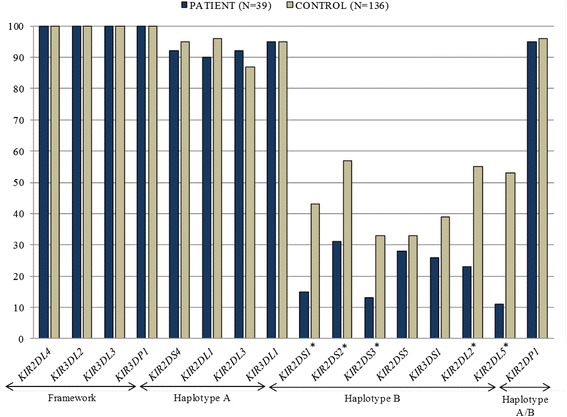
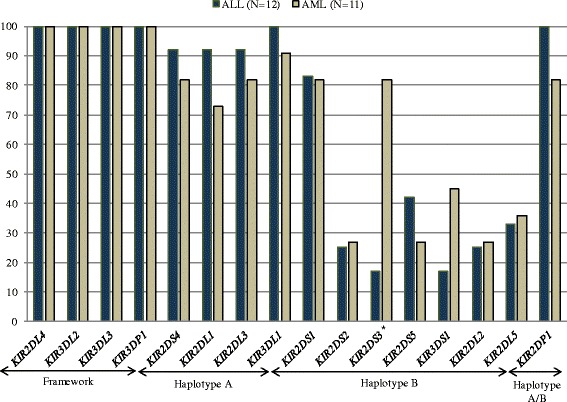
Framework genes and were positive in all samples. The comparison between KIR repertoire of patients and healthy individuals revealed significant differences ( < 0.05) in inhibitors genes ( = 0.0005) and ( = 0.0067) and activating genes ( = 0.0013), ( = 0.0038), ( = 0.0153) that are more frequent in controls than in patients. The was significantly more frequent ( = 0.0031) in patients with acute myeloid leukemia (AML) when compared to patients with acute lymphoblastic leukemia (ALL). We observed a higher frequency of haplotype A (59 %) in the patients.
Our data suggests that susceptibility to leukemia can be influenced, at least, partly byKIR receptors.
自发现特异性组织相容性以来,文献一直将参与免疫反应的基因,如人类白细胞抗原(HLA),与移植中更好的预后相关联。然而,其他非HLA基因也可能影响免疫过程,例如编码自然杀伤细胞免疫球蛋白样受体(KIR)的基因。自然杀伤细胞KIR受体与HLA I类分子中呈现的保守表位(C1、C2、Bw4)相互作用的发现,这些表位具有遗传多态性,在KIR基因中也有观察到,这引发了对KIR系统与造血干细胞移植相关性的研究。骨髓移植(BMT)后白血病和其他血液系统恶性肿瘤患者的治愈部分归因于移植物中存在的供体免疫细胞识别和清除患者肿瘤细胞的能力。自然杀伤细胞的细胞毒性活性是由靶细胞表面缺乏针对抑制性KIR受体的HLA I类特异性配体介导的(“缺失自我”假说)。
我们采用聚合酶链反应分型-序列特异性寡核苷酸探针(PCR typing-SSOP)技术分析了巴拉那州39例血液系统疾病患者和136名健康个体中16种KIR基因和单倍型的存在情况。患者组与对照组之间的比较根据情况使用χ²检验或Fisher精确检验(双侧p值)。当p值≤0.05时认为具有统计学意义。
框架基因2DL1和3DL3在所有样本中均为阳性。患者与健康个体KIR库的比较显示,抑制基因2DL1(p = 0.0005)、2DL3(p = 0.0067)和激活基因2DS1(p = 0.0013)、2DS2(p = 0.0038)、2DS4(p = 0.0153)存在显著差异(p < 0.05),这些基因在对照组中比在患者中更常见。与急性淋巴细胞白血病(ALL)患者相比,急性髓系白血病(AML)患者中2DS4的频率显著更高(p = 0.0031)。我们观察到患者中单倍型A的频率更高(59%)。
我们的数据表明,白血病易感性至少部分可受KIR受体影响。