Curley Louise E, Moody Janice, Gobarani Rukshar, Aspden Trudi, Jensen Maree, McDonald Maureen, Shaw John, Sheridan Janie
School of Pharmacy, Faculty of Medical and Health Sciences, University of Auckland, Private Bag 92019, Auckland, 1142 New Zealand.
J Pharm Policy Pract. 2016 Sep 29;9:29. doi: 10.1186/s40545-016-0080-8. eCollection 2016.
Worldwide the demands on emergency and primary health care services are increasing. General practitioners and accident and emergency departments are often used unnecessarily for the treatment of minor ailments. Community pharmacy is often the first port of call for patients in the provision of advice on minor ailments, advising the patient on treatment or referring the patient to an appropriate health professional when necessary. The potential for community pharmacists to act as providers of triage services has started to be recognised, and community pharmacy triage services (CPTS) are emerging in a number of countries. This review aimed to explore whether key components of triage services can be identified in the literature surrounding community pharmacy, to explore the evidence for the feasibility of implementing CPTS and to evaluate the evidence for the appropriateness of such services.
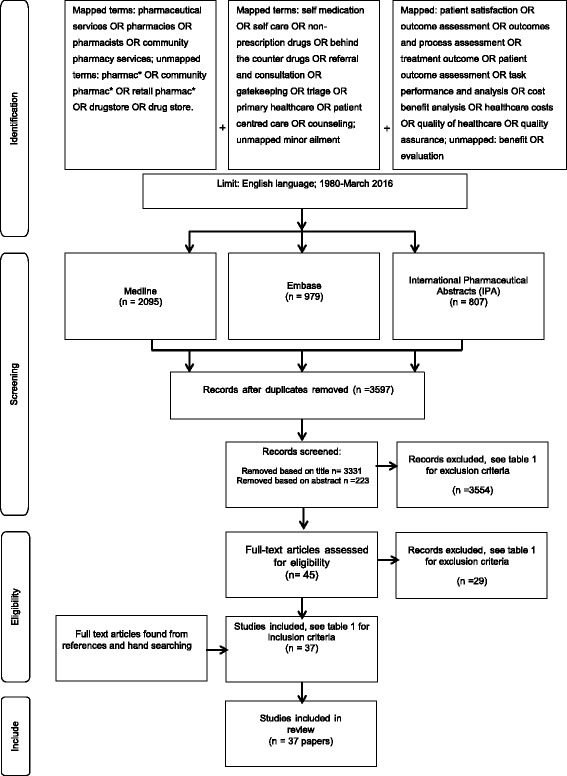
Systematic searches were conducted in MEDLINE, EMBASE and International Pharmaceutical Abstracts (IPA) databases from 1980 to March 2016.
Key elements of community pharmacy triage were identified in 37 studies, which were included in the review. When a guideline or protocol was used, accuracy in identifying the presenting condition was high, with concordance rates ranging from 70 % to 97.6 % between the pharmacist and a medical expert. However, when guidelines and protocols were not used, often questioning was deemed insufficient. Where other health professionals had reviewed decisions made by pharmacists and their staff, e.g. around advice and referral, the decisions were considered to be appropriate in the majority of cases. Authors of the included studies provided recommendations for improving these services, including use of guidelines/protocols, education and staff training, documentation, improving communication between health professional groups and consideration of privacy and confidentiality.
Whilst few studies had specifically trialled triage services, results from this review indicate that a CPTS is feasible and appropriate, and has the potential to reduce the burden on other healthcare services. Questions still remain on issues such as ensuring the consistency of the service, whether all pharmacies could provide this service and who will fund the service.
在全球范围内,对急诊和初级卫生保健服务的需求不断增加。全科医生以及急诊科常常被不必要地用于治疗小病小恙。在为患者提供小病治疗建议、指导患者进行治疗或在必要时将患者转介给合适的医疗专业人员方面,社区药房往往是患者的首选。社区药剂师提供分诊服务的潜力已开始得到认可,并且在一些国家,社区药房分诊服务(CPTS)正在兴起。本综述旨在探讨在有关社区药房的文献中是否能确定分诊服务的关键组成部分,探究实施CPTS可行性的证据,并评估此类服务适当性的证据。
在1980年至2016年3月期间,对MEDLINE、EMBASE和国际药学文摘(IPA)数据库进行了系统检索。
在37项研究中确定了社区药房分诊的关键要素,这些研究被纳入了本综述。当使用指南或方案时,识别就诊病情的准确性较高,药剂师与医学专家之间的一致性率在70%至97.6%之间。然而,当未使用指南和方案时,通常认为问诊不够充分。在其他卫生专业人员对药剂师及其工作人员做出的决策(例如关于建议和转诊的决策)进行审查的情况下,大多数情况下这些决策被认为是适当的。纳入研究的作者提供了改进这些服务的建议,包括使用指南/方案、教育和员工培训、记录、改善卫生专业人员群体之间的沟通以及考虑隐私和保密问题。
虽然很少有研究专门试验过分诊服务,但本综述的结果表明,CPTS是可行且适当的,并且有可能减轻其他医疗服务的负担。在确保服务的一致性、是否所有药房都能提供此项服务以及谁将为该服务提供资金等问题上,仍然存在疑问。