Paul Chubb S A, Davis Wendy A, Peters Kirsten E, Davis Timothy M E
School of Medicine and Pharmacology, University of Western Australia, Fremantle Hospital, PO Box 480, Fremantle, WA, 6959, Australia.
PathWest Laboratory Medicine WA, Fiona Stanley Hospital, Murdoch, WA, Australia.
Cardiovasc Diabetol. 2016 Oct 6;15(1):143. doi: 10.1186/s12933-016-0462-x.
Serum bicarbonate is associated with mortality, heart failure (HF) and progression of renal failure in studies of healthy people and patients with chronic kidney disease, but the significance of these observations in unselected patients with diabetes in the general population is unknown. The aim of this study was to determine whether serum bicarbonate was associated with mortality and cardiovascular disease risk in type 2 diabetes.
Baseline serum bicarbonate was available for 1283 well-characterized community-based patients (mean ± SD age 64.1 ± 11.3 years, 48.7 % males) from the longitudinal observational Fremantle Diabetes Study followed for a mean of 12 years. Associations between serum bicarbonate and mortality, coronary heart disease (CHD) and incident HF were analysed using Cox proportional hazards regression.
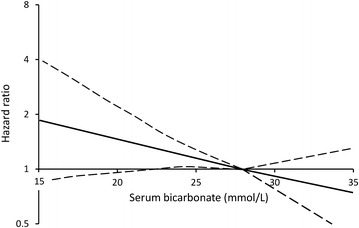
Serum bicarbonate was independently and negatively associated with incident CHD. For each 1 mmol/L increase in bicarbonate, the hazard ratio for CHD was 0.95 (95 % confidence interval 0.92-0.99) after adjustment for age as time scale, age at baseline, sex, English fluency, diabetes duration, log(serum triglycerides), log(urinary albumin: creatinine ratio), peripheral sensory neuropathy and peripheral arterial disease. There were no independent associations between serum bicarbonate and all-cause mortality [0.98 (0.95-1.004)] or incident HF [0.99 (0.95-1.03)].
Serum bicarbonate was a significant independent predictor of incident CHD but not death or HF in community-based patients with type 2 diabetes. This supports intervention trials of bicarbonate replacement in type 2 patients at risk of CHD and who have a low serum bicarbonate concentration.
在健康人群和慢性肾脏病患者的研究中,血清碳酸氢盐与死亡率、心力衰竭(HF)及肾衰竭进展相关,但在普通人群中未经过挑选的糖尿病患者中,这些观察结果的意义尚不清楚。本研究的目的是确定血清碳酸氢盐是否与2型糖尿病患者的死亡率及心血管疾病风险相关。
纵向观察性弗里曼特尔糖尿病研究纳入了1283例特征明确的社区患者(平均±标准差年龄64.1±11.3岁,48.7%为男性),其基线血清碳酸氢盐数据可得,随访时间平均为12年。使用Cox比例风险回归分析血清碳酸氢盐与死亡率、冠心病(CHD)及新发HF之间的关联。
血清碳酸氢盐与新发CHD独立且呈负相关。以年龄作为时间尺度、校正基线年龄、性别、英语流利程度、糖尿病病程、log(血清甘油三酯)、log(尿白蛋白:肌酐比值)、周围感觉神经病变和周围动脉疾病后,碳酸氢盐每升高1 mmol/L,CHD的风险比为0.95(95%置信区间0.92 - 0.99)。血清碳酸氢盐与全因死亡率[0.98(0.95 - 1.004)]或新发HF[0.99(0.95 - 1.03)]之间无独立关联。
血清碳酸氢盐是社区2型糖尿病患者新发CHD的重要独立预测因素,但与死亡或HF无关。这支持了对有CHD风险且血清碳酸氢盐浓度低的2型患者进行碳酸氢盐替代干预试验。