Zeng Xu-Can, Sun Xiao-Dong, Li Jian-Xiong, Chen Meng-Ni, Deng Dao-Wei, Zhang Cang-Lin, Lin Zu-Rui, Zhou Zi-You, Zhou Yao-Wu, Yang Ya-Ming, Zhou Sheng
Yunnan Institute of Parasitic Disease, 6 Xiyuan Road, Pu'er, 665000, Yunnan, China.
Key Laboratory of Surveillance and Early-warning on Infectious Disease, Division of Infectious Diseases, Chinese Center for Disease Control and Prevention, 155 Changbai Road, Changping District, Beijing, 102206, People's Republic of China.
Infect Dis Poverty. 2016 Oct 4;5(1):102. doi: 10.1186/s40249-016-0185-y.
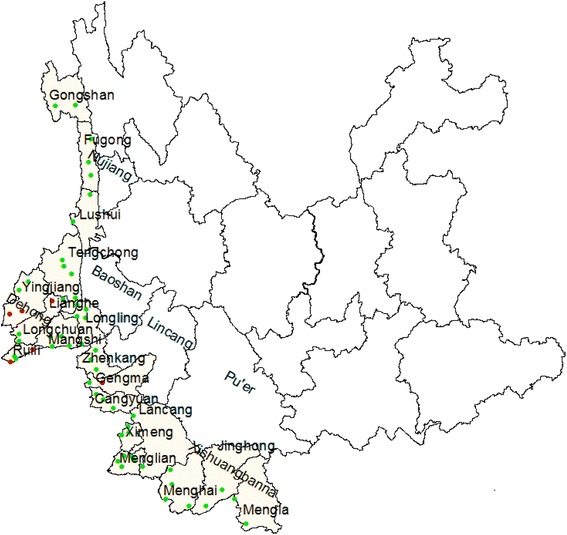
This paper seeks to assess the function of malaria control consultation and service posts (MCCSPs) that are located on the border areas of Yunnan province, P.R. China, as a strategy for eliminating malaria among the mobile and migrant population in these areas.
A retrospective descriptive analytical study was conducted. Blood smear examinations conducted at all MCCSPs in Yunnan from 2008 to 2014 were analysed. A cross-sectional survey was conducted in 2014 to understand how the MCCSPs function and to elucidate the quality of the blood smear examinations that they conduct.
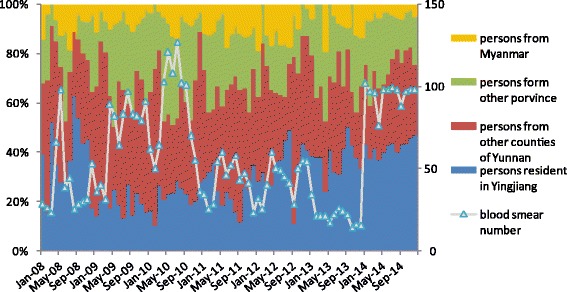
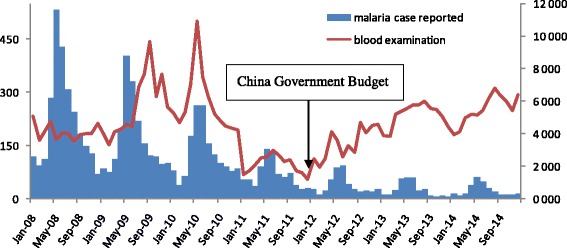
Out of the surveyed MCCSPs, 66 % (39/59), 22 % (13/59), and 12 % (7/59) were attached to local township hospitals, village health clinics, and the county centre for disease control and prevention or private clinics, respectively. More than 64 % (38/59) of the posts' staff were part-time workers from township hospitals and village health facilities. Less than 31 % (18/59) of the posts' staff were full-time workers. A total of 35 positive malaria cases were reported from seven MCCSPs in 2014. Four MCCSPs were unable to perform their functions due to under staffing in 2014. There was a small fluctuation in blood smear examinations from January 2008 to June 2009, with two peaks during the period from July 2009 to October 2010. The number of blood smear examinations has been increasing since 2011. The yearly mean number of blood smear examinations in each post increased from 44 per month in 2011 to 109 per month in 2014, and the number of positive malaria cases detected by blood smear examinations has declined (χ = 90.67, P = 0.000). The percentage of people from Yingjiang county getting blood smear examinations increased between 2008 and 2014, while percentages of the mobile population including Myanmar people, people from other provinces, and people from other Yunnan counties getting blood smear examinations decreased.
MCCSPs face challenges in the phase of malaria elimination in Yunnan, China. New case detection strategies should be designed for MCCSPs taking into account the current trends of migration.
本文旨在评估位于中国云南省边境地区的疟疾防控咨询与服务点(MCCSPs)的功能,将其作为这些地区流动和移民人群疟疾消除策略。
开展回顾性描述性分析研究。对2008年至2014年云南省所有MCCSPs进行的血涂片检查进行分析。2014年进行了横断面调查,以了解MCCSPs的运作方式并阐明其进行的血涂片检查质量。
在接受调查的MCCSPs中,分别有66%(39/59)、22%(13/59)和12%(7/59)隶属于当地乡镇医院、村卫生室以及县疾病预防控制中心或私人诊所。超过64%(38/59)的服务点工作人员为乡镇医院和村卫生机构的兼职人员。不到31%(18/59)的服务点工作人员为全职人员。2014年,7个MCCSPs共报告了35例疟疾病例呈阳性。2014年,有4个MCCSPs因人员不足无法正常履职。2008年1月至2009年6月血涂片检查有小幅度波动,在2009年7月至2010年10月期间出现两个高峰。自2011年以来,血涂片检查数量一直在增加。每个服务点的血涂片检查年平均数量从2011年的每月44次增加到2014年的每月109次,通过血涂片检查检测出的疟疾病例呈阳性数量有所下降(χ = 90.67,P = 0.000)。2008年至2014年期间,盈江县接受血涂片检查的人数百分比有所增加,而包括缅甸人、其他省份人员以及云南省其他县人员在内的流动人群接受血涂片检查的百分比有所下降。
在中国云南省疟疾消除阶段,MCCSPs面临挑战。应根据当前移民趋势为MCCSPs设计新的病例检测策略。