Chan Gary C K, Leung Janni K, Quinn Catherine, Connor Jason P, Hides Leanne, Gullo Matthew J, Alati Rosa, Weier Megan, Kelly Adrian B, Hall Wayne D
Centre for Youth Substance Abuse Research, The University of Queensland, Brisbane, QLD, 4072, Australia.
Policy and Epidemiology Group, Queensland Centre for Mental Health Research, Brisbane, Australia.
BMC Public Health. 2016 Oct 10;16(1):1070. doi: 10.1186/s12889-016-3732-3.
Skog's collectivity theory of alcohol consumption predicted that changes in alcohol consumption would synchronize across all types of drinkers in a population. The aim of this paper is examine this theory in the Australian context. We examined whether there was a collective change in alcohol use in Australia from 2001 to 2013, estimated alcohol consumption in non-high risk and high risk drinkers, and examined the trends in alcohol treatment episodes.
Data from the 2001-2013 National Drug Strategy Household Surveys (N = 127,916) was used to estimate the prevalence and alcohol consumption of abstainers, high risk drinkers and frequent heavy episodic drinkers. Closed treatment episodes recorded in the Alcohol and Other Drug Treatment Services National Minimum Dataset (N = 608,367) from 2001 to 2013 were used to examine the trends of closed alcohol treatment episodes.
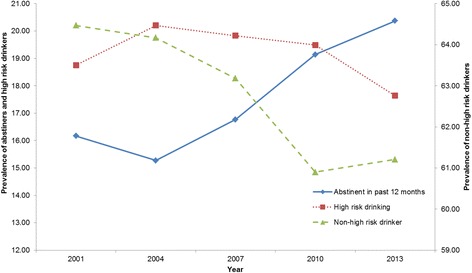
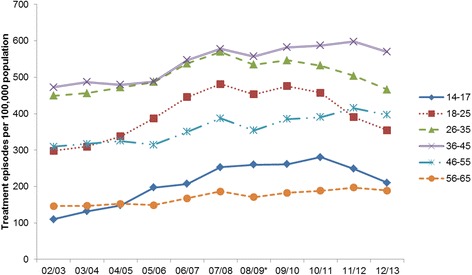
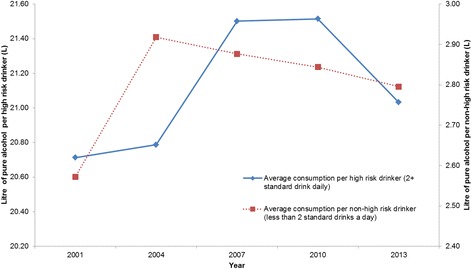
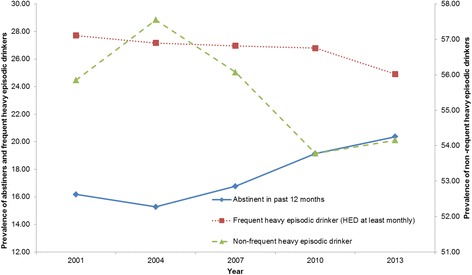
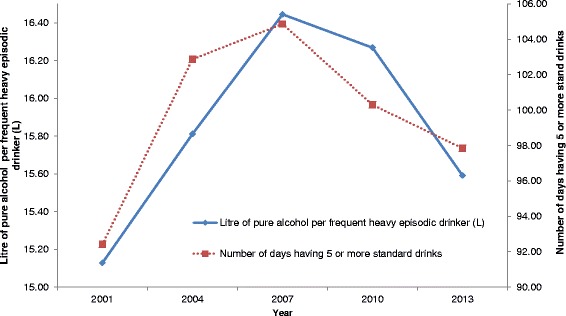
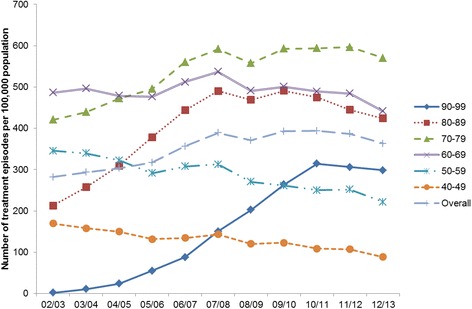
The prevalence of non-drinkers (abstainers) decreased to the lowest level in 2004 (15.3 %) and rebounded steadily thereafter (20.4 % in 2013; p < .001). Correspondingly, the per capita consumption of high risk drinkers (2 standard drinks or more on average per day) increased from 20.7 L in 2001 to peak in 2010 (21.5 L; p = .020). Non-high risk drinkers' consumption peaked in 2004 (2.9 L) and decreased to 2.8 L in 2013 (p < .05). There were decreases in alcohol treatment episodes across nearly all birth cohorts in recent years.
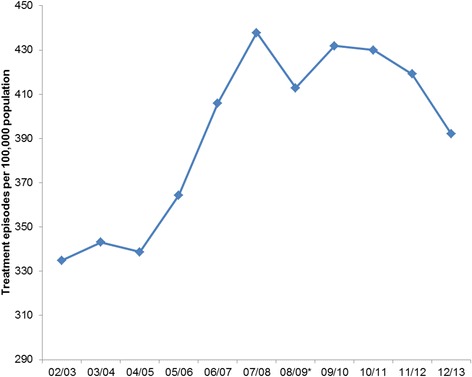
These findings are partially consistent with and support Skog's collectivity theory. There has been a turnaround in alcohol consumption after a decade-long uptrend, as evident in the collective decreases in alcohol consumption among nearly all types of drinkers. There was also a turnaround in rate of treatment seeking, which peaked at 2007 and then decreased steadily. The timing of this turnaround differs with level of drinking, with non-high risk drinkers reaching its peak consumption in 2004 and high risk drinkers reaching its peak consumption in 2010.
斯科格的饮酒集体理论预测,饮酒量的变化将在人群中所有类型的饮酒者中同步。本文旨在在澳大利亚的背景下检验这一理论。我们研究了2001年至2013年澳大利亚饮酒行为是否存在集体变化,估计了非高危和高危饮酒者的酒精消费量,并研究了酒精治疗病例的趋势。
使用2001 - 2013年国家药物战略家庭调查(N = 127,916)的数据来估计戒酒者、高危饮酒者和频繁重度间歇性饮酒者的患病率和酒精消费量。利用2001年至2013年酒精和其他药物治疗服务国家最低数据集(N = 608,367)中记录的封闭治疗病例来研究封闭酒精治疗病例的趋势。
不饮酒者(戒酒者)的患病率在2004年降至最低水平(15.3%),此后稳步回升(2013年为20.4%;p <.001)。相应地,高危饮酒者(平均每天饮用2标准杯或更多)的人均消费量从2001年的20.7升增加到2010年达到峰值(21.5升;p = 0.020)。非高危饮酒者的消费量在2004年达到峰值(2.9升),2013年降至2.8升(p <.05)。近年来,几乎所有出生队列的酒精治疗病例都有所减少。
这些发现部分符合并支持斯科格的集体理论。在长达十年的上升趋势之后,饮酒量出现了转变,几乎所有类型饮酒者的酒精消费量集体下降就证明了这一点。寻求治疗的比率也出现了转变,在2007年达到峰值,然后稳步下降。这种转变的时间因饮酒水平而异,非高危饮酒者的消费量在2004年达到峰值,高危饮酒者的消费量在2010年达到峰值。