Ketele Amandine, Kiss Tamás, Jády Beáta E
a Laboratoire de Biologie Moléculaire Eucaryote du CNRS, UMR5099, Center de Biologie Intégrative, Université Paul Sabatier , Toulouse Cedex 9, France.
b Biological Research Center, Hungarian Academy of Sciences , Szeged , Hungary.
RNA Biol. 2016 Dec;13(12):1274-1285. doi: 10.1080/15476286.2016.1239689. Epub 2016 Oct 11.
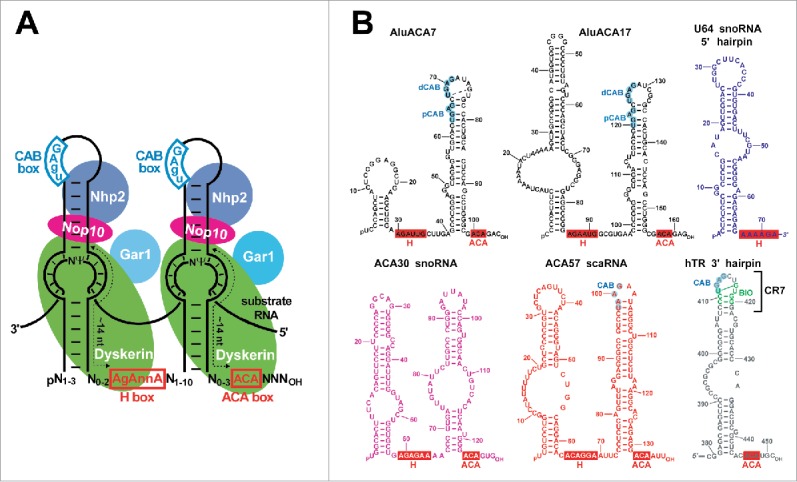
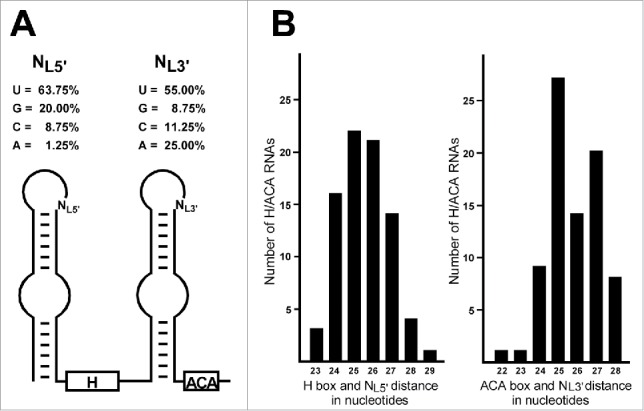
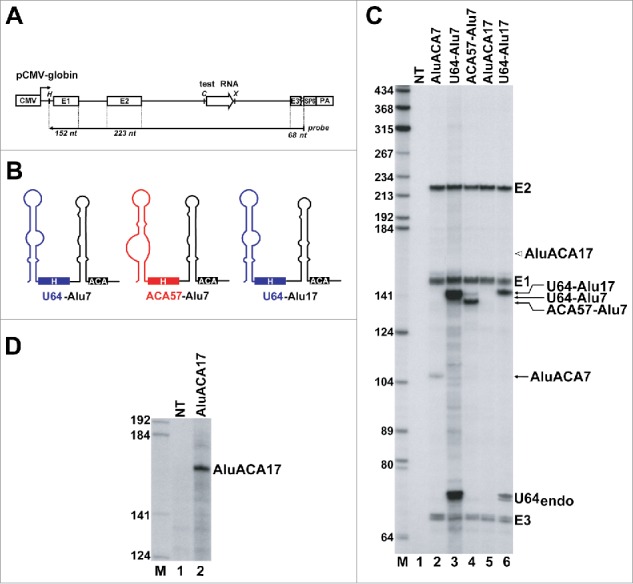
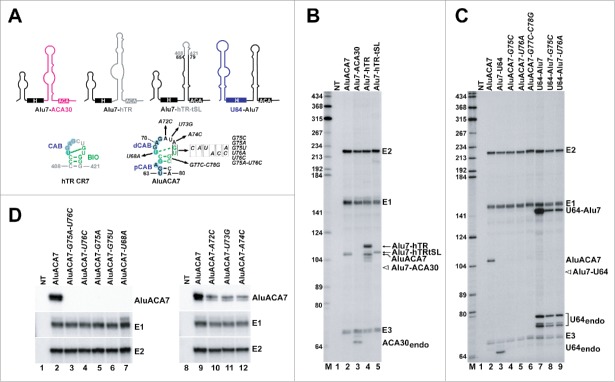
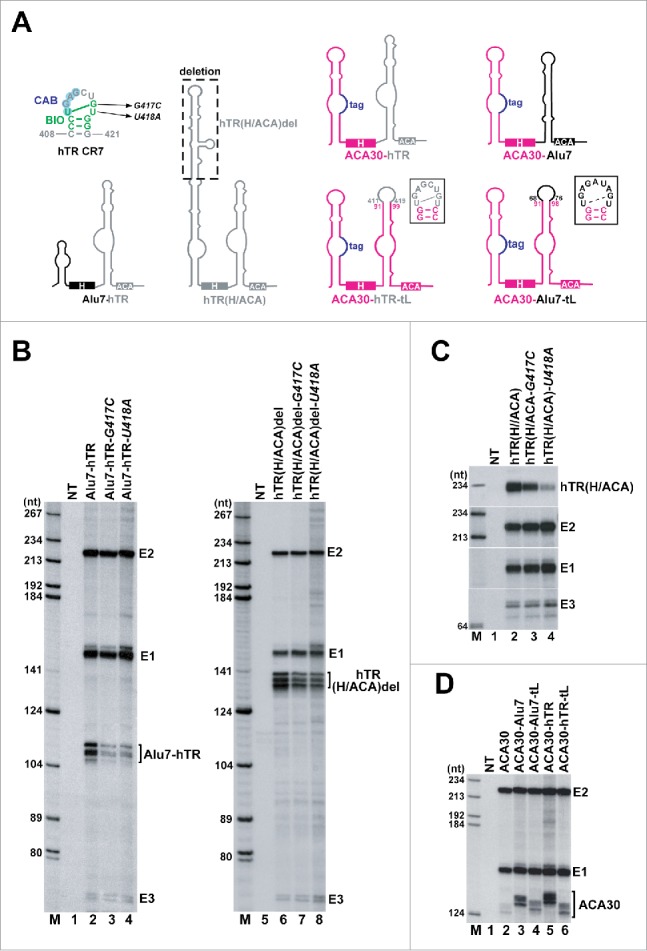
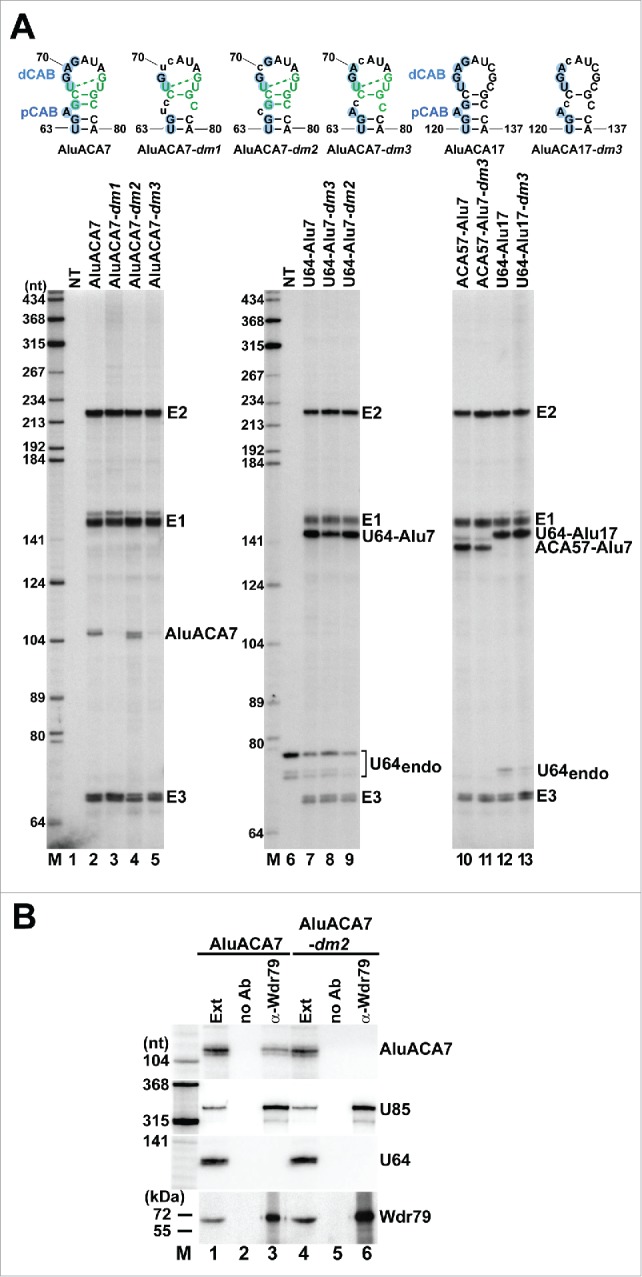
Mammalian cells express hundreds of intron-encoded box H/ACA RNAs which fold into a common hairpin-hinge-hairpin-tail structure, interact with 4 evolutionarily conserved proteins, dyskerin, Nop10, Nhp2 and Gar1, and function mainly in RNA pseudouridylation. The human telomerase H/ACA RNA (hTR) directs telomeric DNA synthesis and it carries a 5'-terminal domain encompassing the telomeric template sequence. The primary hTR transcript is synthesized from an independent gene by RNA polymerase II and undergoes 3' end processing controlled by the 3'-terminal H/ACA domain. The apical stem-loop of the 3' hairpin of hTR carries a unique biogenesis-promoting element, the BIO motif that promotes hTR processing and RNP assembly. AluACA RNAs represent a distinct class of human H/ACA RNAs; they are processed from intronic Alu repetitive sequences. As compared to canonical H/ACA RNAs, the AluACA RNAs carry unusually short or long 5' hairpins and generally, they accumulate at low levels. Here, we demonstrate that the suboptimal 5' hairpins are responsible for the weak expression of AluACA RNAs. We also show that AluACA RNAs frequently carry a processing/stabilization element that is structurally and functionally indistinguishable from the hTR BIO motif. Both hTR and AluACA biogenesis-promoting elements are located in the terminal stem-loop of the 3'-terminal H/ACA hairpin, they show perfect structural conservation and are functionally interchangeable in in vivo RNA processing reactions. Our results demonstrate that the BIO motif, instead of being confined to hTR, is a more general H/ACA RNP biogenesis-facilitating element that can also promote processing/assembly of intron-encoded AluACA RNPs.
哺乳动物细胞表达数百种内含子编码的盒式H/ACA RNA,它们折叠成常见的发夹-铰链-发夹-尾结构,与4种进化上保守的蛋白质(戴斯科林、Nop10、Nhp2和Gar1)相互作用,主要在RNA假尿苷化中发挥作用。人端粒酶H/ACA RNA(hTR)指导端粒DNA合成,它带有一个包含端粒模板序列的5'末端结构域。hTR初级转录本由RNA聚合酶II从一个独立基因合成,并经历由3'末端H/ACA结构域控制的3'末端加工。hTR的3'发夹的顶端茎环带有一个独特的促进生物合成的元件,即BIO基序,它促进hTR加工和RNP组装。AluACA RNA代表一类独特的人H/ACA RNA;它们是从内含子Alu重复序列加工而来的。与典型的H/ACA RNA相比,AluACA RNA携带异常短或长的5'发夹,并且通常以低水平积累。在这里,我们证明次优的5'发夹是AluACA RNA表达较弱的原因。我们还表明,AluACA RNA经常携带一个加工/稳定元件,其在结构和功能上与hTR BIO基序无法区分。hTR和AluACA促进生物合成的元件都位于3'末端H/ACA发夹的末端茎环中,它们显示出完美的结构保守性,并且在体内RNA加工反应中功能上可互换。我们的结果表明,BIO基序并非仅限于hTR,而是一种更普遍的促进H/ACA RNP生物合成的元件,它也可以促进内含子编码的AluACA RNP的加工/组装。