Gan Gabriela, Preston-Campbell Rebecca N, Moeller Scott J, Steinberg Joel L, Lane Scott D, Maloney Thomas, Parvaz Muhammad A, Goldstein Rita Z, Alia-Klein Nelly
Psychiatry and Neuroscience, Icahn School of Medicine at Mount Sinai New York, NY, USA.
Psychiatry and Neuroscience, Icahn School of Medicine at Mount SinaiNew York, NY, USA; Division of Social and Behavioral Sciences, Lindenwood University-BellevilleBelleville, IL, USA.
Front Behav Neurosci. 2016 Sep 27;10:179. doi: 10.3389/fnbeh.2016.00179. eCollection 2016.
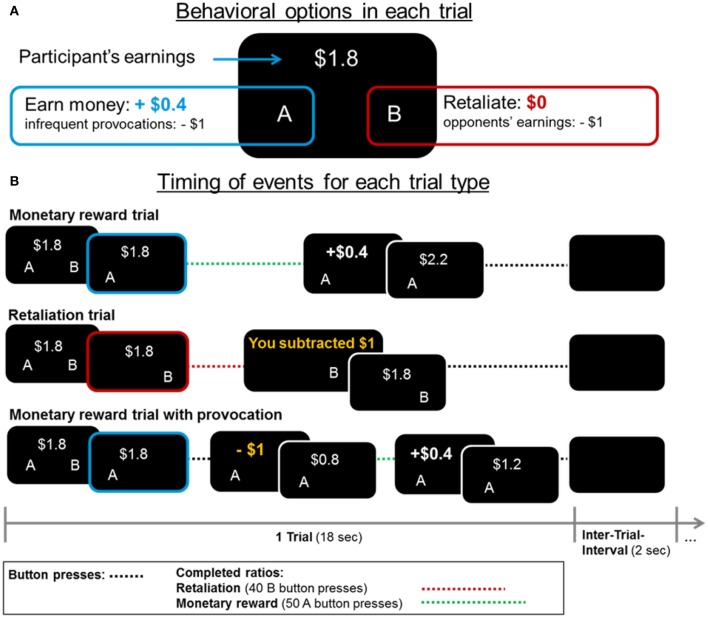
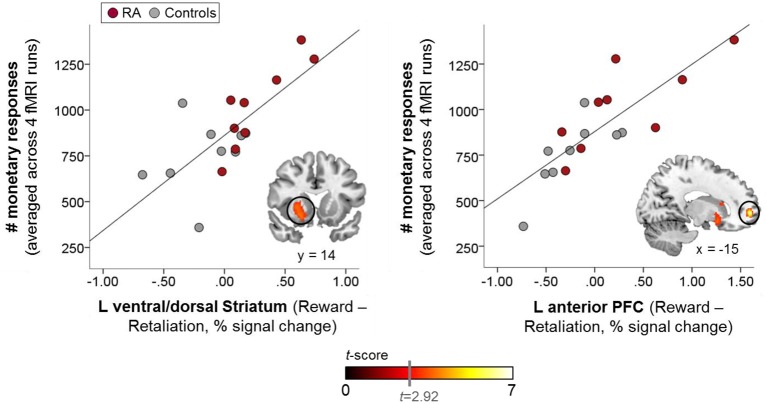
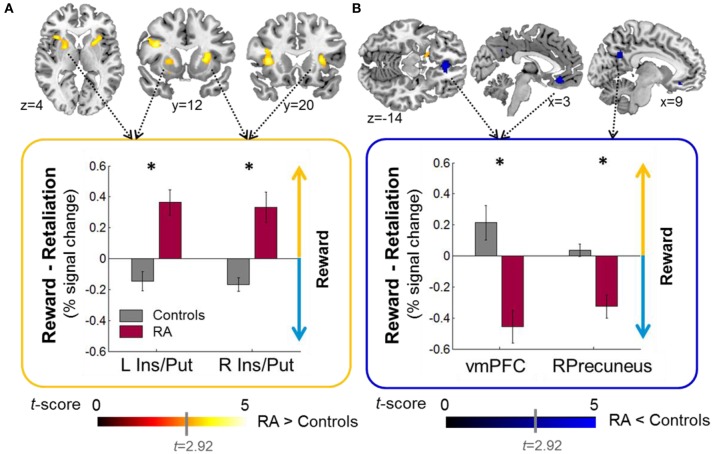
The propensity for reactive aggression (RA) which occurs in response to provocation has been linked to hyperresponsivity of the mesocorticolimbic reward network in healthy adults. Here, we aim to elucidate the role of the mesocorticolimbic network in clinically significant RA for two competing motivated behaviors, reward-seeking vs. retaliation. 18 male participants performed a variant of the Point-Subtraction Aggression Paradigm (PSAP) during functional magnetic resonance imaging (fMRI). We examined whether RA participants compared with non-aggressive controls would choose to obtain a monetary reward over the opportunity to retaliate against a fictitious opponent, who provoked the participant by randomly stealing money from his earnings. Across all fMRI-PSAP runs, RA individuals vs. controls chose to work harder to earn money but not to retaliate. When engaging in such reward-seeking behavior vs. retaliation in a single fMRI-PSAP run, RA individuals exhibited increased activation in the insular-striatal part of the mesocorticolimbic salience network, and decreased precuneus and ventromedial prefrontal cortex activation compared to controls. Enhanced overall reward-seeking behavior along with an up-regulation of the mesocorticolimbic salience network and a down-regulation of the default-mode network in RA individuals indicate that RA individuals are willing to work more for monetary reward than for retaliation when presented with a choice. Our findings may suggest that the use of positive reinforcement might represent an efficacious intervention approach for the potential reduction of retaliatory behavior in clinically significant RA.
因受到挑衅而产生的反应性攻击行为(RA)倾向,在健康成年人中与中脑皮质边缘奖赏网络的反应过度有关。在此,我们旨在阐明中脑皮质边缘网络在具有临床意义的RA中对于两种相互竞争的动机行为(寻求奖赏与报复)所起的作用。18名男性参与者在功能磁共振成像(fMRI)期间进行了点减法攻击范式(PSAP)的变体实验。我们研究了与非攻击性对照组相比,RA参与者是否会选择获取金钱奖励,而非选择有机会报复一个虚构对手,该对手通过随机从其收入中偷钱来挑衅参与者。在所有fMRI - PSAP实验过程中,RA个体与对照组相比,选择更努力工作赚钱而非报复。当在单次fMRI - PSAP实验中进行这种寻求奖赏行为与报复行为时,与对照组相比,RA个体在中脑皮质边缘显著性网络的岛叶 - 纹状体部分表现出激活增加,而楔前叶和腹内侧前额叶皮质激活减少。RA个体增强的整体寻求奖赏行为,以及中脑皮质边缘显著性网络的上调和默认模式网络的下调表明,当面临选择时,RA个体愿意为金钱奖励付出更多努力而非报复。我们的研究结果可能表明,使用正强化可能是一种有效的干预方法,用于潜在减少具有临床意义的RA中的报复行为。