de la Salle Sara, Choueiry Joelle, Shah Dhrasti, Bowers Hayley, McIntosh Judy, Ilivitsky Vadim, Knott Verner
School of Psychology, University of Ottawa Ottawa, ON, Canada.
Department of Cellular and Molecular Medicine, University of Ottawa Ottawa, ON, Canada.
Front Pharmacol. 2016 Sep 27;7:348. doi: 10.3389/fphar.2016.00348. eCollection 2016.
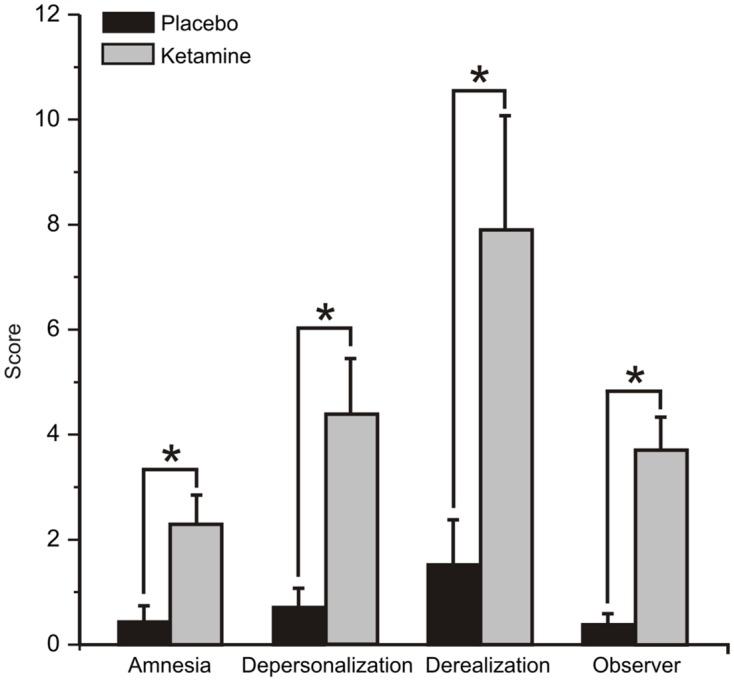
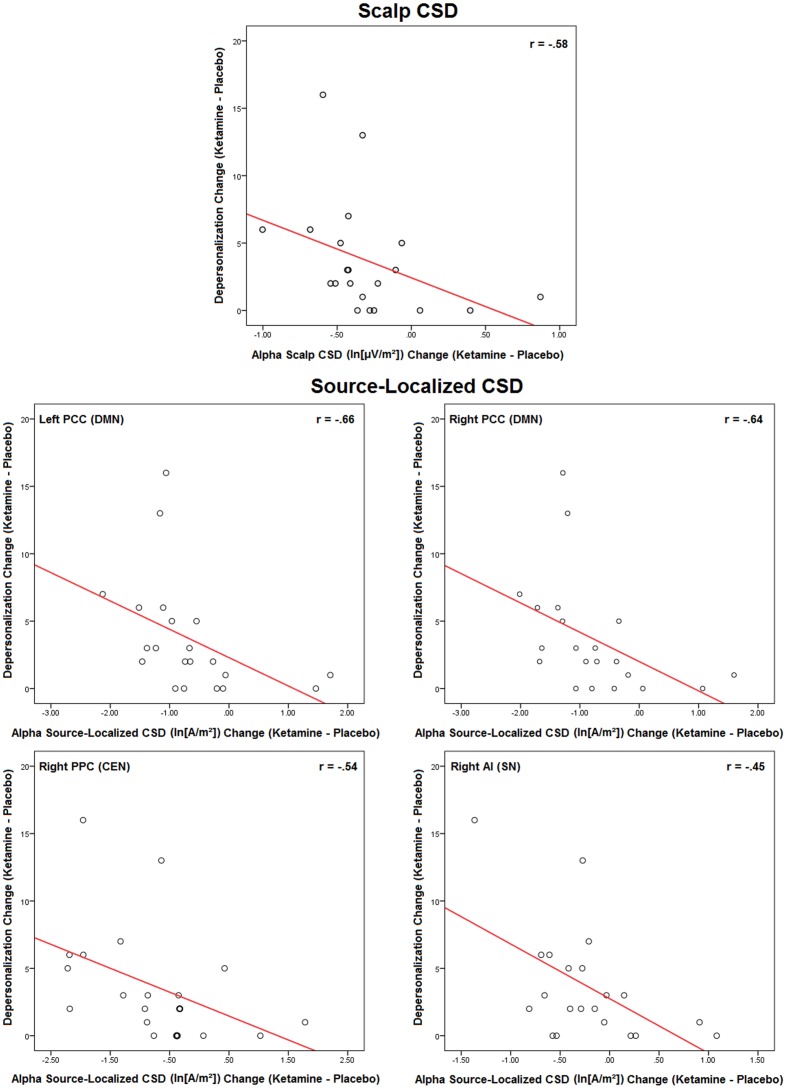
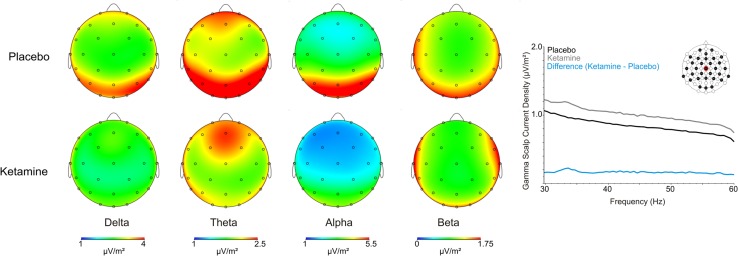
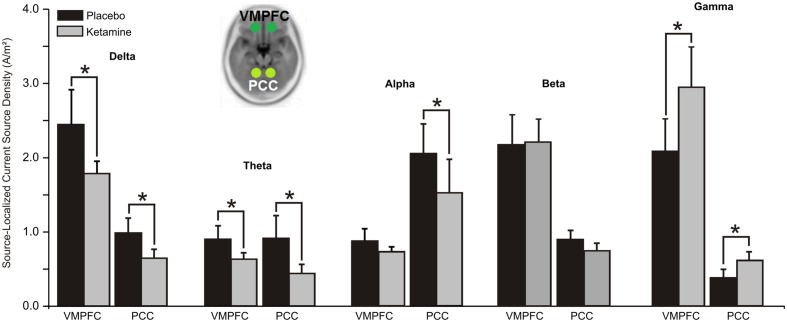
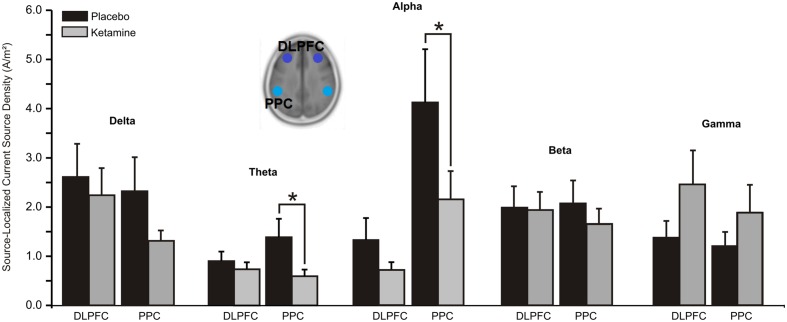
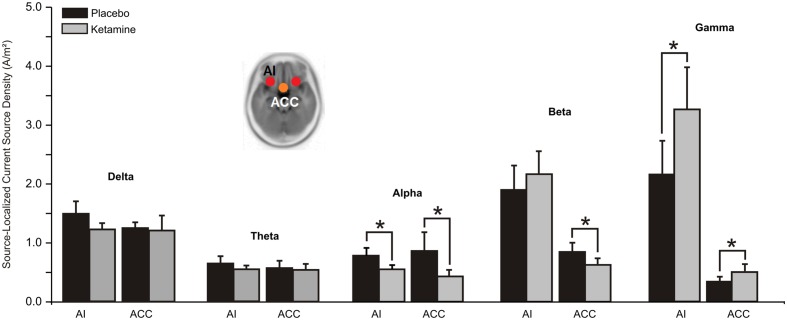
-methyl-D-aspartate (NMDA) receptor antagonists administered to healthy humans results in schizophrenia-like symptoms, which preclinical research suggests are due to glutamatergically altered brain oscillations. Here, we examined resting-state electroencephalographic activity in 21 healthy volunteers assessed in a placebo-controlled, double-blind, randomized study involving administration of either a saline infusion or a sub-anesthetic dose of ketamine, an NMDA receptor antagonist. Frequency-specific current source density (CSD) was assessed at sensor-level and source-level using eLORETA within regions of interest of a triple network model of schizophrenia (this model posits a dysfunctional switching between large-scale Default Mode and Central Executive networks by the monitor-controlling Salience Network). These CSDs were measured in each session along with subjective symptoms as indexed with the Clinician Administered Dissociative States Scale. Ketamine-induced CSD reductions in slow (delta/theta and alpha) and increases in fast (gamma) frequencies at scalp electrode sites were paralleled by frequency-specific CSD changes in the Default Mode, Central Executive, and Salience networks. Subjective symptoms scores were increased with ketamine and ratings of depersonalization in particular were associated with alpha CSD reductions in general and in specific regions of interest in each of the three networks. These results tentatively support the hypothesis that pathological brain oscillations associated with hypofunctional NMDA receptor activity may contribute to the emergence of the perceptual/dissociate symptoms of schizophrenia.
给予健康人的N-甲基-D-天冬氨酸(NMDA)受体拮抗剂会导致精神分裂症样症状,临床前研究表明这是由于谷氨酸能改变的脑振荡所致。在此,我们在一项安慰剂对照、双盲、随机研究中,对21名健康志愿者的静息态脑电图活动进行了检查,该研究涉及给予生理盐水输注或亚麻醉剂量的氯胺酮(一种NMDA受体拮抗剂)。使用eLORETA在精神分裂症三重网络模型的感兴趣区域内,在传感器水平和源水平评估频率特异性电流源密度(CSD)(该模型假定通过监测控制的显著性网络在大规模默认模式和中央执行网络之间存在功能失调的切换)。在每个疗程中测量这些CSD,并使用临床医生评定的分离状态量表对主观症状进行索引。氯胺酮引起头皮电极部位慢波(δ/θ和α)频率的CSD降低以及快波(γ)频率的增加,同时默认模式、中央执行和显著性网络中也出现了频率特异性的CSD变化。氯胺酮使主观症状评分增加,尤其是人格解体评分与三个网络中每个网络特定感兴趣区域以及总体上的α CSD降低相关。这些结果初步支持了这样的假设,即与NMDA受体活性低下相关的病理性脑振荡可能导致精神分裂症的感知/分离症状的出现。