Department of Experimental Oncology, European Institute of Oncology, Milan, Italy.
Department of Experimental Oncology, European Institute of Oncology, Milan, Italy.; Dipartimento di Scienze della Salute, Università degli Studi di Milano, Milan, Italy.
Sci Adv. 2016 Oct 7;2(10):e1600972. doi: 10.1126/sciadv.1600972. eCollection 2016 Oct.
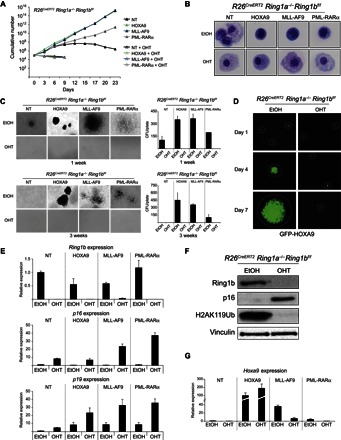
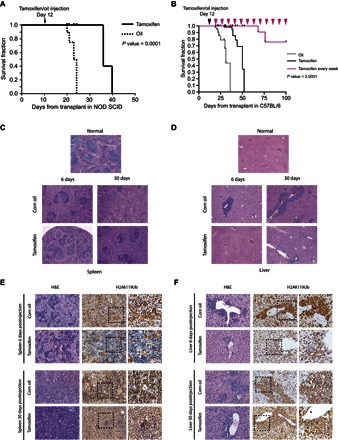
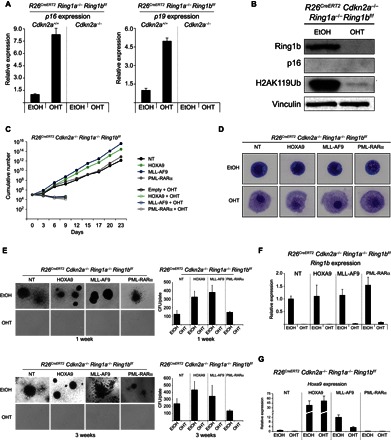
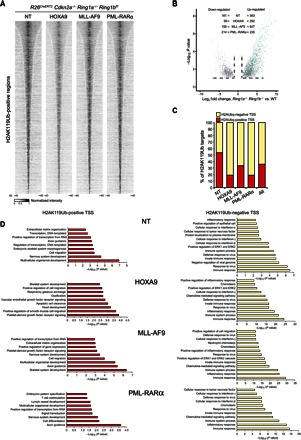
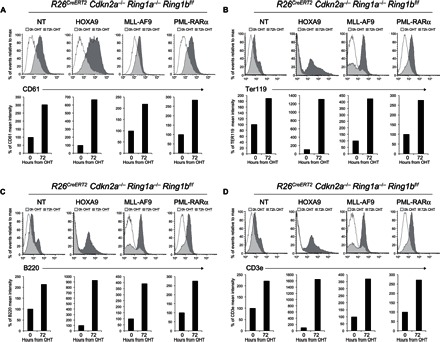
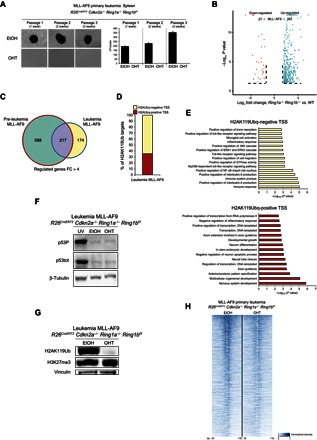
Leukemia is a complex heterogeneous disease often driven by the expression of oncogenic fusion proteins with different molecular and biochemical properties. Whereas several fusion proteins induce leukemogenesis by activating gene expression (Hox-activating fusions), others impinge on different pathways that do not involve the activation of genes (non-Hox-activating fusions). It has been postulated that one of the main oncogenic properties of the HOXA9 transcription factor is its ability to control the expression of the tumor suppressor locus (), thereby compensating Polycomb-mediated repression, which is dispensable for leukemias induced by Hox-activating fusions. We show, by genetically depleting the H2A ubiquitin ligase subunits of the Polycomb repressive complex 1 (PRC1), Ring1a and Ring1b, that activation cannot repress expression in the absence of PRC1 and its dependent deposition of H2AK119 monoubiquitination (H2AK119Ub). This demonstrates the essential role of PRC1 activity in supporting the oncogenic potential of Hox-activating fusion proteins. By combining genetic tools with genome-wide location and transcription analyses, we further show that PRC1 activity is required for the leukemogenic potential of both Hox-activating and non-Hox-activating fusions, thus preventing the differentiation of leukemic cells independently of the expression of the locus. Overall, our results genetically demonstrate that PRC1 activity and the deposition of H2AK119Ub are critical factors that maintain the undifferentiated identity of cancer cells, positively sustaining the progression of different types of leukemia.
白血病是一种复杂的异质性疾病,通常由具有不同分子和生化特性的致癌融合蛋白的表达驱动。虽然有几种融合蛋白通过激活基因表达(Hox 激活融合)诱导白血病发生,但其他融合蛋白则影响不涉及基因激活的不同途径(非 Hox 激活融合)。据推测,HOXA9 转录因子的主要致癌特性之一是其控制基因表达的能力,从而补偿多梳抑制复合物 1(PRC1)介导的抑制,该抑制对于 Hox 激活融合诱导的白血病是可有可无的。我们通过遗传耗尽 Polycomb 抑制复合物 1(PRC1)的 H2A 泛素连接酶亚基 Ring1a 和 Ring1b,表明在没有 PRC1 及其依赖的 H2AK119 单泛素化(H2AK119Ub)沉积的情况下,激活不能抑制的表达。这证明了 PRC1 活性在支持 Hox 激活融合蛋白的致癌潜力方面的重要作用。通过结合遗传工具、全基因组定位和转录分析,我们进一步表明 PRC1 活性对于 Hox 激活和非 Hox 激活融合的白血病发生潜能都是必需的,从而独立于基因表达来防止白血病细胞的分化。总体而言,我们的研究结果从遗传学上证明了 PRC1 活性和 H2AK119Ub 的沉积是维持癌细胞未分化状态的关键因素,积极促进不同类型白血病的进展。