a MIND Institute , University of California , Davis Health System.
b Department of Public Health Sciences , University of California , Davis Health System.
J Clin Child Adolesc Psychol. 2018 Sep-Oct;47(5):737-744. doi: 10.1080/15374416.2016.1220314. Epub 2016 Oct 12.
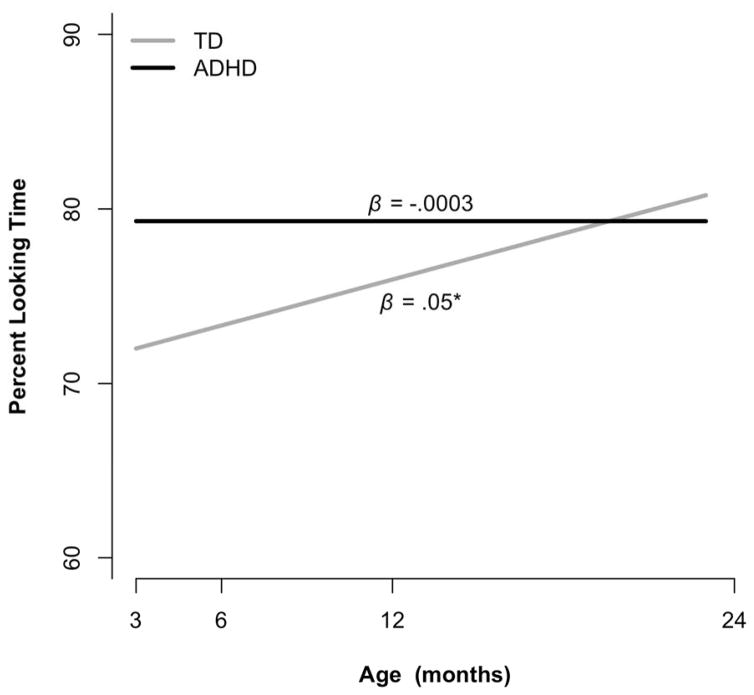
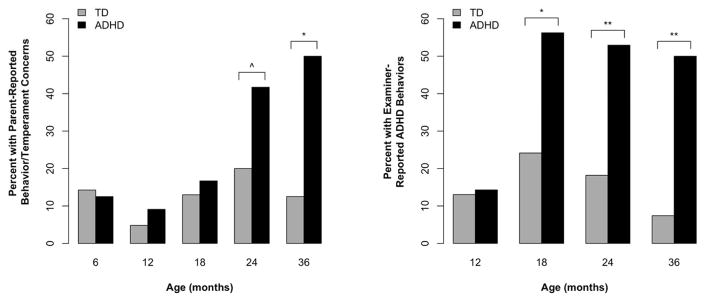
Converging evidence suggests shared genetic underpinnings of attention deficit/hyperactivity disorder (ADHD) and autism spectrum disorder (ASD). Studies of infants at risk for ASD have proliferated over the past decade; the few studies that have followed these infants beyond age 3 report a range of difficulties facing a subset of these infants as they reach school age, including elevated levels of attention problems and externalizing behavior. Given this, we aimed to identify early predictors of school-age ADHD outcomes in a sample of infant siblings at risk for ASD. This study reports on a sample of 59 infants at high and low risk for ASD who had been followed for more than a decade, collecting data at regular intervals from 3 to 36 months and then determining diagnostic outcome at 8-10 years of age. Seventeen participants were diagnosed with Diagnostic and Statistical Manual of Mental Disorders (5th ed.) ADHD at school age (n = 14 high risk, 3 low risk). As infants, the ADHD outcome group demonstrated atypical longitudinal patterns of sustained visual attention. A significantly larger proportion of their parents reported behavior/temperament problems at 36 months of age, and examiners noted the presence of inattentive, hyperactive, and/or impulsive behaviors in this group by 18 months of age. These data suggest that behavioral indicators of risk for later ADHD may be present early in development, which may improve earlier detection and treatment of the disorder.
越来越多的证据表明,注意缺陷多动障碍(ADHD)和自闭症谱系障碍(ASD)具有共同的遗传基础。过去十年中,针对 ASD 高危婴儿的研究大量涌现;少数对这些婴儿进行后续研究的研究报告称,随着他们进入学龄期,一部分婴儿会面临一系列困难,包括注意力问题和外化行为水平升高。鉴于此,我们旨在确定自闭症高危婴儿样本中与学龄期 ADHD 结果相关的早期预测因素。本研究报告了一个由 59 名患有 ASD 高风险和低风险的婴儿组成的样本,该样本已被跟踪超过十年,从 3 个月到 36 个月定期收集数据,然后在 8-10 岁时确定诊断结果。17 名参与者在学龄期被诊断为《精神障碍诊断与统计手册》(第 5 版)ADHD(高风险组 14 名,低风险组 3 名)。作为婴儿,ADHD 结局组表现出持续视觉注意力的异常纵向模式。其父母在 36 个月时报告行为/气质问题的比例显著较高,检查者在 18 个月时注意到该组存在注意力不集中、多动和/或冲动行为。这些数据表明,日后 ADHD 的风险行为指标可能在发育早期就存在,这可能有助于更早地发现和治疗该疾病。