Trimarchi H, Canzonieri R, Schiel A, Costales-Collaguazo C, Politei J, Stern A, Paulero M, Rengel T, Andrews J, Forrester M, Lombi M, Pomeranz V, Iriarte R, Muryan A, Zotta E, Sanchez-Niño M D, Ortiz A
Nephrology Service, Hospital Británico de Buenos Aires, Perdriel 74, 1280, Buenos Aires, Argentina.
Central Laboratory, Hospital Británico de Buenos Aires, Buenos Aires, Argentina.
J Transl Med. 2016 Oct 13;14(1):289. doi: 10.1186/s12967-016-1049-8.
Certain glomerulopathies are associated with increased levels of CD80 (B7-1). We measured the urinary excretion of CD80, podocyturia and proteinuria in controls and in subjects with Fabry disease either untreated or on enzyme replacement therapy (ERT).
Cross-sectional study including 65 individuals: controls (n = 20) and Fabry patients (n = 45, 23 of them not on ERT and 22 on ERT). Variables included age, gender, urinary protein/creatinine ratio (UPCR), estimated glomerular filtration rate (eGFR), urinary uCD80/creatinine ratio (uCD80) and podocyturia. CD80 mRNA expression in response to lyso-Gb3, a bioactive glycolipid accumulated in Fabry disease, was studied in cultured human podocytes.
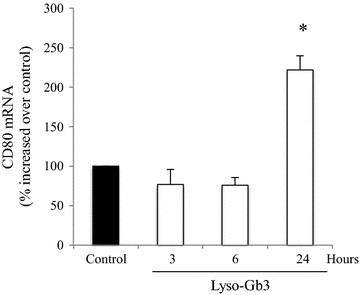
Controls and Fabry patients did not differ in age, eGFR and gender. However, UPCR, uCD80 and podocyturia were significantly higher in Fabry patients than in controls. As expected, Fabry patients not on ERT were younger and a higher percentage were females. Non-ERT Fabry patients had less advanced kidney disease than ERT Fabry patients: UPCR was lower and eGFR higher, but uCD80 and podocyturia did not differ between non-ERT or ERT Fabry patients. There was a significant correlation between uCD80 and UPCR in the whole population (r 0.44, p 0.0005) and in Fabry patients (r 0.42, p 0.0046). Lyso-Gb3 at concentrations found in the circulation of Fabry patients increased uCD80 expression in cultured podocytes.
Fabry disease is characterized by early occurrence of increased uCD80 excretion that appears to be a consequence of glycolipid accumulation. The potential for uCD80 excretion to reflect early, subclinical renal Fabry involvement should be further studied.
某些肾小球病与CD80(B7-1)水平升高有关。我们测量了对照组以及未经治疗或接受酶替代疗法(ERT)的法布里病患者的尿CD80排泄量、足细胞尿和蛋白尿。
横断面研究纳入65名个体:对照组(n = 20)和法布里病患者(n = 45,其中23名未接受ERT,22名接受ERT)。变量包括年龄、性别、尿蛋白/肌酐比值(UPCR)、估计肾小球滤过率(eGFR)、尿uCD80/肌酐比值(uCD80)和足细胞尿。在培养的人足细胞中研究了溶血性Gb3(一种在法布里病中积累的生物活性糖脂)刺激下的CD80 mRNA表达。
对照组和法布里病患者在年龄、eGFR和性别方面无差异。然而,法布里病患者的UPCR、uCD80和足细胞尿显著高于对照组。正如预期的那样,未接受ERT的法布里病患者更年轻,女性比例更高。未接受ERT的法布里病患者的肾脏疾病程度比接受ERT的患者轻:UPCR较低,eGFR较高,但未接受ERT或接受ERT的法布里病患者的uCD80和足细胞尿无差异。在整个人群中(r = 0.44,p = 0.0005)以及法布里病患者中(r = 0.42,p = 0.0046),uCD80与UPCR之间存在显著相关性。法布里病患者循环中发现的浓度的溶血性Gb3增加了培养足细胞中uCD80的表达。
法布里病的特征是早期出现尿uCD80排泄增加,这似乎是糖脂积累的结果。尿uCD80排泄反映法布里病早期亚临床肾脏受累的可能性应进一步研究。