Vujkovac Bojan, Srebotnik Kirbiš Irena, Keber Tajda, Cokan Vujkovac Andreja, Tretjak Martin, Radoš Krnel Sandra
Department of Internal Medicine, General Hospital Slovenj Gradec, Slovenj Gradec, Slovenia.
Faculty of Medicine, Institute of Pathology, University of Ljubljana, Ljubljana, Slovenia.
Clin Kidney J. 2021 Sep 16;15(2):269-277. doi: 10.1093/ckj/sfab172. eCollection 2022 Feb.
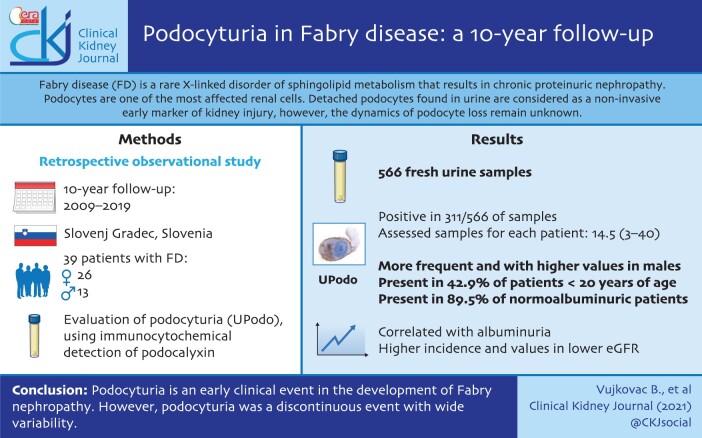
Fabry disease (FD) is a rare X-linked disorder of sphingolipid metabolism that results in chronic proteinuric nephropathy. Podocytes are one of the most affected renal cells and play an important role in the development and progression of kidney disease. Detached podocytes found in urine (podocyturia) are considered as a non-invasive early marker of kidney injury; however, the dynamics of podocyte loss remains unknown.
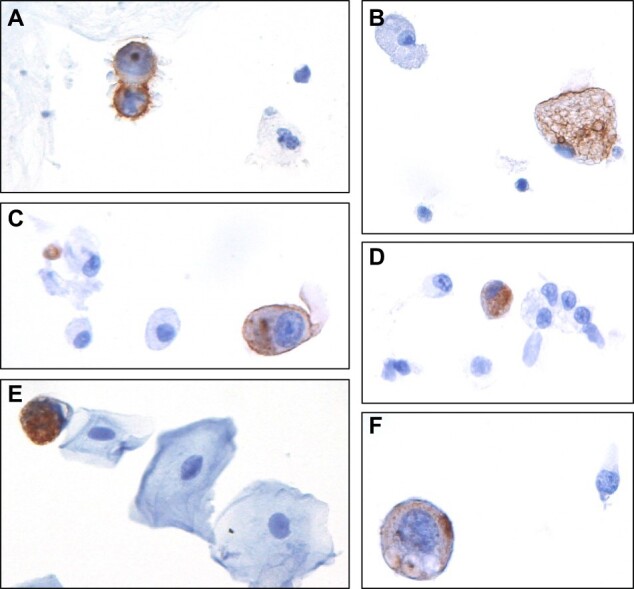
In this 10-year follow-up study, podocyturia and other renal clinical data were evaluated in 39 patients with FD. From 2009 to 2019, podocyturia was assessed in 566 fresh urine samples from 13 male and 26 female FD patients using immunocytochemical detection of podocalyxin.
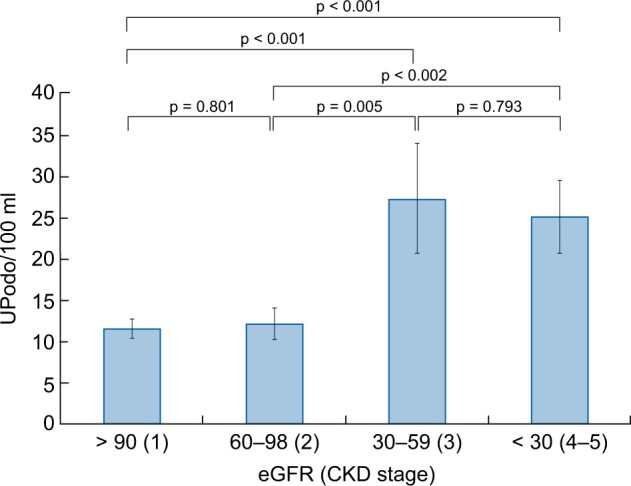
Podocyturia (number of podocytes per 100 mL of urine) was found in 311/566 (54.9%) of the samples, more frequently (68.9 ± 21.9% versus 50.6 ± 25.9%; P = 0.035) and with higher values (364 ± 286 versus 182 ± 180 number of podocytes per gram of creatinine (Cr) in urine; P = 0.020) in males compared with females. The mean number of assessed samples for each patient was 14.5 (range 3-40) and the frequency of samples with podocyturia ranged from 0% to 100% (median 57%). Podocyturia was already present in 42.9% of patients <20 years of age and in 89.5% of normoalbuminuric patients. Podocyturia correlated with albuminuria (urine albumin:Cr ratio) ( = 0.20, P < 0.001) and a higher incidence and values of podocyturia were observed in patients with lower estimated glomerular filtration rate.
Our data demonstrated that podocyturia is an early clinical event in the development of nephropathy. In addition, we found podocyturia to be a discontinuous event with wide variability.
法布里病(FD)是一种罕见的X连锁鞘脂代谢紊乱疾病,可导致慢性蛋白尿性肾病。足细胞是受影响最严重的肾细胞之一,在肾脏疾病的发生和发展中起重要作用。尿液中发现的脱落足细胞(足细胞尿)被认为是肾脏损伤的一种非侵入性早期标志物;然而,足细胞丢失的动态变化仍不清楚。
在这项为期10年的随访研究中,对39例FD患者的足细胞尿和其他肾脏临床数据进行了评估。2009年至2019年期间,使用免疫细胞化学法检测足细胞标记蛋白,对13例男性和26例女性FD患者的566份新鲜尿液样本进行了足细胞尿评估。
在311/566(54.9%)的样本中发现了足细胞尿(每100 mL尿液中的足细胞数量),男性比女性更频繁(68.9±21.9%对50.6±25.9%;P = 0.035)且数值更高(每克尿肌酐(Cr)中足细胞数量为364±286对182±180;P = 0.020)。每位患者评估样本的平均数量为14.5(范围3 - 40),有足细胞尿的样本频率范围为0%至100%(中位数57%)。42.9%的<20岁患者和89.5%的正常白蛋白尿患者已出现足细胞尿。足细胞尿与蛋白尿(尿白蛋白:Cr比值)相关( = 0.20,P < 0.001),并且在估计肾小球滤过率较低的患者中观察到足细胞尿的发生率和数值更高。
我们的数据表明,足细胞尿是肾病发展过程中的一个早期临床事件。此外,我们发现足细胞尿是一个具有广泛变异性的不连续事件。