Arnbak Bodil, Jensen Rikke Krüger, Manniche Claus, Hendricks Oliver, Kent Peter, Jurik Anne Grethe, Jensen Tue Secher
Research Department, Spine Centre of Southern Denmark, Hospital Lillebaelt, Oestre Hougvej 55, Middelfart, 5500, Denmark.
Institute of Regional Health Research, University of Southern Denmark, Winsloewparken 19-3, Odense C, 5000, Denmark.
Arthritis Res Ther. 2016 Oct 13;18(1):237. doi: 10.1186/s13075-016-1131-x.
The aim of this study was to investigate subgroups of magnetic resonance imaging (MRI) findings for the spine and sacroiliac joints (SIJs) using latent class analysis (LCA), and to investigate whether these subgroups differ in their demographic and clinical characteristics.
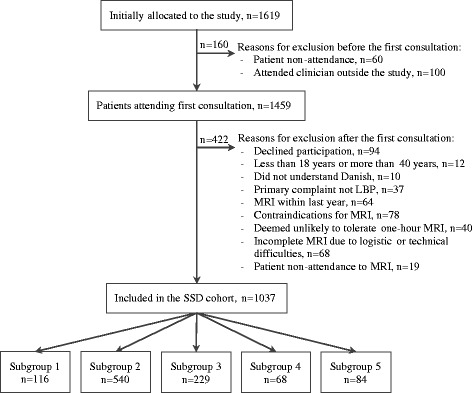
The sample included 1037 patients aged 18-40 years with persistent low back pain (LBP). LCA was applied to MRI findings of the spine and SIJs. The resulting subgroups were tested for differences in self-reported demographic and clinical characteristics.
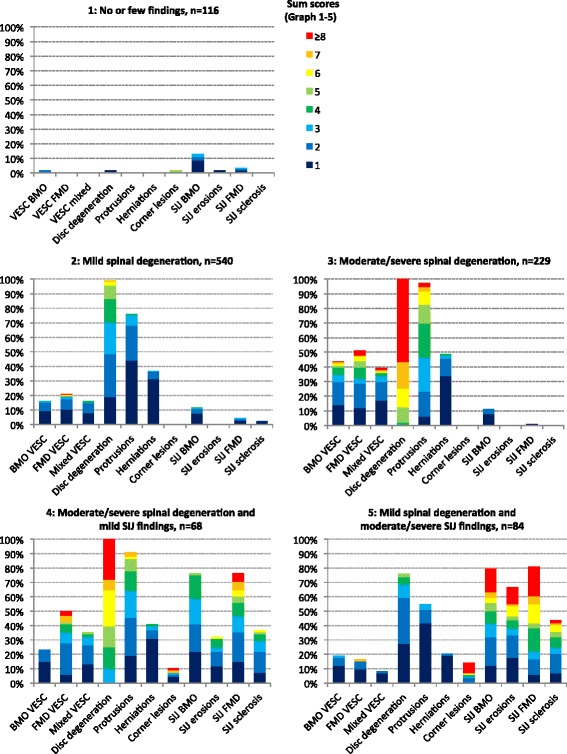
A five-class model was identified: Subgroup 1, 'No or few findings' (n = 116); Subgroup 2, 'Mild spinal degeneration' (n = 540); Subgroup 3, 'Moderate to severe spinal degeneration' (n = 229); Subgroup 4, 'Moderate to severe spinal degeneration with mild SIJ findings' (n = 68); and Subgroup 5, 'Mild spinal degeneration with moderate to severe SIJ findings' (n = 84). The two SIJ subgroups (Subgroups 4 and 5) had a higher median activity limitation score (Roland Morris Disability Questionnaire calculated as a proportional score: 65 (IQR 48-78)/65 (48-78)) compared with Subgroups 1-3 (48 (35-74)/57 (39-74)/57 (39-74)), a higher prevalence of women (68 % (95 % CI 56-79)/68 % (58-78)) compared with Subgroups 2 and 3 (51 % (47-55)/40 % (33-46)), a higher prevalence of being overweight (67 % (95 % CI 55-79)/53 % (41-65)) compared with Subgroup 1 (36 % (26-46)) and a higher prevalence of previous LBP episodes (yes/no: 81 % (95 % CI 71-91)/79 % (70-89)) compared with Subgroup 1 (58 % (48-67)). Subgroup 5 was younger than Subgroup 4 (median age 29 years (IQR 25-33) versus 34 years (30-37)) and had a higher prevalence of HLA-B27 (40 % (95 % CI 29-50)) compared with the other subgroups (Subgroups 1-4: 12 % (6-18)/7 % (5-10)/6 % (3-9)/12 % (4-20)). Across the subgroups with predominantly spinal findings (Subgroups 1-3), median age, prevalence of men, being overweight and previous LBP episodes were statistically significantly lower in Subgroup 1, higher in Subgroup 2 and highest in Subgroup 3.
Five distinct subgroups of MRI findings in the spine and SIJs were identified. The results indicate that SIJ MRI findings not only can be seen as a part of the spondyloarthritis disease entity, but also are associated with age, gender and being overweight. Furthermore, the results indicate that LBP patients with SIJ MRI findings are more disabled compared with patients without SIJ MRI findings, and that moderate to severe spinal degeneration and/or SIJ MRI findings may be associated with recurrent pain.
本研究旨在利用潜在类别分析(LCA)探究脊柱和骶髂关节(SIJ)磁共振成像(MRI)结果的亚组,并研究这些亚组在人口统计学和临床特征方面是否存在差异。
样本包括1037名年龄在18至40岁之间的持续性下腰痛(LBP)患者。将LCA应用于脊柱和SIJ的MRI结果。对所得亚组的自我报告人口统计学和临床特征差异进行测试。
确定了一个五类模型:亚组1,“无或少量发现”(n = 116);亚组2,“轻度脊柱退变”(n = 540);亚组3,“中度至重度脊柱退变”(n = 229);亚组4,“中度至重度脊柱退变伴轻度SIJ发现”(n = 68);亚组5,“轻度脊柱退变伴中度至重度SIJ发现”(n = 84)。与亚组1至3(48(35 - 74)/57(39 - 74)/57(39 - 74))相比,两个SIJ亚组(亚组4和5)的中位活动受限评分更高(罗兰·莫里斯残疾问卷以比例评分计算:65(四分位间距48 - 78)/65(48 - 78)),女性患病率更高(68%(95%置信区间56 - 79)/68%(58 - 78)),相比之下亚组2和3为51%(47 - 55)/40%(33 - 46)),超重患病率更高(67%(95%置信区间55 - 79)/53%(41 - 65)),相比之下亚组1为36%(26 - 46)),既往LBP发作患病率更高(是/否:81%(95%置信区间71 - 91)/79%(70 - 89)),相比之下亚组1为58%(48 - 67))。亚组5比亚组4年轻(中位年龄29岁(四分位间距25 - 33)对34岁(30 - 37)),与其他亚组(亚组1至4:12%(6 - 18)/7%(5 - 10)/6%(3 - 9)/12%(4 - 20))相比,HLA - B27患病率更高(40%(95%置信区间29 - 50))。在主要为脊柱发现的亚组(亚组1至3)中,亚组1的中位年龄、男性患病率、超重和既往LBP发作在统计学上显著更低,亚组2更高,亚组3最高。
确定了脊柱和SIJ的MRI结果的五个不同亚组。结果表明,SIJ的MRI发现不仅可被视为脊柱关节炎疾病实体的一部分,还与年龄、性别和超重有关。此外,结果表明与无SIJ的MRI发现的患者相比,有SIJ的MRI发现的LBP患者残疾程度更高,并且中度至重度脊柱退变和/或SIJ的MRI发现可能与复发性疼痛有关。