Wright Harry W, Bartley Kathryn, Huntley John F, Nisbet Alasdair J
Moredun Research Institute, Pentlands Science Park, Bush Loan, Edinburgh, Midlothian, EH26 0PZ, Scotland, UK.
Parasit Vectors. 2016 Oct 12;9(1):544. doi: 10.1186/s13071-016-1831-8.
Dermanyssus gallinae is the most economically important haematophagous ectoparasite in commercial egg laying flocks worldwide. It infests the hens during the night where it causes irritation leading to restlessness, pecking and in extreme cases anaemia and increased cannibalism. Due to an increase in the occurrence of acaricide-resistant D. gallinae populations, new control strategies are required and vaccination may offer a sustainable alternative to acaricides. In this study, recombinant forms of D. gallinae tropomyosin (Der g 10) and paramyosin (Der g 11) were produced, characterised and tested as vaccine candidate molecules.
The D. gallinae paramyosin (Der g 11) coding sequence was characterised and recombinant versions of Der g 11 and D. gallinae tropomyosin (Der g 10) were produced. Hens were immunised with the recombinant proteins and the resulting antibodies were fed to D. gallinae and mite mortality evaluated. Sections of mites were probed with anti- Der g 11 and Der g 10 antibodies to identify the tissue distribution of these protein in D. gallinae.
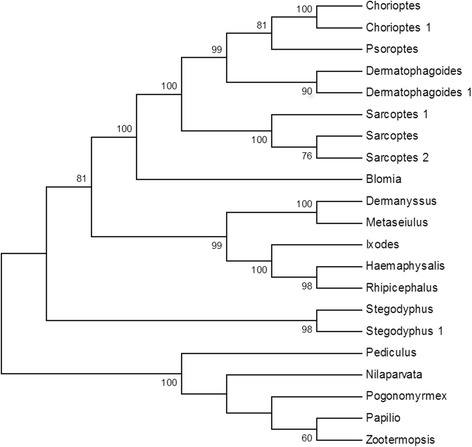
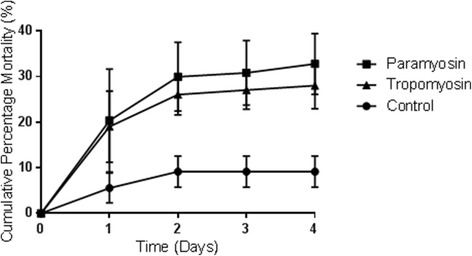
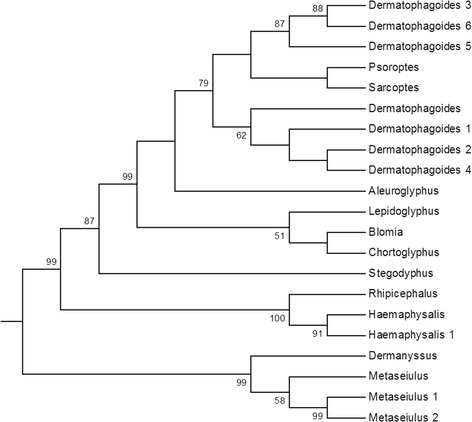
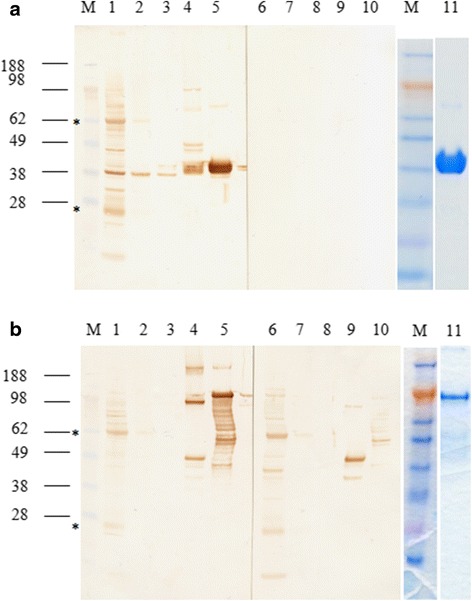
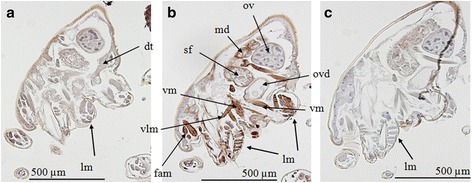
The entire coding sequence of Der g 11 was 2,622 bp encoding 874 amino acid residues. Immunohistochemical staining of mite sections revealed that Der g 10 and Der g 11 were located throughout D. gallinae tissues. In phylogenetic analyses of these proteins both clustered with orthologues from tick species rather than with orthologues from astigmatid mites. Antibodies raised in hens against recombinant forms of these proteins significantly increased D. gallinae mortality, by 19 % for Der g 10 (P < 0.001) and by 23 % for Der g 11 (P = 0.009) when fed to the mites using an in vitro feeding device.
This study has shown that Der g 10 and Der g 11 were located ubiquitously throughout D. gallinae and that antibodies raised against recombinant versions of these proteins can be used to significantly increase D. gallinae mortality in an in vitro feeding assay. When comparing archived data for all recombinant and native proteins assessed as vaccines using this in vitro feeding assay, Der g 10 and Der g 11 ranked highly and performed better than some of the pools of native proteins.
鸡皮刺螨是全球商业蛋鸡群中经济影响最为重大的吸血性体外寄生虫。它在夜间侵袭母鸡,引发刺激,导致母鸡烦躁不安、相互啄羽,在极端情况下会造成贫血和同类相食现象增加。由于对杀螨剂产生抗性的鸡皮刺螨种群不断增多,需要新的控制策略,而疫苗接种可能为杀螨剂提供一种可持续的替代方法。在本研究中,制备了鸡皮刺螨原肌球蛋白(Der g 10)和副肌球蛋白(Der g 11)的重组形式,对其进行了表征,并作为候选疫苗分子进行了测试。
对鸡皮刺螨副肌球蛋白(Der g 11)的编码序列进行了表征,并制备了Der g 11和鸡皮刺螨原肌球蛋白(Der g 10)的重组版本。用重组蛋白对母鸡进行免疫,然后将产生的抗体喂给鸡皮刺螨,并评估螨的死亡率。用抗Der g 11和Der g 10抗体对螨的切片进行检测,以确定这些蛋白在鸡皮刺螨中的组织分布。
Der g 11的完整编码序列为2622 bp,编码874个氨基酸残基。螨切片的免疫组织化学染色显示,Der g 10和Der g 11遍布鸡皮刺螨组织。在对这些蛋白的系统发育分析中,二者均与蜱类物种的直系同源物聚类,而非与粉螨类螨的直系同源物聚类。母鸡针对这些蛋白的重组形式产生的抗体显著提高了鸡皮刺螨的死亡率,使用体外饲养装置将抗体喂给螨时,Der g 10使死亡率提高了19%(P < 0.001),Der g 11使死亡率提高了23%(P = 0.009)。
本研究表明,Der g 10和Der g 11在鸡皮刺螨中普遍存在,针对这些蛋白重组形式产生的抗体可用于在体外饲养试验中显著提高鸡皮刺螨的死亡率。在使用这种体外饲养试验评估的所有作为疫苗的重组蛋白和天然蛋白的存档数据进行比较时,Der g 10和Der g 11排名靠前,表现优于一些天然蛋白组合。