Lin Zi-Ying, Liang Zhen-Xing, Zhuang Pei-Lin, Chen Jie-Wei, Cao Yun, Yan Li-Xu, Yun Jing-Ping, Xie Dan, Cai Mu-Yan
Sun Yat-sen University Cancer Center, State Key Laboratory of Oncology in South China; Collaborative Innovation Center for Cancer Medicine, Guangzhou, China.
Department of Pathology, Sun Yat-sen University Cancer Center, No. 651, Dongfeng Road East, 510060, Guangzhou, China.
BMC Cancer. 2016 Oct 12;16(1):792. doi: 10.1186/s12885-016-2827-7.
Serum C-reactive protein (CRP), an acute inflammatory response biomarker, has been recognized as an indicator of malignant disease progression. However, the prognostic significance of CRP levels collected before tumor removal in intrahepatic cholangiocarcinoma requires further investigation.
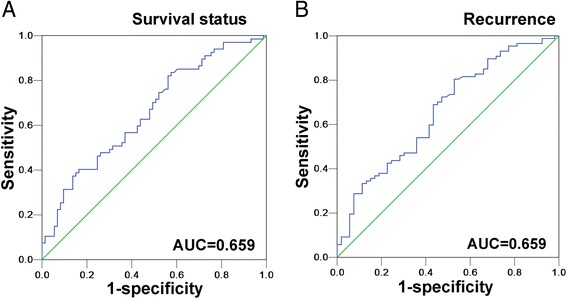
We sampled the CRP levels in 140 patients with intrahepatic cholangiocarcinoma who underwent hepatectomies with regional lymphadenectomies between 2006 and 2013. A retrospective analysis of the clinicopathological data was performed. We focused on the impact of serum CRP on the patients' cancer-specific survival and recurrence-free survival rates.
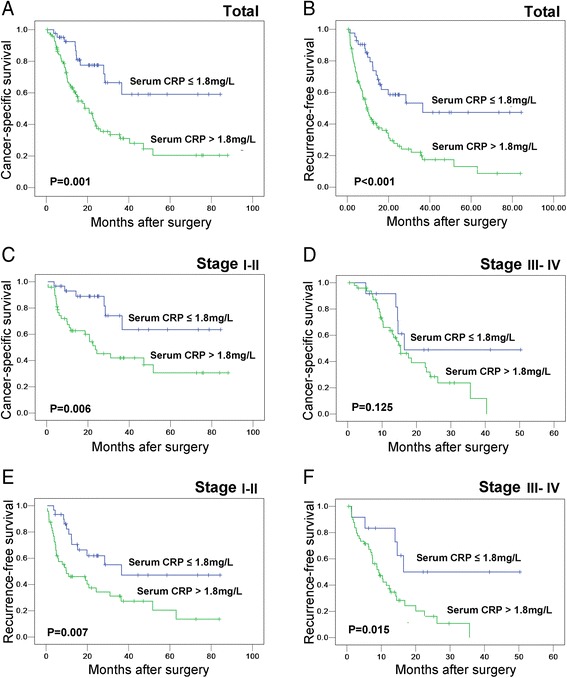
High levels of preoperative serum CRP were significantly associated with well-established clinicopathologic features, including gender, advanced tumor stage, and elevated carcinoembryonic antigen and carbohydrate antigen 19-9 levels (P < 0.05). Univariate analysis demonstrated a significant association between high levels of serum CRP and adverse cancer-specific survival (P = 0.001) and recurrence-free survival (P < 0.001). In patients with stage I/II intrahepatic cholangiocarcinoma, the serum CRP level was a prognostic indicator for cancer-specific survival. In patients with stage I/II or stage III/IV, the serum CRP level was a prognostic indicator for recurrence-free survival (P < 0.05). Additionally, multivariate analysis identified serum CRP level in intrahepatic cholangiocarcinoma as an independent prognostic factor (P < 0.05).
We confirmed a significant association of elevated pre-operative CRP levels with poor clinical outcomes for the tested patients with intrahepatic cholangiocarcinoma. Our results indicate that the serum CRP level may represent a useful factor for patient stratification in intrahepatic cholangiocarcinoma management.
血清C反应蛋白(CRP)是一种急性炎症反应生物标志物,已被公认为恶性疾病进展的指标。然而,肝内胆管癌肿瘤切除术前采集的CRP水平的预后意义需要进一步研究。
我们对2006年至2013年间接受肝切除及区域淋巴结清扫术的140例肝内胆管癌患者的CRP水平进行了采样。对临床病理数据进行了回顾性分析。我们重点关注血清CRP对患者癌症特异性生存率和无复发生存率的影响。
术前血清CRP水平高与既定的临床病理特征显著相关,包括性别、肿瘤晚期、癌胚抗原和糖类抗原19-9水平升高(P < 0.05)。单因素分析显示血清CRP水平高与不良癌症特异性生存(P = 0.001)和无复发生存(P < 0.001)显著相关。在I/II期肝内胆管癌患者中,血清CRP水平是癌症特异性生存的预后指标。在I/II期或III/IV期患者中,血清CRP水平是无复发生存的预后指标(P < 0.05)。此外,多因素分析确定肝内胆管癌患者的血清CRP水平是独立的预后因素(P < 0.05)。
我们证实,对于接受测试的肝内胆管癌患者,术前CRP水平升高与不良临床结局显著相关。我们的结果表明,血清CRP水平可能是肝内胆管癌管理中患者分层的有用因素。