Yim Nambin, Choi Chulhee
Department of Bio and Brain Engineering, KAIST, Daejeon 34141, Korea.
Department of Bio and Brain Engineering, KAIST; Cellex Life Sciences Inc.; Cancer Metastasis Control Center, KAIST Institute for the Biocentury, KAIST, Daejeon 34141, Korea.
BMB Rep. 2016 Nov;49(11):585-586. doi: 10.5483/bmbrep.2016.49.11.174.
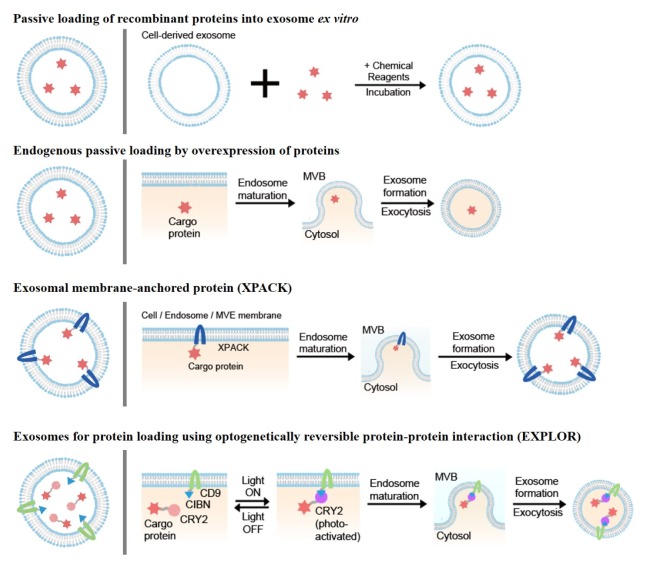
Extracellular vesicles (EVs) are natural carriers of biomolecules that play central roles in cell-to-cell communications. Based on this, there have been various attempts to use EVs as therapeutic drug carriers. From chemical reagents to nucleic acids, various macromolecules were successfully loaded into EVs; however, loading of proteins with high molecular weight has been huddled with several problems. Purification of recombinant proteins is expensive and time consuming, and easily results in modification of proteins due to physical or chemical forces. Also, the loading efficiency of conventional methods is too low for most proteins. We have recently proposed a new method, the so-called exosomes for protein loading via optically reversible protein-protein interaction (EXPLORs), to overcome the limitations. Since EXPLORs are produced by actively loading of intracellular proteins into EVs using blue light without protein purification steps, we demonstrated that the EXPLOR technique significantly improves the loading and delivery efficiency of therapeutic proteins. In further in vitro and in vivo experiments, we demonstrate the potential of EXPLOR technology as a novel platform for biopharmaceuticals, by successful delivery of several functional proteins such as Cre recombinase, into the target cells. [BMB Reports 2016; 49(11): 585-586].
细胞外囊泡(EVs)是生物分子的天然载体,在细胞间通讯中发挥着核心作用。基于此,人们进行了各种尝试,将EVs用作治疗药物载体。从化学试剂到核酸,各种大分子都成功地装载到了EVs中;然而,高分子量蛋白质的装载却面临着几个问题。重组蛋白的纯化既昂贵又耗时,而且由于物理或化学作用力,很容易导致蛋白质发生修饰。此外,传统方法的装载效率对大多数蛋白质来说都太低。最近,我们提出了一种新方法,即通过光可逆蛋白质-蛋白质相互作用进行蛋白质装载的外泌体(EXPLORs),以克服这些局限性。由于EXPLORs是通过蓝光将细胞内蛋白质主动装载到EVs中产生的,无需蛋白质纯化步骤,我们证明EXPLOR技术显著提高了治疗性蛋白质的装载和递送效率。在进一步的体外和体内实验中,我们通过成功地将几种功能蛋白(如Cre重组酶)递送至靶细胞,证明了EXPLOR技术作为生物制药新平台的潜力。[《BMB报告》2016年;49(11):585 - 586]