Department of Biological Science, Florida State University, Tallahassee, Florida, United States of America.
Institute of Molecular Biophysics, Florida State University, Tallahassee, Florida, United States of America.
PLoS One. 2016 Oct 13;11(10):e0164222. doi: 10.1371/journal.pone.0164222. eCollection 2016.
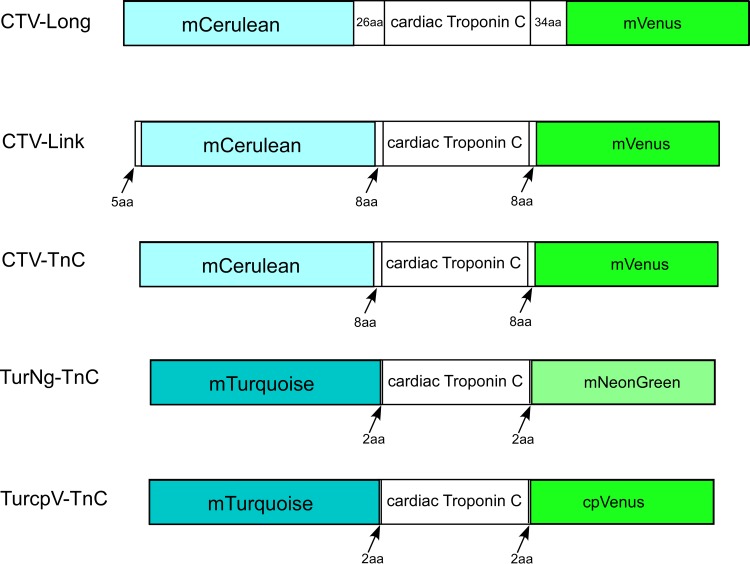
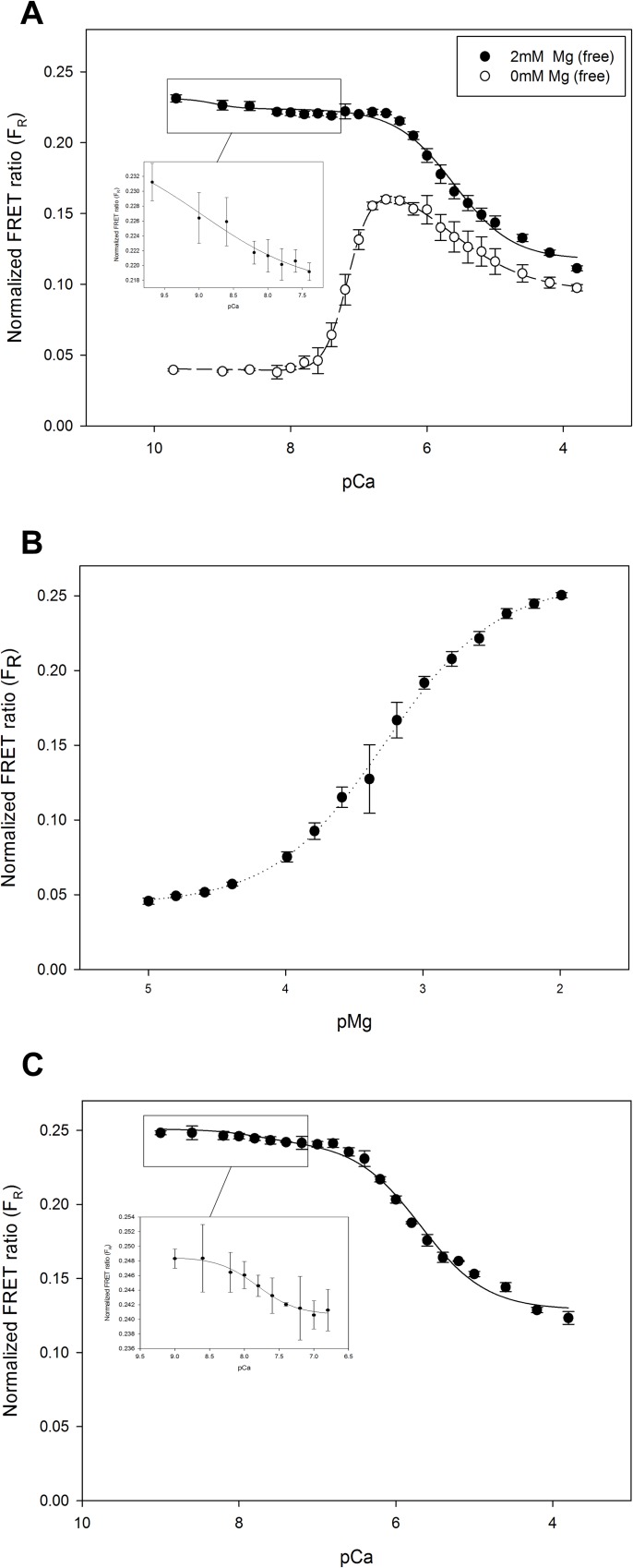
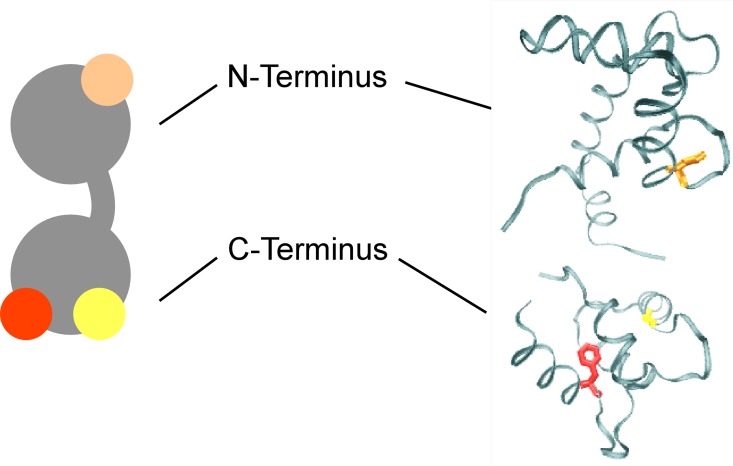
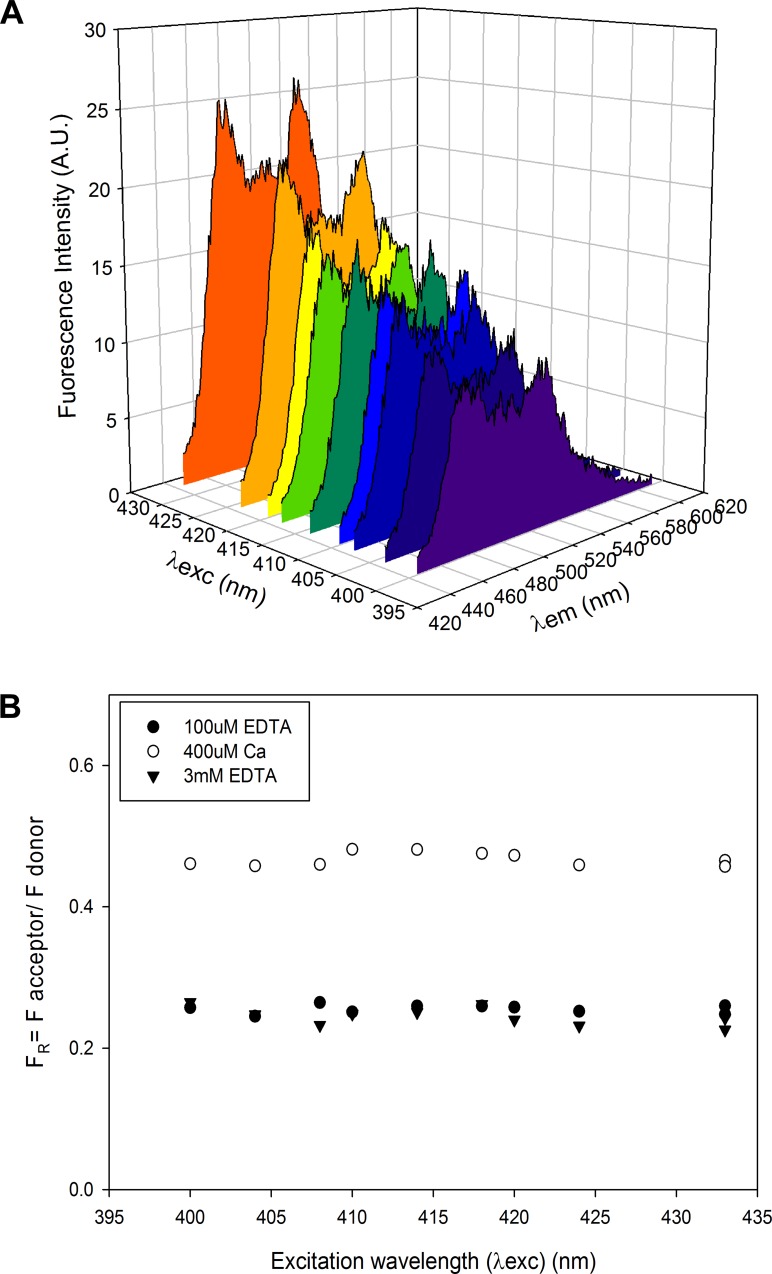
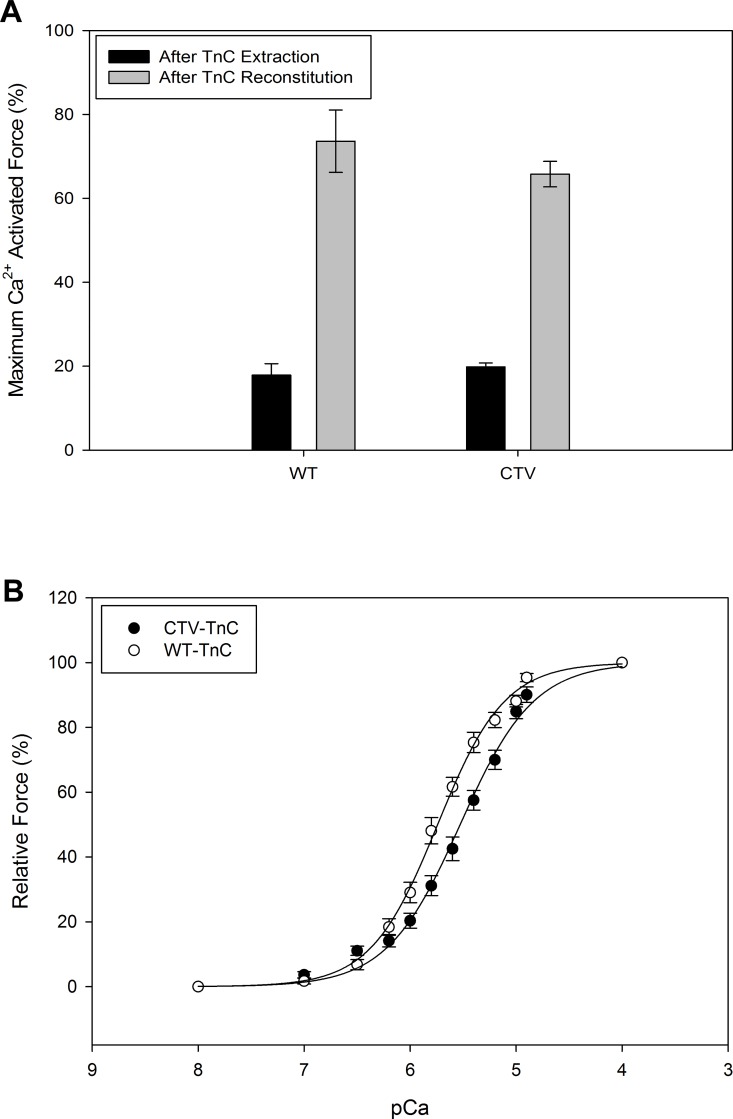
Cardiac troponin C (cTnC) is a key effector in cardiac muscle excitation-contraction coupling as the Ca2+ sensing subunit responsible for controlling contraction. In this study, we generated several FRET sensors for divalent cations based on cTnC flanked by a donor fluorescent protein (CFP) and an acceptor fluorescent protein (YFP). The sensors report Ca2+ and Mg2+ binding, and relay global structural information about the structural relationship between cTnC's N- and C-domains. The sensors were first characterized using end point titrations to decipher the response to Ca2+ binding in the presence or absence of Mg2+. The sensor that exhibited the largest responses in end point titrations, CTV-TnC, (Cerulean, TnC, and Venus) was characterized more extensively. Most of the divalent cation-dependent FRET signal originates from the high affinity C-terminal EF hands. CTV-TnC reconstitutes into skinned fiber preparations indicating proper assembly of troponin complex, with only ~0.2 pCa unit rightward shift of Ca2+-sensitive force development compared to WT-cTnC. Affinity of CTV-TnC for divalent cations is in agreement with known values for WT-cTnC. Analytical ultracentrifugation indicates that CTV-TnC undergoes compaction as divalent cations bind. C-terminal sites induce ion-specific (Ca2+ versus Mg2+) conformational changes in cTnC. Our data also provide support for the presence of additional, non-EF-hand sites on cTnC for Mg2+ binding. In conclusion, we successfully generated a novel FRET-Ca2+ sensor based on full length cTnC with a variety of cellular applications. Our sensor reveals global structural information about cTnC upon divalent cation binding.
心肌肌钙蛋白 C(cTnC)是心肌兴奋-收缩偶联的关键效应因子,作为 Ca2+ 感应亚基,负责控制收缩。在这项研究中,我们基于侧翼为供体荧光蛋白(CFP)和受体荧光蛋白(YFP)的 cTnC 生成了几种用于二价阳离子的 FRET 传感器。这些传感器报告 Ca2+和 Mg2+结合,并传递 cTnC 的 N-和 C-结构域之间结构关系的全局结构信息。这些传感器首先通过终点滴定进行了表征,以解析在存在或不存在 Mg2+的情况下 Ca2+结合的响应。在终点滴定中表现出最大响应的传感器,CTV-TnC(Cerulean、TnC 和 Venus),进行了更广泛的表征。大部分依赖于二价阳离子的 FRET 信号源于高亲和力的 C 端 EF 手。CTV-TnC 重新组装到去皮纤维制剂中,表明肌钙蛋白复合物的正确组装,与 WT-cTnC 相比,Ca2+敏感力发展的仅右移约 0.2 pCa 单位。CTV-TnC 对二价阳离子的亲和力与 WT-cTnC 的已知值一致。分析超速离心表明,随着二价阳离子的结合,CTV-TnC 发生紧缩。C 端位点诱导 cTnC 中离子特异性(Ca2+与 Mg2+)构象变化。我们的数据还为 cTnC 上存在用于 Mg2+结合的其他非 EF 手位点提供了支持。总之,我们成功地基于全长 cTnC 生成了一种新型的 FRET-Ca2+传感器,具有多种细胞应用。我们的传感器揭示了 cTnC 结合二价阳离子时的全局结构信息。