
呼吸动作作为检测诱发性心肌缺血的血管活性刺激因素——一项心血管磁共振实验研究
Breathing Maneuvers as a Vasoactive Stimulus for Detecting Inducible Myocardial Ischemia - An Experimental Cardiovascular Magnetic Resonance Study.
作者信息
Fischer Kady, Guensch Dominik P, Shie Nancy, Lebel Julie, Friedrich Matthias G
机构信息
Philippa & Marvin Carsley CMR Centre at the Montreal Heart Institute, Université de Montréal, Montreal, QC, Canada.
University Hospital Bern, Department Anaesthesiology and Pain Therapy, Inselspital, University of Bern, Bern, Switzerland.
出版信息
PLoS One. 2016 Oct 14;11(10):e0164524. doi: 10.1371/journal.pone.0164524. eCollection 2016.
BACKGROUND
Breathing maneuvers can elicit a similar vascular response as vasodilatory agents like adenosine; yet, their potential diagnostic utility in the presence of coronary artery stenosis is unknown. The objective of the study is to investigate if breathing maneuvers can non-invasively detect inducible ischemia in an experimental animal model when the myocardium is imaged with oxygenation-sensitive cardiovascular magnetic resonance (OS-CMR).
METHODS AND FINDINGS
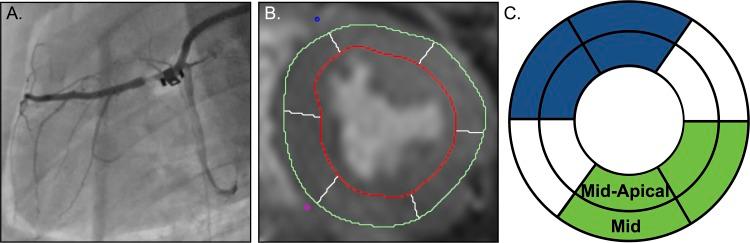
In 11 anesthetised swine with experimentally induced significant stenosis (fractional flow reserve <0.75) of the left anterior descending coronary artery (LAD) and 9 control animals, OS-CMR at 3T was performed during two different breathing maneuvers, a long breath-hold; and a combined maneuver of 60s of hyperventilation followed by a long breath-hold. The resulting change of myocardial oxygenation was compared to the invasive measurements of coronary blood flow, blood gases, and oxygen extraction. In control animals, all breathing maneuvers could significantly alter coronary blood flow as hyperventilation decreased coronary blood flow by 34±23%. A long breath-hold alone led to an increase of 97±88%, while the increase was 346±327% (p<0.001), when the long breath-hold was performed after hyperventilation. In stenosis animals, the coronary blood flow response was attenuated after both hyperventilation and the following breath-hold. This was matched by the observed oxygenation response as breath-holds following hyperventilation consistently yielded a significant difference in the signal of the MRI images between the perfusion territory of the stenosis LAD and remote myocardium. There was no difference between the coronary territories during the other breathing maneuvers or in the control group at any point.
CONCLUSION
In an experimental animal model, the response to a combined breathing maneuver of hyperventilation with subsequent breath-holding is blunted in myocardium subject to significant coronary artery stenosis. This maneuver may allow for detecting severe coronary artery stenosis and have a significant clinical potential as a non-pharmacological method for diagnostic testing in patients with suspected coronary artery disease.
背景
呼吸动作可引发与血管扩张剂(如腺苷)类似的血管反应;然而,其在冠状动脉狭窄情况下的潜在诊断效用尚不清楚。本研究的目的是调查当用氧敏感型心血管磁共振(OS-CMR)对心肌进行成像时,呼吸动作能否在实验动物模型中无创检测出诱导性缺血。
方法与结果
对11只麻醉的猪进行实验性诱导左前降支冠状动脉(LAD)出现明显狭窄(血流储备分数<0.75),并设置9只对照动物,在两种不同的呼吸动作期间进行3T的OS-CMR检查,一种是长时间屏气;另一种是60秒过度通气后接着长时间屏气的联合动作。将由此产生的心肌氧合变化与冠状动脉血流、血气和氧摄取的有创测量结果进行比较。在对照动物中,所有呼吸动作均可显著改变冠状动脉血流,过度通气使冠状动脉血流减少34±23%。单独长时间屏气导致冠状动脉血流增加97±88%,而在过度通气后进行长时间屏气时,增加幅度为346±327%(p<0.001)。在狭窄动物中,过度通气和随后的屏气后冠状动脉血流反应均减弱。这与观察到的氧合反应相匹配,因为过度通气后的屏气始终在狭窄LAD的灌注区域和远隔心肌之间的MRI图像信号上产生显著差异。在其他呼吸动作期间或对照组的任何时间点,冠状动脉区域之间均无差异。
结论
在实验动物模型中,对于存在明显冠状动脉狭窄的心肌,过度通气后接着屏气的联合呼吸动作的反应减弱。这种动作可能有助于检测严重冠状动脉狭窄,并作为一种非药物诊断方法在疑似冠状动脉疾病患者中具有显著的临床应用潜力。



 Zotero 插件