Marchi Andrea, Bari Vlasta, De Maria Beatrice, Esler Murray, Lambert Elisabeth, Baumert Mathias, Porta Alberto
Department of Electronics Information and Bioengineering, Politecnico di MilanoMilan, Italy; Department of Emergency and Intensive Care, San Gerardo HospitalMonza, Italy.
Department of Biomedical Sciences for Health, University of Milan Milan, Italy.
Front Physiol. 2016 Sep 29;7:438. doi: 10.3389/fphys.2016.00438. eCollection 2016.
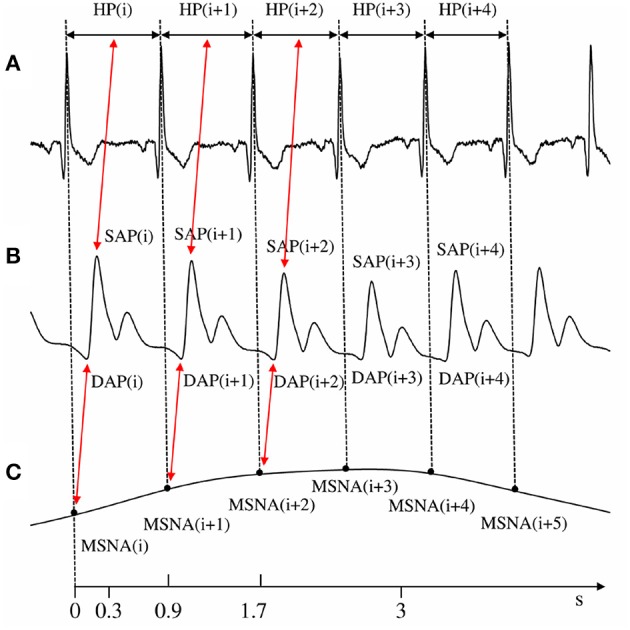
We propose a sympathetic baroreflex (sBR) sequence method for characterizing sBR from spontaneous beat-to-beat fluctuations of muscle sympathetic nerve activity (MSNA) and diastolic arterial pressure (DAP). The method exploits a previously defined MSNA variability quantifying the fluctuations of MSNA burst rate. The method is based on the detection of MSNA and DAP sequences characterized by the contemporaneous DAP increase and MSNA decrease or . The percentage of sBR sequences (SEQ%) was taken as an indication of the degree of sBR solicitation and the average slope of the regression lines in the (DAP, MSNA) plane was taken as sBR sensitivity (sBRS) and expressed in burstssmmHg. sBRS was compared to a more traditional estimate based on the baroreflex threshold analysis (sBRS). An incremental head-up tilt protocol, carried out in 12 young healthy subjects (age: 20-36 yr, median = 22.5 yr, 9 females) sequentially tilted at 0, 20, 30, 40, 60° table inclinations, was utilized to set the sBR sequence method parameters. Traditional sequence analysis was exploited to estimate cardiac baroreflex (cBR) sensitivity (cBRS) and percentage of cBR sequences (SEQ%). The head-up tilt induced the progressive increase of SEQ% and SEQ% and gradual decrease of both sBRS and cBRS, thus suggesting the gradual rise of the sBR and cBR solicitations and the progressive reduction of their effectiveness with the stimulus. sBRS was significantly associated with sBRS. sBRS and cBRS were significantly correlated as well as SEQ% and SEQ%, even though the correlation was not strong, thus suggesting a certain degree of independence between the baroreflex arms. The proposed sBR sequence approach provides a dynamical characterization of the sBR alternative to more traditional static pharmacological and nonpharmacological methods and fully homogenous with the cBR sequence technique.
我们提出了一种交感压力反射(sBR)序列方法,用于从肌肉交感神经活动(MSNA)和舒张压(DAP)的逐搏自发波动中表征sBR。该方法利用了先前定义的MSNA变异性,以量化MSNA爆发率的波动。该方法基于对MSNA和DAP序列的检测,其特征在于DAP同时升高和MSNA降低或 。sBR序列的百分比(SEQ%)被用作sBR激发程度的指标,并且(DAP,MSNA)平面中回归线的平均斜率被用作sBR敏感性(sBRS),并以爆发数/mmHg表示。将sBRS与基于压力反射阈值分析的更传统估计值(sBRS)进行比较。在12名年轻健康受试者(年龄:20 - 36岁,中位数 = 22.5岁,9名女性)中进行了递增式头高位倾斜方案,依次将倾斜角度设置为0、20、30、40、60°,以设置sBR序列方法的参数。利用传统序列分析来估计心脏压力反射(cBR)敏感性(cBRS)和cBR序列的百分比(SEQ%)。头高位倾斜导致SEQ%和SEQ%逐渐增加,而sBRS和cBRS均逐渐降低,因此表明sBR和cBR激发逐渐增加,并且它们的有效性随着刺激而逐渐降低。sBRS与sBRS显著相关。sBRS和cBRS以及SEQ%和SEQ%也显著相关,尽管相关性不强,因此表明压力反射臂之间存在一定程度的独立性。所提出的sBR序列方法提供了一种与更传统的静态药理学和非药理学方法不同的sBR动态表征,并且与cBR序列技术完全一致。