Schapschröer M, Lemez S, Baker J, Schorer J
Institute of Sport Science, Carl von Ossietzky University Oldenburg, Ammerländer Heerstraße 114-118, 26129, Oldenburg, Germany.
School of Kinesiology and Health Science, York University, Toronto, Canada.
Sports Med Open. 2016 Dec;2(1):37. doi: 10.1186/s40798-016-0061-0. Epub 2016 Sep 12.
Many researchers have considered the impact of physical exercise on perceptual-cognitive performance. There have also been a substantial number of studies that have examined how perceptual-cognitive skills differ between elite athletes and non-athletes. However, the knowledge on how physical exercise interacts with perceptual-cognitive skill is limited. This systematic review aims to provide detailed information on how athletes' perceptual-cognitive performance is influenced by acute physical exercise load and whether these effects differ between elite athletes and lesser skilled groups.
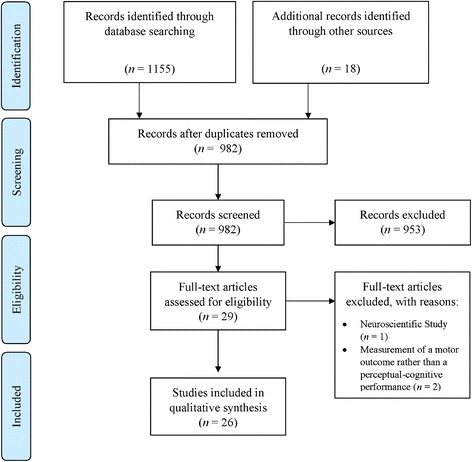
A systematic review was conducted using different combinations of the keywords physical load, acute, exercise, perception, cognition, perceptual, cognitive, sport, and athlete with the PubMed and SportDiscus databases. Additional articles were found through screening the references of these papers. Articles had to (a) be full journal articles written in English, (b) include an athlete sample, (c) examine acute effects of physical exercise, and (d) measure a perceptual-cognitive task as the dependent variable.
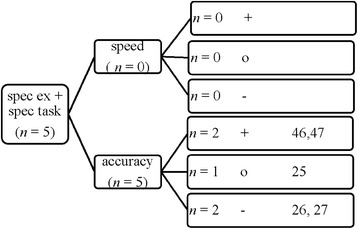
Twenty-six articles matched the inclusion criteria. Results suggested the impact of acute physical exercise on perceptual-cognitive performances of athletes depends on the specificity of the induced exercise and perceptual-cognitive task. Additionally, speed and accuracy were influenced differently by physical exercise. Furthermore, skilled athletes seem to be more positively influenced by acute physical exercise than novices.
Since many factors influence perceptual-cognitive expertise, future research should be highly precise (e.g., regarding the definition of variables, the intensity of the physical exercise) and specific (e.g., regarding the tasks used, the type of the physical exercise).
许多研究人员已经考虑了体育锻炼对感知认知表现的影响。也有大量研究考察了精英运动员和非运动员在感知认知技能方面的差异。然而,关于体育锻炼如何与感知认知技能相互作用的知识有限。本系统综述旨在提供详细信息,说明急性体育锻炼负荷如何影响运动员的感知认知表现,以及这些影响在精英运动员和技能水平较低的群体之间是否存在差异。
使用关键词“身体负荷”“急性”“锻炼”“感知”“认知”“感知的”“认知的”“运动”和“运动员”的不同组合,在PubMed和SportDiscus数据库中进行系统综述。通过筛选这些论文的参考文献发现了其他文章。文章必须(a)是用英文撰写的完整期刊文章,(b)包括运动员样本,(c)研究体育锻炼的急性影响,以及(d)将感知认知任务作为因变量进行测量。
26篇文章符合纳入标准。结果表明,急性体育锻炼对运动员感知认知表现的影响取决于所诱导锻炼和感知认知任务的特异性。此外,速度和准确性受体育锻炼的影响方式不同。此外,熟练运动员似乎比新手更受急性体育锻炼的积极影响。
由于许多因素影响感知认知专业技能,未来的研究应该高度精确(例如,关于变量的定义、体育锻炼的强度)和具体(例如,关于所使用的任务、体育锻炼的类型)。