Vincent Delphine, Elkins Aaron, Condina Mark R, Ezernieks Vilnis, Rochfort Simone
Department of Economic Development, Jobs, Transport and Resources, AgriBio Centre, 5 Ring Road, Bundoora, Victoria 3083, Australia.
Bruker Pty. Ltd, Preston, Victoria, Australia.
PLoS One. 2016 Oct 17;11(10):e0163471. doi: 10.1371/journal.pone.0163471. eCollection 2016.
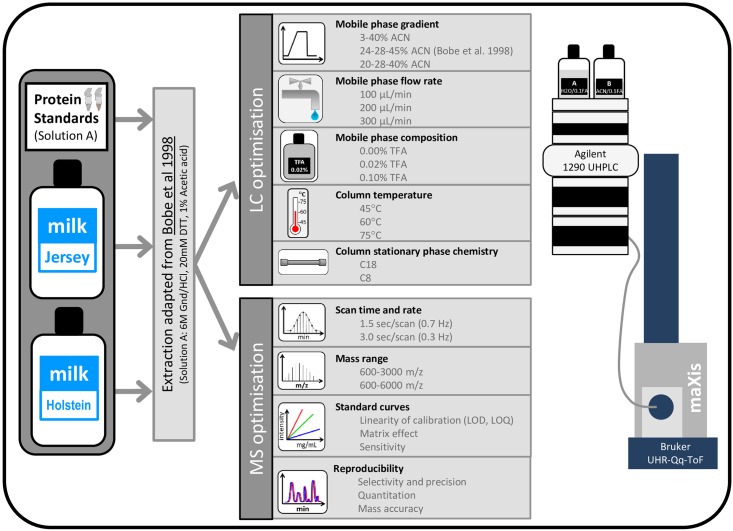
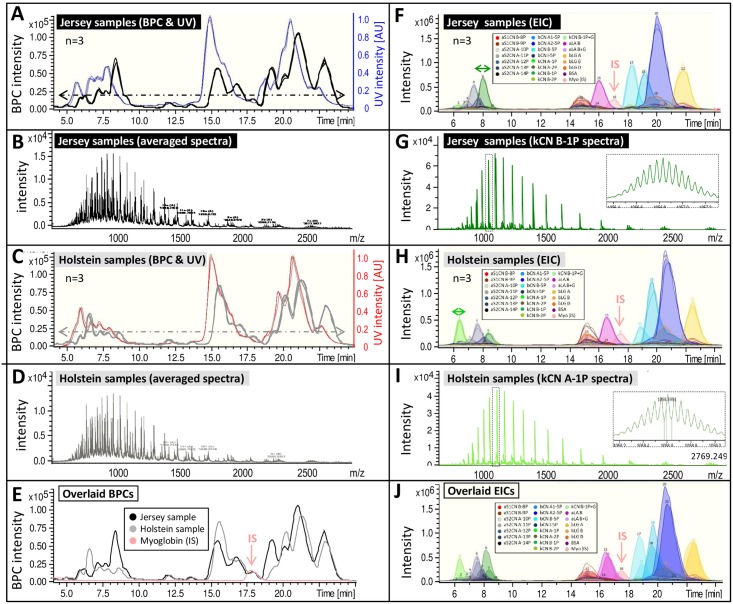
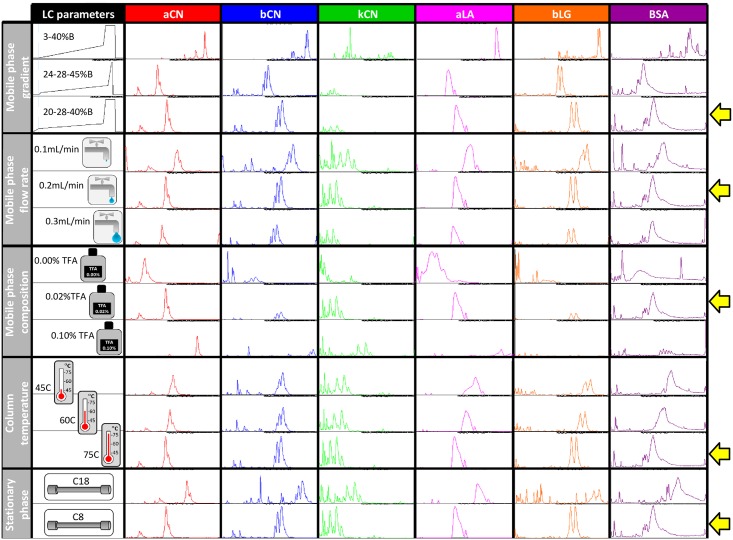
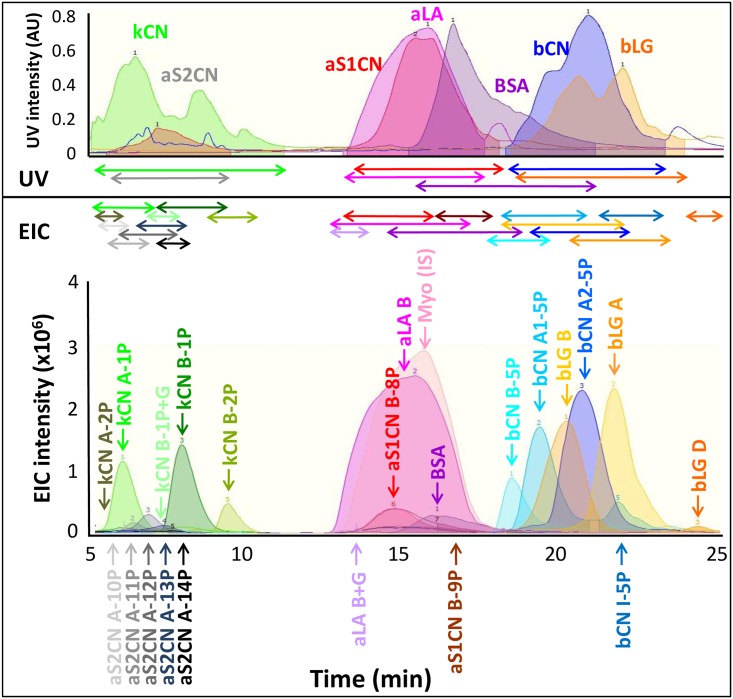
Cow's milk is an important source of proteins in human nutrition. On average, cow's milk contains 3.5% protein. The most abundant proteins in bovine milk are caseins and some of the whey proteins, namely beta-lactoglobulin, alpha-lactalbumin, and serum albumin. A number of allelic variants and post-translationally modified forms of these proteins have been identified. Their occurrence varies with breed, individuality, stage of lactation, and health and nutritional status of the animal. It is therefore essential to have reliable methods of detection and quantitation of these proteins. Traditionally, major milk proteins are quantified using liquid chromatography (LC) and ultra violet detection method. However, as these protein variants co-elute to some degree, another dimension of separation is beneficial to accurately measure their amounts. Mass spectrometry (MS) offers such a tool. In this study, we tested several RP-HPLC and MS parameters to optimise the analysis of intact bovine proteins from milk. From our tests, we developed an optimum method that includes a 20-28-40% phase B gradient with 0.02% TFA in both mobile phases, at 0.2 mL/min flow rate, using 75°C for the C8 column temperature, scanning every 3 sec over a 600-3000 m/z window. The optimisations were performed using external standards commercially purchased for which ionisation efficiency, linearity of calibration, LOD, LOQ, sensitivity, selectivity, precision, reproducibility, and mass accuracy were demonstrated. From the MS analysis, we can use extracted ion chromatograms (EICs) of specific ion series of known proteins and integrate peaks at defined retention time (RT) window for quantitation purposes. This optimum quantitative method was successfully applied to two bulk milk samples from different breeds, Holstein-Friesian and Jersey, to assess differences in protein variant levels.
牛奶是人类营养中蛋白质的重要来源。平均而言,牛奶含有3.5%的蛋白质。牛乳中最丰富的蛋白质是酪蛋白和一些乳清蛋白,即β-乳球蛋白、α-乳白蛋白和血清白蛋白。已经鉴定出这些蛋白质的许多等位基因变体和翻译后修饰形式。它们的出现因品种、个体、泌乳阶段以及动物的健康和营养状况而异。因此,拥有可靠的检测和定量这些蛋白质的方法至关重要。传统上,主要的乳蛋白使用液相色谱(LC)和紫外检测方法进行定量。然而,由于这些蛋白质变体在一定程度上会同时洗脱,另一个分离维度有助于准确测量它们的含量。质谱(MS)提供了这样一种工具。在本研究中,我们测试了几个反相高效液相色谱(RP-HPLC)和质谱参数,以优化牛奶中完整牛蛋白的分析。通过我们的测试,我们开发了一种最佳方法,包括在两个流动相中使用0.02%三氟乙酸(TFA)的20-28-40%B相梯度,流速为0.2 mL/min,C8柱温度为75°C,在600-3000 m/z窗口每3秒扫描一次。使用商业购买的外标进行优化,证明了其电离效率、校准线性、检测限(LOD)、定量限(LOQ)、灵敏度、选择性、精密度、重现性和质量准确度。通过质谱分析,我们可以使用已知蛋白质特定离子系列的提取离子色谱图(EIC),并在定义的保留时间(RT)窗口积分峰以进行定量。这种最佳定量方法成功应用于来自不同品种荷斯坦-弗里生牛和泽西牛的两个散装牛奶样品,以评估蛋白质变体水平的差异。