Luo Jake, Eldredge Christina, Cho Chi C, Cisler Ron A
Center for Biomedical Data and Language Processing, College of Health Sciences, Department of Health Informatics and Administration, University of Wisconsin-Milwaukee, Milwaukee, WI, United States.
JMIR Med Inform. 2016 Oct 17;4(4):e30. doi: 10.2196/medinform.6437.
Understanding adverse event patterns in clinical studies across populations is important for patient safety and protection in clinical trials as well as for developing appropriate drug therapies, procedures, and treatment plans.
The objective of our study was to conduct a data-driven population-based analysis to estimate the incidence, diversity, and association patterns of adverse events by age of the clinical trials patients and participants.
Two aspects of adverse event patterns were measured: (1) the adverse event incidence rate in each of the patient age groups and (2) the diversity of adverse events defined as distinct types of adverse events categorized by organ system. Statistical analysis was done on the summarized clinical trial data. The incident rate and diversity level in each of the age groups were compared with the lowest group (reference group) using t tests. Cohort data was obtained from ClinicalTrials.gov, and 186,339 clinical studies were analyzed; data were extracted from the 17,853 clinical trials that reported clinical outcomes. The total number of clinical trial participants was 6,808,619, and total number of participants affected by adverse events in these trials was 1,840,432. The trial participants were divided into eight different age groups to support cross-age group comparison.
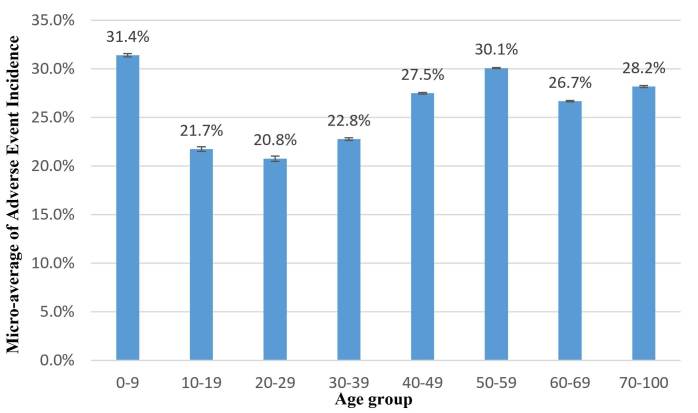
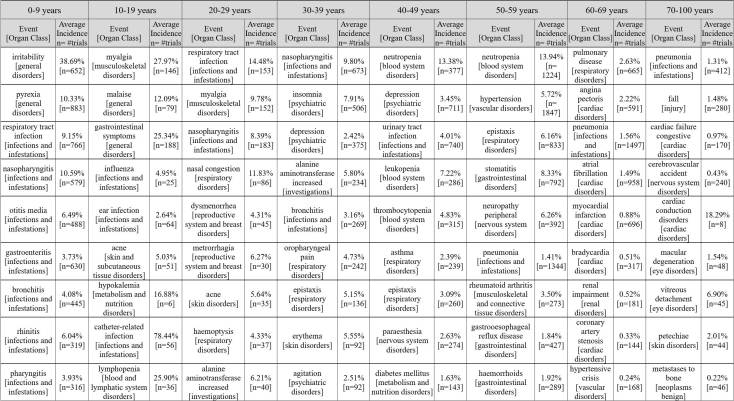
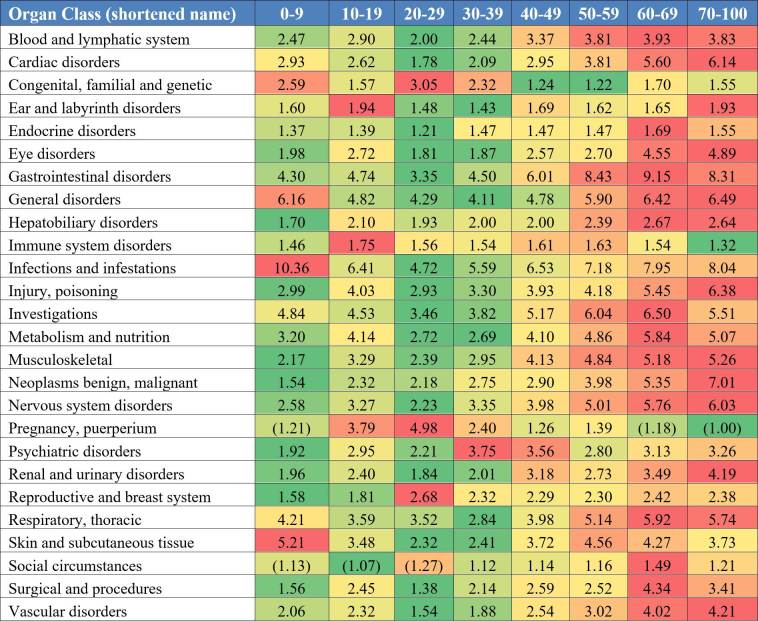
In general, children and older patients are more susceptible to adverse events in clinical trial studies. Using the lowest incidence age group as the reference group (20-29 years), the incidence rate of the 0-9 years-old group was 31.41%, approximately 1.51 times higher (P=.04) than the young adult group (20-29 years) at 20.76%. The second-highest group is the 50-59 years-old group with an incidence rate of 30.09%, significantly higher (P<.001) when compared with the lowest incidence in the 20-29 years-old group. The adverse event diversity also increased with increase in patient age. Clinical studies that recruited older patients (older than 40 years) were more likely to observe a diverse range of adverse events (P<.001). Adverse event diversity increased at an average rate of 77% for each age group (older than 30 years) until reaching the 60-69 years-old group, which had a diversity level of 54.7 different types of adverse events per trial arm. The 70-100 years-old group showed the highest diversity level of 55.5 events per trial arm, which is approximately 3.44 times more than the 20-29 years-old group (P<.001). We also observe that adverse events display strong age-related patterns among different categories.
The results show that there is a significant adverse event variance at the population level between different age groups in clinical trials. The data suggest that age-associated adverse events should be considered in planning, monitoring, and regulating clinical trials.
了解不同人群临床研究中的不良事件模式,对于临床试验中的患者安全与保护以及制定合适的药物治疗、程序和治疗方案至关重要。
我们研究的目的是进行一项基于数据的人群分析,以估计临床试验患者和参与者按年龄划分的不良事件发生率、多样性及关联模式。
对不良事件模式的两个方面进行了测量:(1)每个患者年龄组的不良事件发生率;(2)不良事件的多样性,定义为按器官系统分类的不同类型不良事件。对汇总的临床试验数据进行了统计分析。使用t检验将每个年龄组的发生率和多样性水平与最低组(参考组)进行比较。队列数据来自ClinicalTrials.gov,共分析了186,339项临床研究;数据从17,853项报告临床结果的临床试验中提取。临床试验参与者总数为6,808,619人,这些试验中受不良事件影响的参与者总数为1,840,432人。将试验参与者分为八个不同年龄组以支持跨年龄组比较。
总体而言,儿童和老年患者在临床试验研究中更容易发生不良事件。以最低发生率年龄组(20 - 29岁)作为参考组,0 - 9岁组的发生率为31.41%,约比年轻成年组(20 - 29岁)的20.76%高1.51倍(P = 0.04)。第二高的组是50 - 59岁组,发生率为30.09%,与20 - 29岁组的最低发生率相比显著更高(P < 0.001)。不良事件的多样性也随着患者年龄的增加而增加。招募老年患者(40岁以上)的临床研究更有可能观察到多种不良事件(P < 0.001)。每个年龄组(30岁以上)的不良事件多样性平均以77%的速率增加,直至60 - 69岁组,每个试验组的多样性水平为54.7种不同类型的不良事件。70 - 100岁组显示出最高的多样性水平,每个试验组有55.5个事件,约为20 - 29岁组的3.44倍(P < 0.001)。我们还观察到不同类别不良事件呈现出强烈的年龄相关模式。
结果表明,临床试验中不同年龄组在人群水平上存在显著的不良事件差异。数据表明,在规划、监测和监管临床试验时应考虑与年龄相关的不良事件。