Ohlendorf Daniela, Erbe Christina, Hauck Imke, Nowak Jennifer, Hermanns Ingo, Ditchen Dirk, Ellegast Rolf, Groneberg David A
Institute of Occupational Medicine, Social Medicine and Environmental Medicine, Goethe-University, Theodor-Stern-Kai 7, Frankfurt am Main, 60590, Germany.
School of Dentistry, Department of Orthodontics, University Medical Centre of the Johannes Gutenberg University Mainz, Augustusplatz 2, Main, 55131, Germany.
BMC Musculoskelet Disord. 2016 Oct 18;17(1):427. doi: 10.1186/s12891-016-1288-0.
In Germany, about 86.7 % of the dentists have stated to suffer from pain in the neck and shoulder region. These findings are predominantly based on surveys. Therefore the objective of this study is to conduct a kinematic analysis of occupational posture in dentistry.
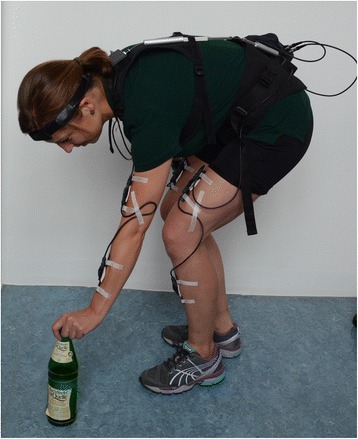
Twenty one dentists (11 f/10 m; age: 40.1 ± 10.4 years) have participated in this examination. The CUELA-System was used to collect kinematic data of the activities on an average dental workday. A detailed, computer-based task analysis took place parallel to the kinematic examination. Through the synchronization of data collected from both measurements, patterns of posture were arranged chronologically and in conjunction with the tasks performed: (I) "treatment" (II) "office" and (III) "other activities". For the data analysis, characteristic data of joint angular distributions (percentiles P05, P25, P50, P75 and P95) of head, neck and torso at pre-defined tasks were examined and assessed corresponding to ergonomic standards.
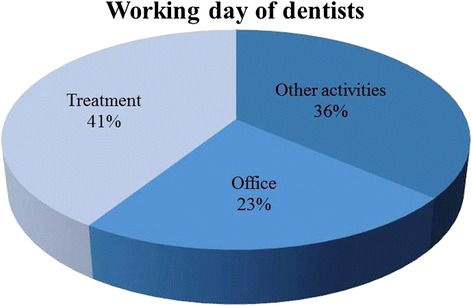
Forty one percent of tasks executed on an average dental workday can be categorized as the treatment of patients. These tasked are most frequently performed in "straight back" positions (78.7 %), whereas 20.1 % were carried out in a "twisted or inclined" torso posture, 1.1 % "bowed" and only 0.1 % "bowed and twisted/inclined to the side" upper body position. In particular, it can be observed that in the area of the cervical and thoracic spine the 75th and 95th percentile show worse angular values during treatment than during non-dental tasks. For the period of treatment (at a standardized dental chair construction), a seated position with a strong inclination of the thoracic spine to the right while the lumbar spine is inclined towards the left is adopted.
The kinematic analysis of dentists illustrates typical patterns of postures during tasks that are essential to the dental treatment of patients. The postures in the area of the cervical and thoracic spine have higher angular values during treatment compared to other dental tasks. Consistently, appropriate ergonomic design measures to optimize the dental chair and equipment as well as integrated training in ergonomics as part of the study of dentistry to prevent musculoskeletal are recommended.
在德国,约86.7%的牙医表示有颈部和肩部疼痛。这些发现主要基于调查。因此,本研究的目的是对牙科职业姿势进行运动学分析。
21名牙医(11名女性/10名男性;年龄:40.1±10.4岁)参与了此次检查。使用CUELA系统收集平均牙科工作日活动的运动学数据。在运动学检查的同时进行了详细的基于计算机的任务分析。通过同步从这两项测量中收集的数据,按时间顺序并结合执行的任务安排姿势模式:(I)“治疗”(II)“办公室”和(III)“其他活动”。对于数据分析,检查并根据人体工程学标准评估在预定义任务中头部、颈部和躯干的关节角度分布的特征数据(百分位数P05、P25、P50、P75和P95)。
平均牙科工作日执行的任务中有41%可归类为患者治疗。这些任务最常以“挺直背部”姿势进行(78.7%),而20.1%是在“扭转或倾斜”的躯干姿势下进行,1.1%是“弯腰”姿势,只有0.1%是“弯腰并扭转/向一侧倾斜”的上身姿势。特别是,可以观察到在颈椎和胸椎区域,第75和第95百分位数在治疗期间的角度值比非牙科任务期间更差。在治疗期间(在标准化牙科椅结构下),采用胸椎强烈向右倾斜而腰椎向左倾斜的坐姿。
对牙医的运动学分析揭示了对患者进行牙科治疗必不可少的任务期间的典型姿势模式。与其他牙科任务相比,颈椎和胸椎区域在治疗期间的角度值更高。因此,建议采取适当的人体工程学设计措施来优化牙科椅和设备,并将人体工程学综合培训作为牙科学习的一部分,以预防肌肉骨骼问题。