Ohlendorf Daniela, Erbe Christina, Hauck Imke, Nowak Jennifer, Hermanns Ingo, Ditchen Dirk, Ellegast Rolf, Groneberg David A
Institute of Occupational Medicine, Social Medicine and Environmental Medicine, Goethe-University, Theodor-Stern-Kai 7, 60590, Frankfurt am Main, Germany.
School of Dentistry, Department of Orthodontics, University Medical Centre of the Johannes Gutenberg University Mainz, Augustusplatz 2, 55131, Mainz, Germany.
BMC Musculoskelet Disord. 2017 Jun 23;18(1):275. doi: 10.1186/s12891-017-1629-7.
This study aims at identifying orthodontic activities with the highest frequency of unfavorable/awkward and static postures held over a period of more than 4 s based on kinematic analysis. Moreover, a separate analysis of static postures for orthodontic and non-orthodontic activities serves to evaluate the duration for which these particular postures are assumed.
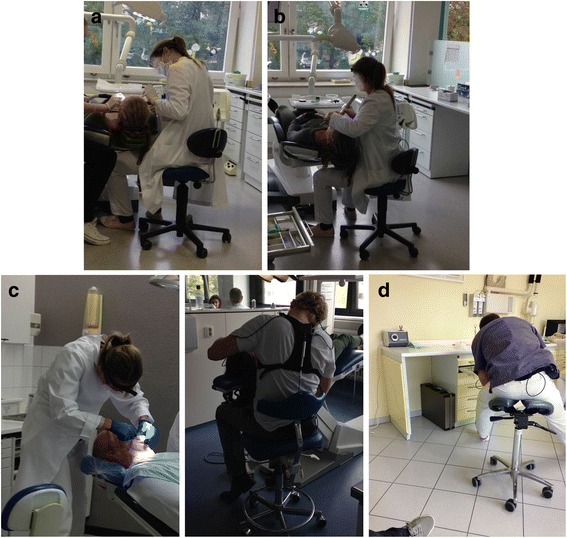
In total, 21 (13f/8 m) orthodontists (age: 31.5 ± 3.8 years) participated in this study. CUELA, a personal measurement system, was used to collect kinematic data for all orthodontic activities in a working day. Angle values of the head and torso were evaluated in accordance with ergonomic standards. Only those postures that were held statically for 4 s and longer were selected for further analysis. Alongside the kinematic analysis, the activities performed on-site were also subject to a detailed computerized analysis. The synchronization of data collected from both measurements arranges the patterns of posture found chronologically and in conjunction with the orthodontic activities performed ((I) "treatment" (II) "office" and (III) "other activities").
For (I) we observed an anterior inclination of the head and torso area as well as a twist of the head and neck area to the right. We found anterior back inclination and lateral back torsion to the right for (II) and (III). If, furthermore, we differentiate the duration of static postures, there are primarily short to medium-term (4-30s) static postures identified for (I). Also, categories (II) and (III) predominantly demonstrate static back postures with a duration of up to 30 s. With regard to (II) we observed that the back is ventrally inclined for 10.1% of the total activity duration.
During treatment static strains are observed in the entire head and torso area. On the contrary, static postures prevalent in the torso area are essential for activities of the other categories, particularly office work. These findings allow for a careful selection of unfavorable and static postures for each of the activities performed and help to develop specific preventive measures.
本研究旨在通过运动学分析,确定在超过4秒的时间段内保持不良/别扭和静态姿势频率最高的正畸活动。此外,对正畸和非正畸活动的静态姿势进行单独分析,以评估这些特定姿势的持续时间。
共有21名(13名女性/8名男性)正畸医生(年龄:31.5±3.8岁)参与了本研究。使用个人测量系统CUELA收集工作日内所有正畸活动的运动学数据。根据人体工程学标准评估头部和躯干的角度值。仅选择那些静态保持4秒及以上的姿势进行进一步分析。除运动学分析外,还对现场进行的活动进行了详细的计算机分析。从这两种测量中收集的数据同步,按时间顺序排列发现的姿势模式,并结合进行的正畸活动((I)“治疗”(II)“办公室”和(III)“其他活动”)。
对于(I),我们观察到头部和躯干区域向前倾斜,以及头部和颈部区域向右扭转。对于(II)和(III),我们发现向前向后倾斜和向右外侧向后扭转。此外,如果我们区分静态姿势的持续时间,(I)主要识别出短期到中期(4 - 30秒)的静态姿势。同样,(II)和(III)类别主要表现为持续时间长达30秒的背部静态姿势。关于(II),我们观察到在总活动持续时间的10.1%内,背部向前倾斜。
在治疗过程中,整个头部和躯干区域都观察到静态应变。相反,躯干区域普遍存在的静态姿势对于其他类别的活动,特别是办公室工作至关重要。这些发现有助于为所进行的每项活动仔细选择不良和静态姿势,并有助于制定具体的预防措施。