McLeod Kristin, Wall Samuel, Leren Ida Skrinde, Saberniak Jørg, Haugaa Kristina Hermann
Cardiac Modelling Department, Simula Research Laboratory, PO Box 134, Oslo, Norway.
Center for Cardiological Innovation, Oslo, Norway.
J Cardiovasc Magn Reson. 2016 Oct 14;18(1):73. doi: 10.1186/s12968-016-0291-9.
Altered right ventricular structure is an important feature of Arrhythmogenic Right Ventricular Cardiomyopathy (ARVC), but is challenging to quantify objectively. The aim of this study was to go beyond ventricular volumes and diameters and to explore if the shape of the right and left ventricles could be assessed and related to clinical measures. We used quantifiable computational methods to automatically identify and analyse malformations in ARVC patients from Cardiovascular Magnetic Resonance (CMR) images. Furthermore, we investigated how automatically extracted structural features were related to arrhythmic events.
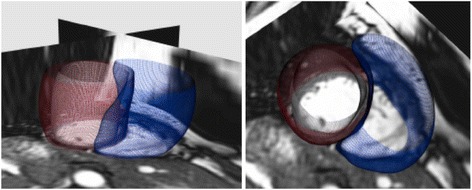
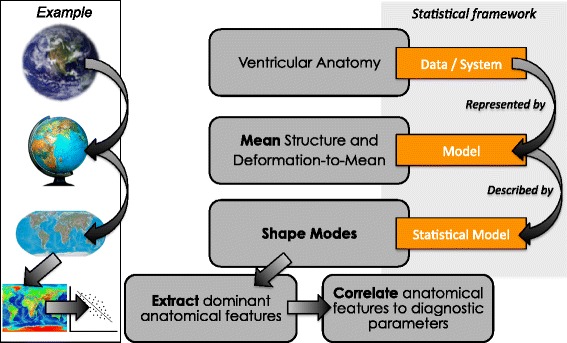
A retrospective cross-sectional feasibility study was performed on CMR short axis cine images of 27 ARVC patients and 21 ageing asymptomatic control subjects. All images were segmented at the end-diastolic (ED) and end-systolic (ES) phases of the cardiac cycle to create three-dimensional (3D) bi-ventricle shape models for each subject. The most common components to single- and bi-ventricular shape in the ARVC population were identified and compared to those obtained from the control group. The correlations were calculated between identified ARVC shapes and parameters from the 2010 Task Force Criteria, in addition to clinical outcomes such as ventricular arrhythmias.
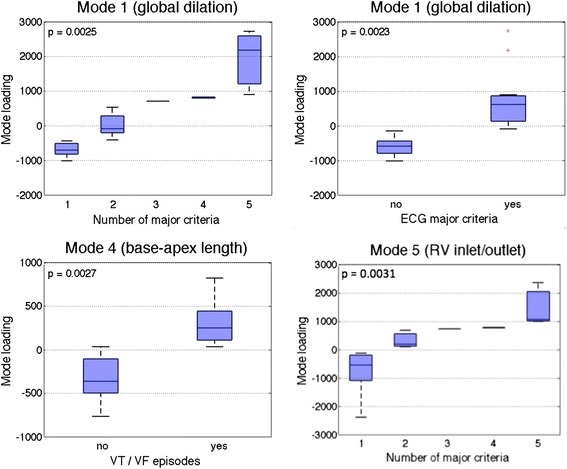
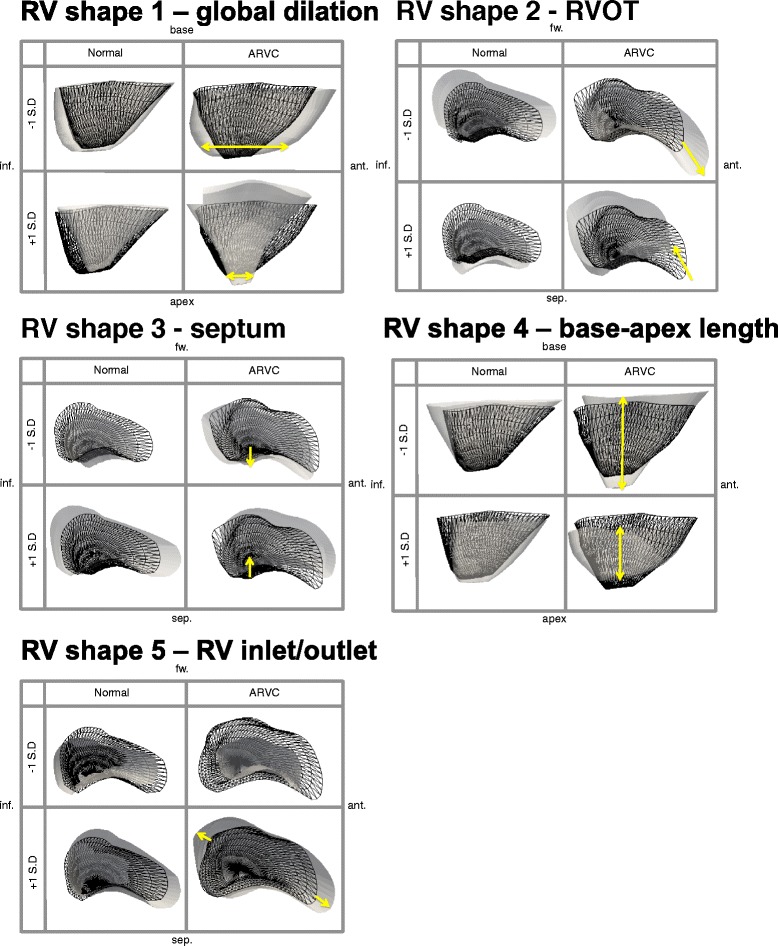
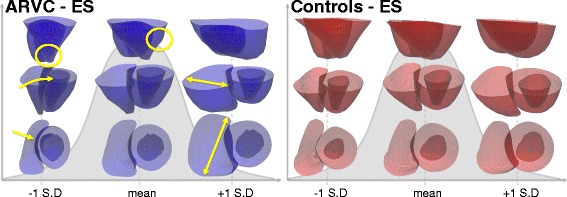
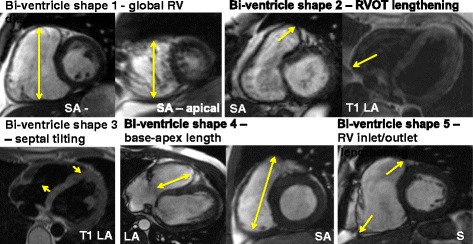
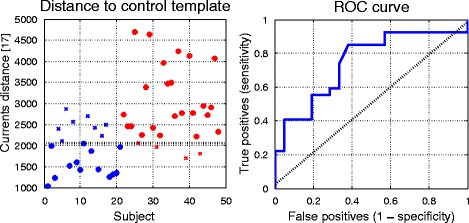
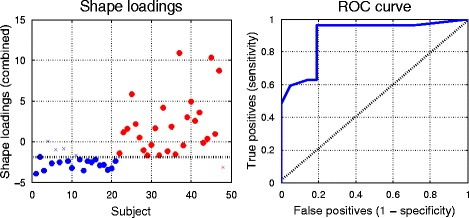
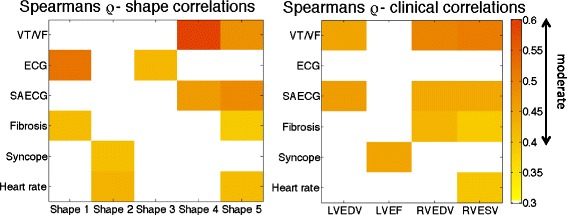
Bi-ventricle shape for the ARVC population showed, as ordered by prevalence with the percent of total variance in the population explained by each shape: global dilation/shrinking of both ventricles (44 %), elongation/shortening at the right ventricle (RV) outflow tract (15 %), tilting at the septum (10 %), shortening/lengthening of both ventricles (7 %), and bulging/shortening at both the RV inflow and outflow (5 %). Bi-ventricle shapes were significantly correlated to several clinical diagnostic parameters and outcomes, including (but not limited to) correlations between global dilation and electrocardiography (ECG) major criteria (p = 0.002), and base-to-apex lengthening and history of arrhythmias (p = 0.003). Classification of ARVC vs. control using shape modes yielded high sensitivity (96 %) and moderate specificity (81 %).
We presented for the first time an automatic method for quantifying and analysing ventricular shapes in ARVC patients from CMR images. Specific ventricular shape features were highly correlated with diagnostic indices in ARVC patients and yielded high classification sensitivity. Ventricular shape analysis may be a novel approach to classify ARVC disease, and may be used in diagnosis and in risk stratification for ventricular arrhythmias.
右心室结构改变是致心律失常性右心室心肌病(ARVC)的一个重要特征,但客观量化具有挑战性。本研究的目的是超越心室容积和直径,探讨是否可以评估右心室和左心室的形状,并将其与临床指标相关联。我们使用可量化的计算方法,从心血管磁共振(CMR)图像中自动识别和分析ARVC患者的畸形情况。此外,我们还研究了自动提取的结构特征与心律失常事件之间的关系。
对27例ARVC患者和21例老年无症状对照者的CMR短轴电影图像进行了一项回顾性横断面可行性研究。在心动周期的舒张末期(ED)和收缩末期(ES)阶段对所有图像进行分割,为每个受试者创建三维(3D)双心室形状模型。确定了ARVC人群中单心室和双心室形状最常见的组成部分,并与对照组获得的组成部分进行比较。除了室性心律失常等临床结果外,还计算了确定的ARVC形状与2010年工作组标准中的参数之间的相关性。
ARVC人群的双心室形状按患病率排序,每种形状在人群中总方差的百分比解释如下:两个心室的整体扩张/收缩(44%)、右心室(RV)流出道的伸长/缩短(15%)、室间隔的倾斜(10%)、两个心室的缩短/伸长(7%)以及RV流入和流出处的膨出/缩短(5%)。双心室形状与几个临床诊断参数和结果显著相关,包括(但不限于)整体扩张与心电图(ECG)主要标准之间的相关性(p = 0.002),以及心底到心尖的延长与心律失常病史之间的相关性(p = 0.003)。使用形状模式对ARVC与对照组进行分类,灵敏度高(96%),特异性中等(81%)。
我们首次提出了一种从CMR图像中量化和分析ARVC患者心室形状的自动方法。特定心室形状特征与ARVC患者的诊断指标高度相关,并具有高分类灵敏度。心室形状分析可能是一种对ARVC疾病进行分类的新方法,可用于诊断和室性心律失常的风险分层。