Ahn Na-Ri, Leem Yea-Hyun, Kato Morimasa, Chang Hyuk-ki
Laboratory of Exercise Physiology, Department of Human Movement Science, Seoul Women's University, Seoul Republic of Korea.
Department of Neuroscience and TIDRC, Ewha Womans University Medical Center, Seoul Republic of Korea.
J Exerc Nutrition Biochem. 2016 Sep;20(3):24-31. doi: 10.20463/jenb.2016.09.20.3.4. Epub 2016 Sep 30.
The effects of creatine and exercise on chronic stress-induced depression are unclear. In the present study, we identified the effects of 4-week supplementation of creatine monohydrate and/or exercise on antidepressant behavior and raphe 5-HT expression in a chronic mild stress-induced depressed mouse model.
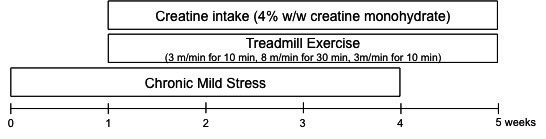
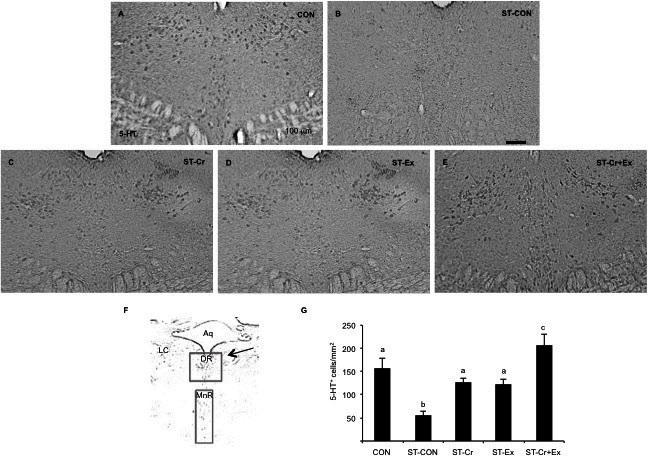
Seven-week-old male C57BL/6 mice (n=48) were divided randomly into 5 groups: (1) non-stress control (CON, n=10), (2) stress control (ST-CON, n=10), (3) stress and creatine intake (ST-Cr, n=10), (4) stress and exercise (ST-Ex, n=9), and (5) combined stress, exercise, and creatine intake (ST-Cr+Ex, n=9). After five weeks' treatment, we investigated using both anti-behavior tests (the Tail Suspension Test (TST) and the Forced Swimming Test (FST)), and 5-HT expression in the raphe nuclei (the dorsal raphe (DR) and median raphe (MnR)).
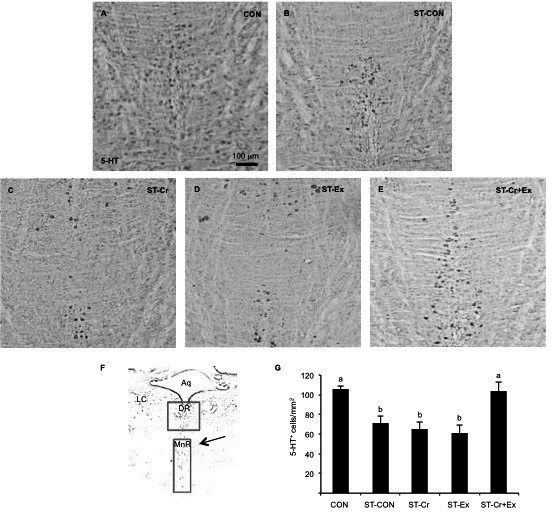
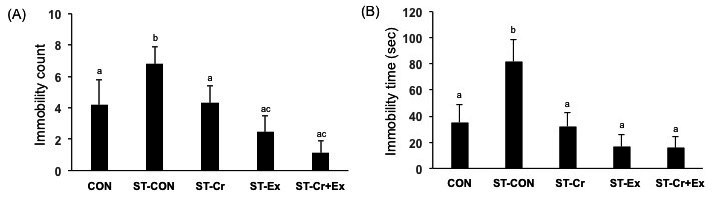
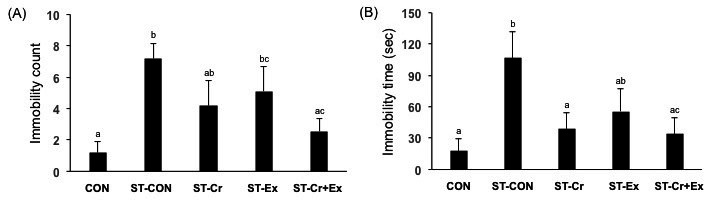
Stress for 4 weeks significantly increased depressive behaviors in the mice. Treatment with creatine supplementation combined with exercise significantly decreased depressive behaviors as compared with the CON-ST group in both the TST and FST tests. With stress, 5-HT expression in the raphe nuclei decreased significantly. With combined creatine and exercise, 5-HT positive cells increased significantly and had a synergic effect on both DR and MnR.
The present study found that even a single treatment of creatine or exercise has partial effects as an antidepressant in mice with chronic mild stress-induced depression. Furthermore, combined creatine and exercise has synergic effects and is a more effective prescription than a single treatment.
肌酸和运动对慢性应激诱导的抑郁症的影响尚不清楚。在本研究中,我们在慢性轻度应激诱导的抑郁小鼠模型中,确定了4周补充一水肌酸和/或运动对抗抑郁行为及中缝5-羟色胺(5-HT)表达的影响。
将7周龄雄性C57BL/6小鼠(n = 48)随机分为5组:(1)非应激对照组(CON,n = 10),(2)应激对照组(ST-CON,n = 10),(3)应激并摄入肌酸组(ST-Cr,n = 10),(4)应激并运动组(ST-Ex,n = 9),以及(5)应激、运动并摄入肌酸组(ST-Cr+Ex,n = 9)。经过五周的治疗后,我们通过抗行为测试(悬尾试验(TST)和强迫游泳试验(FST))以及中缝核(背侧中缝核(DR)和中缝正中核(MnR))中的5-HT表达进行研究。
4周的应激显著增加了小鼠的抑郁行为。与CON-ST组相比,补充肌酸并结合运动的治疗在TST和FST测试中均显著降低了抑郁行为。应激状态下,中缝核中的5-HT表达显著下降。肌酸和运动相结合时,5-HT阳性细胞显著增加,并且对DR和MnR均有协同作用。
本研究发现,即使是单次使用肌酸或运动治疗,对慢性轻度应激诱导的抑郁小鼠也有部分抗抑郁作用。此外,肌酸和运动相结合具有协同作用,是比单一治疗更有效的方案。