Yang Fen, Yang Chongming, Liu Yuzhong, Peng Shuzhen, Liu Bei, Gao Xudong, Tan Xiaodong
Department of Epidemiology and Biostatistics, School of Health Sciences, Wuhan University, 115# Donghu Road, Wuhan 430071, China.
College of Nursing, Hubei University of Chinese Medicine, 1# Huangjiahu West Road, Wuhan 430061, China.
Int J Environ Res Public Health. 2016 Oct 18;13(10):1024. doi: 10.3390/ijerph13101024.
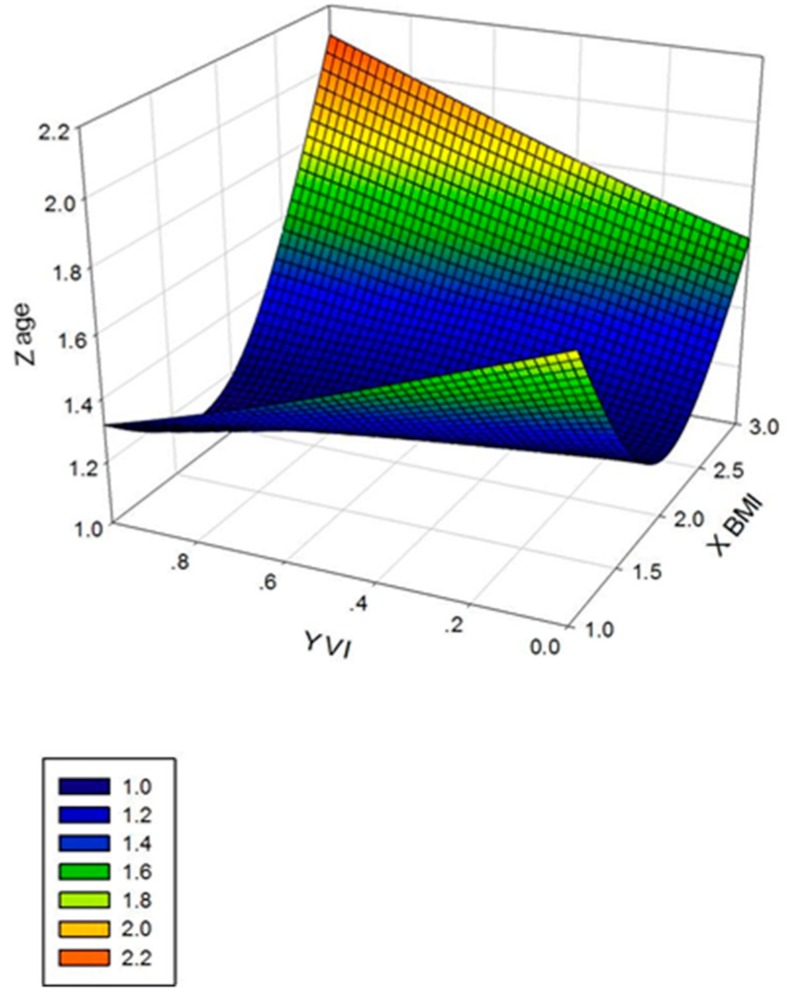
Body Mass Index (BMI) is a risk indicator for some eye diseases. However, the association between BMI and Visual Impairment (VI) was not quite certain in Chinese students. Our aim was to assess the relationship between BMI and VI with a cross-sectional study. A total of 3771 students aged 6-21 years, including 729 with VI, were sampled from 24 schools in Huangpi District of central China to participate in the study. A multistage stratified cluster random sampling was adopted. Each of the students answered a questionnaire and had physical and eye examinations. The association between BMI and VI was examined with logistic regression and threshold effect analysis. The prevalence of VI was 19.33% (729/3771). Compared to normal and underweight, overweight/obese students showed a stronger relation with VI in age- and sex-adjusted (Odds Ratio (OR) = 16.16, 95% Confidence Interval (CI): 12.37-21.09, < 0.001) and multivariable models (OR = 8.32, 95% CI: 6.13-11.30, < 0.001). There was a nonlinear dose-response relation between levels of BMI and the prevalence of VI ( < 0.001). A high level of BMI (≥19.81 kg/m²) was associated with a higher VI prevalence (adjusted OR = 1.20, 95% CI: 1.15-1.25, < 0.001). In conclusion, the study demonstrated BMI levels were significantly associated with the prevalence of VI.
体重指数(BMI)是某些眼部疾病的风险指标。然而,在中国学生中,BMI与视力损害(VI)之间的关联并不十分确定。我们的目的是通过一项横断面研究评估BMI与VI之间的关系。从中国中部黄陂区的24所学校抽取了3771名6至21岁的学生,其中包括729名视力受损学生,参与了这项研究。采用多阶段分层整群随机抽样。每位学生都回答了一份问卷,并进行了身体和眼部检查。通过逻辑回归和阈值效应分析检验BMI与VI之间的关联。视力损害的患病率为19.33%(729/3771)。与正常体重和体重不足的学生相比,超重/肥胖学生在年龄和性别调整模型(优势比(OR)=16.16,95%置信区间(CI):12.37-21.09,P<0.001)和多变量模型(OR = 8.32,95% CI:6.13-11.30,P<0.001)中与视力损害的关系更强。BMI水平与视力损害患病率之间存在非线性剂量反应关系(P<0.001)。高BMI水平(≥19.81kg/m²)与较高的视力损害患病率相关(调整后的OR = 1.20,95% CI:1.15-1.25,P<0.001)。总之,该研究表明BMI水平与视力损害患病率显著相关。