Tsang Greg, Insel Michael B, Weis Justin M, Morgan Mary Anne M, Gough Michael S, Frasier Lauren M, Mack Cynthia M, Doolin Kathleen P, Graves Brian T, Apostolakos Michael J, Pietropaoli Anthony P
Division of Pulmonary and Critical Care Medicine, Department of Medicine, University of Rochester Medical Center, 601 Elmwood Avenue, Rochester, NY, 14642, USA.
Department of Nursing, University of Rochester Medical Center, 601 Elmwood Avenue, Rochester, NY, 14642, USA.
Crit Care. 2016 Oct 21;20(1):335. doi: 10.1186/s13054-016-1525-9.
Experimental studies demonstrate beneficial immunological and hemodynamic effects of estradiol in animal models of sepsis. This raises the question whether estradiol contributes to sex differences in the incidence and outcomes of sepsis in humans. Yet, total estradiol levels are elevated in sepsis patients, particularly nonsurvivors. Bioavailable estradiol concentrations have not previously been reported in septic patients. The bioavailable estradiol concentration accounts for aberrations in estradiol carrier protein concentrations that could produce discrepancies between total and bioavailable estradiol levels. We hypothesized that bioavailable estradiol levels are low in septic patients and sepsis nonsurvivors.
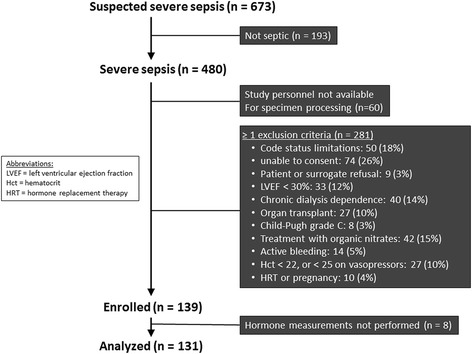
We conducted a combined case-control and prospective cohort study. Venous blood samples were obtained from 131 critically ill septic patients in the medical and surgical intensive care units at the University of Rochester Medical Center and 51 control subjects without acute illness. Serum bioavailable estradiol concentrations were calculated using measurements of total estradiol, sex hormone-binding globulin, and albumin. Comparisons were made between patients with severe sepsis and control subjects and between hospital survivors and nonsurvivors. Multivariable logistic regression analysis was also performed.
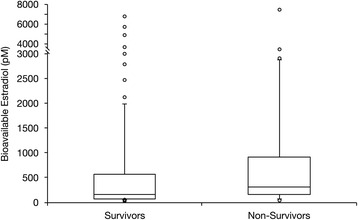
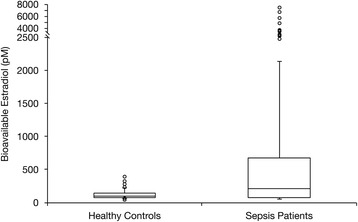
Bioavailable estradiol concentrations were significantly higher in sepsis patients than in control subjects (211 [78-675] pM vs. 100 [78-142] pM, p < 0.01) and in sepsis nonsurvivors than in survivors (312 [164-918] pM vs. 167 [70-566] pM, p = 0.04). After adjustment for age and comorbidities, patients with bioavailable estradiol levels above the median value had significantly higher risk of hospital mortality (OR 4.27, 95 % CI 1.65-11.06, p = 0.003). Bioavailable estradiol levels were directly correlated with severity of illness and did not differ between men and women.
Contrary to our hypothesis, bioavailable estradiol levels were elevated in sepsis patients, particularly nonsurvivors, and were independently associated with mortality. Whether estradiol's effects are harmful, beneficial, or neutral in septic patients remains unknown, but our findings raise caution about estradiol's therapeutic potential in this setting. Our findings do not provide an explanation for sex-based differences in sepsis incidence and outcomes.
实验研究表明,在脓毒症动物模型中,雌二醇具有有益的免疫和血流动力学效应。这就提出了一个问题,即雌二醇是否会导致人类脓毒症发病率和预后的性别差异。然而,脓毒症患者,尤其是非幸存者,其总雌二醇水平会升高。此前尚未报道过脓毒症患者的生物可利用雌二醇浓度。生物可利用雌二醇浓度考虑了雌二醇载体蛋白浓度的异常情况,这可能会导致总雌二醇水平与生物可利用雌二醇水平之间出现差异。我们假设脓毒症患者和脓毒症非幸存者的生物可利用雌二醇水平较低。
我们进行了一项病例对照与前瞻性队列相结合的研究。从罗切斯特大学医学中心内科和外科重症监护病房的131例重症脓毒症患者以及51例无急性疾病的对照受试者中采集静脉血样。使用总雌二醇、性激素结合球蛋白和白蛋白的测量值计算血清生物可利用雌二醇浓度。对严重脓毒症患者与对照受试者之间以及医院幸存者与非幸存者之间进行了比较。还进行了多变量逻辑回归分析。
脓毒症患者的生物可利用雌二醇浓度显著高于对照受试者(211[78 - 675]pM对100[78 - 142]pM,p < 0.01),脓毒症非幸存者的生物可利用雌二醇浓度显著高于幸存者(312[164 - 918]pM对167[70 - 566]pM,p = 0.04)。在调整年龄和合并症后,生物可利用雌二醇水平高于中位数的患者医院死亡率显著更高(比值比4.27,95%置信区间1.65 - 11.06,p = 0.003)。生物可利用雌二醇水平与疾病严重程度直接相关,且男女之间无差异。
与我们的假设相反,脓毒症患者,尤其是非幸存者,其生物可利用雌二醇水平升高,且与死亡率独立相关。在脓毒症患者中,雌二醇的作用是有害、有益还是中性尚不清楚,但我们的研究结果对雌二醇在这种情况下的治疗潜力提出了警示。我们的研究结果并未解释脓毒症发病率和预后的性别差异。