Division of Pulmonary and Critical Care Medicine, Department of Nursing, University of Rochester Medical Center, Rochester, NY, USA.
Crit Care Med. 2011 Jun;39(6):1351-8. doi: 10.1097/CCM.0b013e318212097c.
Arginine deficiency may contribute to microvascular dysfunction, but previous studies suggest that arginine supplementation may be harmful in sepsis. Systemic arginine availability can be estimated by measuring the ratio of arginine to its endogenous inhibitors, asymmetric and symmetric dimethylarginine. We hypothesized that the arginine-to-dimethylarginine ratio is reduced in patients with severe sepsis and associated with severity of illness and outcomes.
Case-control and prospective cohort study.
Medical and surgical intensive care units of an academic medical center.
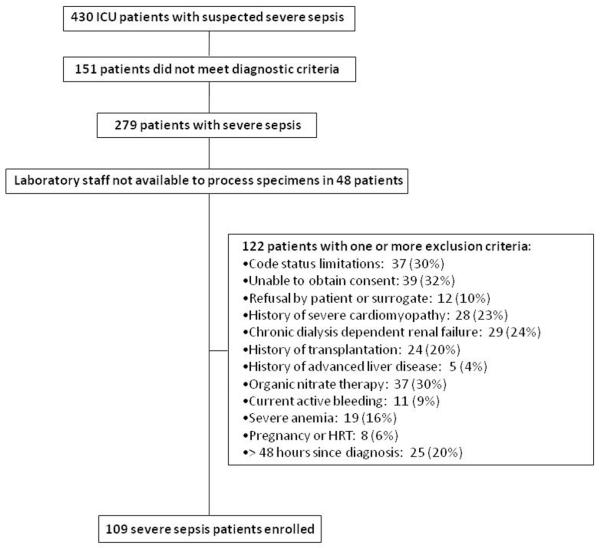
One hundred nine severe sepsis and 50 control subjects.
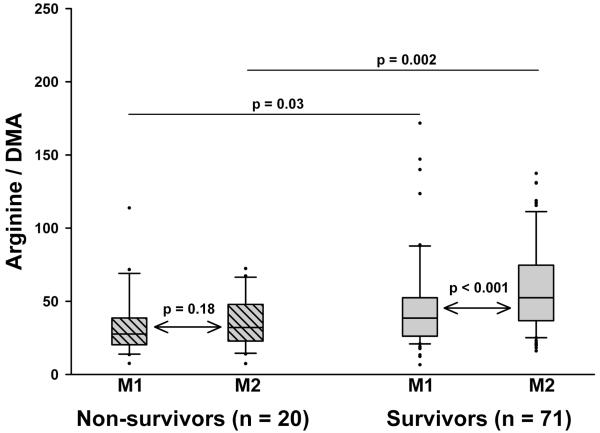
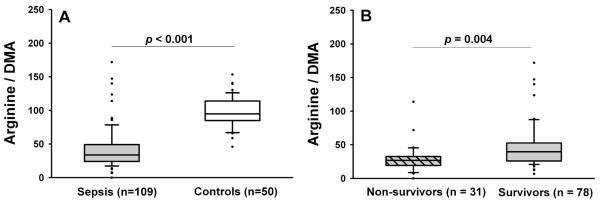
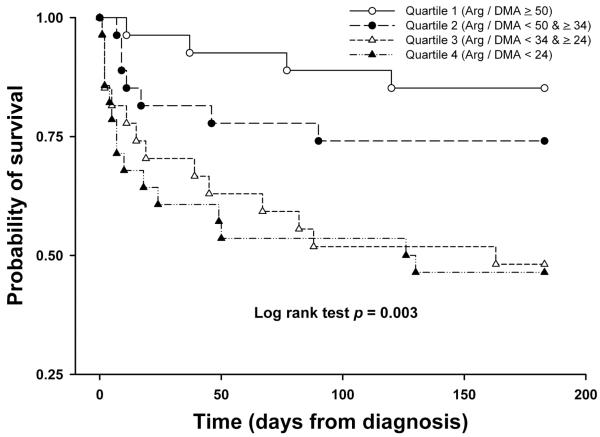
Plasma and urine were obtained in control subjects and within 48 hrs of diagnosis in severe sepsis patients. The arginine-to-dimethylarginine ratio was higher in control subjects vs. sepsis patients (median, 95; interquartile range, 85-114; vs. median, 34; interquartile range, 24-48; p < .001) and in hospital survivors vs. nonsurvivors (median, 39; interquartile range, 26-52; vs. median, 27; interquartile range, 19-32; p = .004). The arginine-to-dimethylarginine ratio was correlated with Acute Physiology and Chronic Health Evaluation II score (Spearman's correlation coefficient [ρ] = - 0.40; p < .001) and organ-failure free days (ρ = 0.30; p = .001). A declining arginine-to-dimethylarginine ratio was independently associated with hospital mortality (odds ratio, 1.63 per quartile; 95% confidence interval, 1.00-2.65; p = .048) and risk of death over the course of 6 months (hazard ratio, 1.41 per quartile; 95% confidence interval, 1.01-1.98; p = .043). The arginine-to-dimethylarginine ratio was correlated with the urinary nitrate-to-creatinine ratio (ρ = 0.46; p < .001).
The arginine-to-dimethylarginine ratio is associated with severe sepsis, severity of illness, and clinical outcomes. The arginine-to-dimethylarginine ratio may be a useful biomarker, and interventions designed to augment systemic arginine availability in severe sepsis may still be worthy of investigation.
精氨酸缺乏可能导致微血管功能障碍,但先前的研究表明,精氨酸补充可能对脓毒症有害。可以通过测量精氨酸与其内源性抑制剂不对称和对称二甲基精氨酸的比值来估计全身精氨酸的可用性。我们假设,严重脓毒症患者的精氨酸/二甲基精氨酸比值降低,并与疾病严重程度和结局相关。
病例对照和前瞻性队列研究。
学术医疗中心的内科和外科重症监护病房。
109 例严重脓毒症患者和 50 例对照受试者。
在对照受试者中以及在严重脓毒症患者诊断后的 48 小时内获得了血浆和尿液。与脓毒症患者相比,对照组的精氨酸/二甲基精氨酸比值更高(中位数,95;四分位距,85-114;vs.中位数,34;四分位距,24-48;p<.001),与住院幸存者相比,非幸存者更高(中位数,39;四分位距,26-52;vs.中位数,27;四分位距,19-32;p=0.004)。精氨酸/二甲基精氨酸比值与急性生理学和慢性健康评估Ⅱ评分(Spearman 相关系数[ρ] =-0.40;p<.001)和无器官衰竭存活天数(ρ=0.30;p=0.001)相关。精氨酸/二甲基精氨酸比值逐渐降低与住院死亡率独立相关(优势比,每四分位数 1.63;95%置信区间,1.00-2.65;p=0.048)和 6 个月内死亡风险(风险比,每四分位数 1.41;95%置信区间,1.01-1.98;p=0.043)相关。精氨酸/二甲基精氨酸比值与尿硝酸盐/肌酐比值相关(ρ=0.46;p<.001)。
精氨酸/二甲基精氨酸比值与严重脓毒症、疾病严重程度和临床结局相关。精氨酸/二甲基精氨酸比值可能是一种有用的生物标志物,旨在增加严重脓毒症患者全身精氨酸可用性的干预措施可能仍值得研究。