Loucks Eric B, Huang Yen-Tsung, Agha Golareh, Chu Su, Eaton Charles B, Gilman Stephen E, Buka Stephen L, Kelsey Karl T
From the Department of Epidemiology (Loucks, Huang, Chu, Eaton, Buka, Kelsey), Brown University School of Public Health, Providence, Rhode Island; Department of Environmental Health (Agha), Harvard T.H. Chan School of Public Health, Boston, Massachusetts; Department of Family Medicine (Eaton), Brown University Warren Alpert Medical School, Providence, Rhode Island; Health Behavior Branch, Division of Intramural Population Health Research (Gilman), Eunice Kennedy Shriver National Institute of Child Health and Human Development, Rockville, Maryland; and Department of Social and Behavioral Sciences and Department of Epidemiology (Gilman), Harvard T.H. Chan School of Public Health, Boston, Massachusetts.
Psychosom Med. 2016 Nov/Dec;78(9):1053-1065. doi: 10.1097/PSY.0000000000000411.
Childhood socioeconomic disadvantage is associated with adulthood obesity risk; however, epigenetic mechanisms are poorly understood. This work's objective was to evaluate whether associations of childhood socioeconomic disadvantage with adulthood body mass index (BMI) are mediated by DNA methylation.
Participants were 141 men and women from the New England Family Study, prospectively followed prenatally through a mean age of 47 years. Epigenomewide DNA methylation was evaluated in peripheral blood and adipose tissue obtained at adulthood, using the Infinium HumanMethylation450K BeadChip. Childhood socioeconomic status (SES) at age 7 years was assessed directly from parents' reports. Offspring adiposity was directly assessed using BMI at a mean age of 47 years. Associations of SES, DNA methylation, and BMI were estimated using least square estimators. Statistical mediation analyses were performed using joint significance test and bootstrapping.
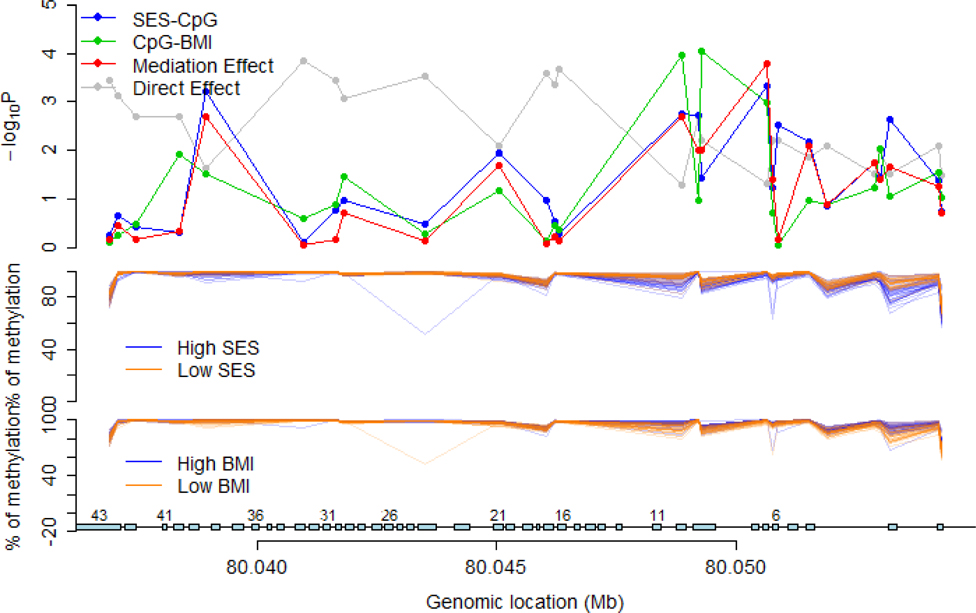
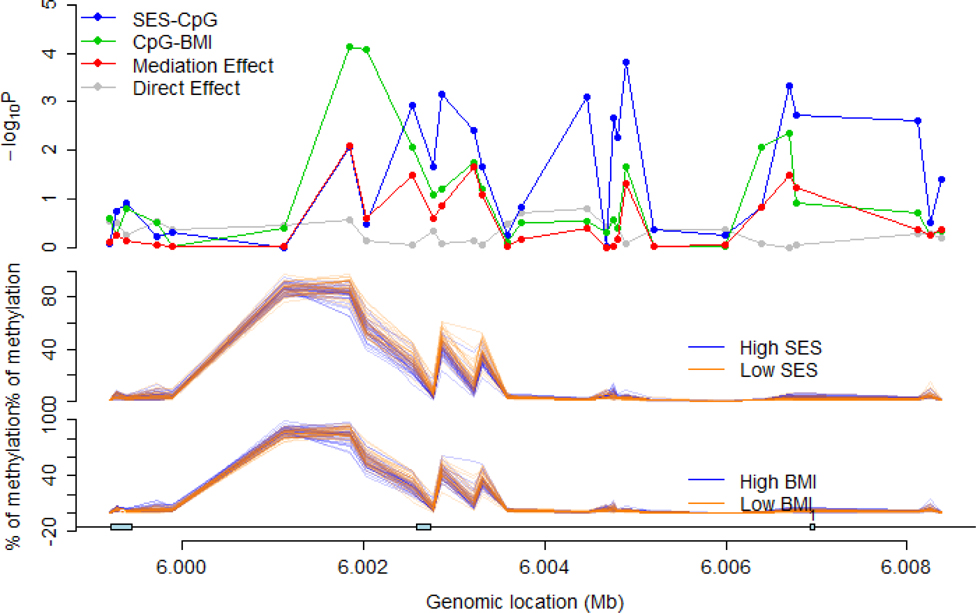
Of CpG sites significant at the 25% false discovery rate level in epigenomewide methylation BMI analyses, 91 sites in men and 71 sites in women were additionally significant for SES-methylation associations (p < .001) in adipose tissue. Many involved genes biologically relevant for development of obesity, including fatty acid synthase, transmembrane protein 88, signal transducer and activator of transcription 3, and neuritin 1. There was no evidence of epigenetic mediation in peripheral blood leukocytes.
DNA methylation at specific genes may be mediators of associations between childhood socioeconomic disadvantage and mid-life BMI in adipose tissue. Findings motivate continued efforts to study if and how childhood socioeconomic disadvantage is biologically embedded at the level of the epigenome in regions etiologically relevant for adiposity.
儿童期社会经济劣势与成年期肥胖风险相关;然而,表观遗传机制却知之甚少。本研究的目的是评估儿童期社会经济劣势与成年期体重指数(BMI)之间的关联是否由DNA甲基化介导。
研究对象为来自新英格兰家庭研究的141名男性和女性,从孕期开始进行前瞻性随访,直至平均年龄47岁。使用Infinium HumanMethylation450K芯片对成年期采集的外周血和脂肪组织进行全基因组DNA甲基化评估。通过父母报告直接评估7岁时儿童的社会经济地位(SES)。在平均年龄47岁时,使用BMI直接评估后代肥胖情况。使用最小二乘估计量估计SES、DNA甲基化和BMI之间的关联。使用联合显著性检验和自抽样法进行统计中介分析。
在全基因组甲基化BMI分析中,错误发现率水平为25%时显著的CpG位点中,脂肪组织中91个男性位点和71个女性位点在SES-甲基化关联中也显著(p <.001)。许多相关基因在肥胖发生中具有生物学相关性,包括脂肪酸合酶、跨膜蛋白88、信号转导和转录激活因子3以及神经生长因子1。在外周血白细胞中没有表观遗传介导的证据。
特定基因的DNA甲基化可能是儿童期社会经济劣势与脂肪组织中年期BMI之间关联的介导因素。这些发现促使人们继续努力研究儿童期社会经济劣势是否以及如何在表观基因组水平上在与肥胖病因相关的区域中被生物学嵌入。