Vanneste Yvonne T M, Mathijssen Jolanda J P, van de Goor Ien A M, Rots-de Vries Carin M C, Feron Frans J M
Regional Public Health Service West Brabant, PO Box 3024, 5003 DA, Tilburg, The Netherlands.
Faculty of Social and Behavioural Sciences, Tranzo, Tilburg University, PO Box 90153, 5000 LE, Tilburg, The Netherlands.
BMC Public Health. 2016 Oct 21;16(1):1107. doi: 10.1186/s12889-016-3718-1.
Students' health and school absenteeism affect educational level, with adverse effects on their future health. This interdependence is reflected in medical absenteeism. In the Netherlands, a public health intervention has been developed to address medical absenteeism in pre-vocational secondary education. This study aims to investigate the effectiveness of this intervention on students' medical absenteeism, compared to "medical absenteeism policy as usual".
A quasi-experimental design with an intervention group (493 students) and a control group (445 students) was applied. Multilevel analysis was used to study differences in the development of the level of a student's medical absence over time (after 3 and 12 months).
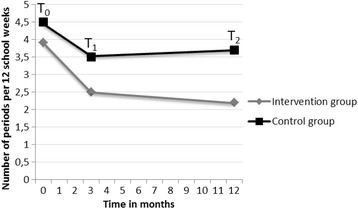
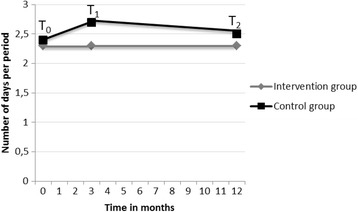
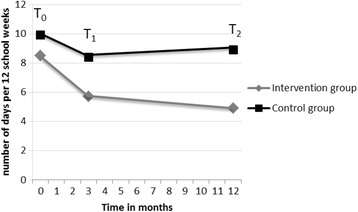
In the intervention group, the level of absenteeism decreased from 8.5 days reported sick in 12 school weeks to 5.7 days after 3 months, and to 4.9 days after 12 months. The number of absence periods fell from 3.9 in 12 school weeks to 2.5 after 3 months, and to 2.2 after 12 months. In the control group, the absence days initially decreased from 9.9 days reported sick in 12 school weeks to 8.4 days after 3 months, after which an increase to 8.9 days was measured. The number of absence periods initially decreased from 4.5 in 12 school weeks to 3.5, after which an increase to 3.7 was measured. The number of absence days per period remained about the same in both groups.
The study provides first indications for the intervention to be effective for Dutch pre-vocational secondary students with increased medical absence rates. The intervention, which consists of personalised management of medical absenteeism by systematic identification of students with extensive medical absenteeism and consistent referral to youth health care physicians, appears to reduce the absence rates more effectively than "medical absenteeism policy as usual". The effectiveness of the intervention is shown primarily by a decrease in the number of periods reported sick.
学生的健康状况和缺课情况会影响教育水平,并对其未来健康产生不利影响。这种相互依存关系体现在因病缺课方面。在荷兰,已制定一项公共卫生干预措施来解决职业前中等教育阶段的因病缺课问题。本研究旨在调查与“照常执行的因病缺课政策”相比,该干预措施对学生因病缺课情况的有效性。
采用了一个准实验设计,设有干预组(493名学生)和对照组(445名学生)。运用多水平分析来研究学生因病缺课水平随时间(3个月和12个月后)变化的差异。
在干预组中,缺课天数从12个教学周内报告的8.5天病假降至3个月后的5.7天,12个月后降至4.9天。缺课次数从12个教学周内的3.9次降至3个月后的2.5次,12个月后降至2.2次。在对照组中,缺课天数最初从12个教学周内报告的9.9天病假降至3个月后的8.4天,之后又增至8.9天。缺课次数最初从12个教学周内的4.5次降至3.5次,之后增至3.7次。两组中每个时间段的缺课天数基本保持不变。
该研究首次表明,该干预措施对因病缺课率较高的荷兰职业前中等教育学生有效。该干预措施包括通过系统识别因病缺课较多的学生并持续转介给青少年保健医生,对因病缺课进行个性化管理,似乎比“照常执行的因病缺课政策”更有效地降低了缺课率。干预措施的有效性主要体现在病假报告次数的减少上。