
综合精神卫生保健与职业康复以提高因精疲力竭症、适应障碍和精神困扰而休病假者的复工率(丹麦IBBIS试验):一项随机对照试验的研究方案
Integrated mental health care and vocational rehabilitation to improve return to work rates for people on sick leave because of exhaustion disorder, adjustment disorder, and distress (the Danish IBBIS trial): study protocol for a randomized controlled trial.
作者信息
Poulsen Rie, Fisker Jonas, Hoff Andreas, Hjorthøj Carsten, Eplov Lene Falgaard
机构信息
Mental Health Center Copenhagen, Mental Health Services Capital Region of Denmark, University of Copenhagen, Kildegårdsvej 28, 2900, Hellerup, Copenhagen, Denmark.
出版信息
Trials. 2017 Dec 2;18(1):579. doi: 10.1186/s13063-017-2273-0.
BACKGROUND
Common mental disorders are important contributors to the global burden of disease and cause negative effects on both the individual and society. Stress-related disorders influence the individual's workability and cause early retirement pensions in Denmark. There is no clear evidence that mental health care alone will provide sufficient support for vocational recovery for this group. Integrated vocational and health care services have shown good effects on return to work in other similar welfare contexts. The purpose of the Danish IBBIS (Integreret Behandlings- og BeskæftigelsesIndsats til Sygemeldte) study is to examine the efficacy of (1) a stepped mental health care intervention with individual stress coaching and/or group-based MBSR and (2) an integrated stepped mental health care with individual stress coaching and/or group-based MBSR and vocational rehabilitation intervention for people on sick leave because of exhaustion disorder, adjustment disorder or distress in Denmark.
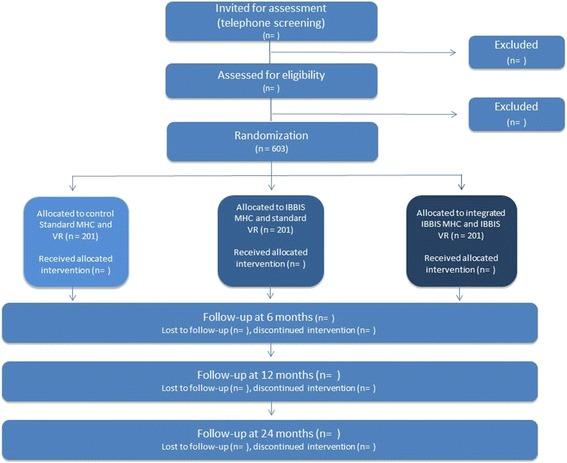
METHOD/DESIGN: This three-armed, parallel-group, randomized superiority trial is set up to investigate the effectiveness of a stepped mental health care intervention and an integrated mental health care and vocational rehabilitation intervention for people on sick leave because of exhaustion disorder, adjustment disorder or distress in Denmark. The trial has an investigator-initiated multicenter design. Six hundred and three patients will be recruited from Danish vocational rehabilitation centers in four municipalities and randomly assigned into three groups: (1) IBBIS mental health care integrated with IBBIS vocational rehabilitation, (2) IBBIS mental health care and standard vocational rehabilitation, and (3) standard mental health care and standard vocational rehabilitation. The primary outcome is register-based return to work at 12 months. The secondary outcome measures are self-assessed level of depression (BDI), anxiety (BAI), distress symptoms (4DSQ), work- and social functioning (WSAS), and register-based recurrent sickness absence.
DISCUSSION
This study will contribute with knowledge on the consequence of the current organizational separation of health care interventions and vocational rehabilitation regarding the individual's process of returning to work after sick leave because of exhaustion disorder, adjustment disorder or distress. If the effect on return to work, symptom level, and recurrent sick leave is different in the intervention groups, this study can contribute with new knowledge on shared care models and the potential for preventing deterioration in stress symptoms, prolonged sick leave, and recurrent sick leave.
TRIAL REGISTRATION
ClinicalTrials.gov, registration number: NCT02885519 . Retrospectively registered on 15 August 2016). Participants have been included in the IBBIS trial for distress, adjustment disorder and exhaustion disorder since April 2016.
背景
常见精神障碍是全球疾病负担的重要促成因素,对个人和社会都会产生负面影响。与压力相关的障碍会影响个人的工作能力,并导致丹麦的提前退休养老金问题。目前尚无明确证据表明单纯的精神卫生保健就能为该群体的职业康复提供足够支持。在其他类似的福利环境中,综合职业与卫生保健服务已显示出对重返工作岗位有良好效果。丹麦IBBIS(Integreret Behandlings-og BeskæftigelsesIndsats til Sygemeldte,即针对病假人员的综合治疗与就业举措)研究的目的是检验以下两种干预措施的效果:(1)一种逐步推进的精神卫生保健干预,包括个体压力辅导和/或基于团体的正念减压疗法(MBSR);(2)一种综合的逐步推进的精神卫生保健干预,包括个体压力辅导和/或基于团体的MBSR以及职业康复干预,针对丹麦因精疲力竭症、适应障碍或精神困扰而休病假的人员。
方法/设计:这项三臂、平行组、随机优效性试验旨在研究一种逐步推进的精神卫生保健干预以及一种综合精神卫生保健与职业康复干预对于丹麦因精疲力竭症、适应障碍或精神困扰而休病假人员的有效性。该试验采用研究者发起的多中心设计。将从四个城市的丹麦职业康复中心招募603名患者,并随机分为三组:(1)IBBIS精神卫生保健与IBBIS职业康复相结合组;(2)IBBIS精神卫生保健与标准职业康复组;(3)标准精神卫生保健与标准职业康复组。主要结局是基于登记的12个月时重返工作岗位情况。次要结局指标包括自我评估的抑郁水平(贝克抑郁量表,BDI)、焦虑水平(贝克焦虑量表,BAI);困扰症状(4DSQ)、工作和社会功能(工作与社会适应量表,WSAS)以及基于登记的复发性病假情况。
讨论
本研究将提供关于当前卫生保健干预与职业康复在组织上相分离对于因精疲力竭症、适应障碍或精神困扰而休病假的个人重返工作岗位过程的影响的相关知识。如果干预组在重返工作岗位、症状水平和复发性病假方面的效果存在差异,本研究可为共享照护模式以及预防压力症状恶化、长期病假和复发性病假的可能性提供新知识。
试验注册
ClinicalTrials.gov,注册号:NCT02885519(2016年8月15日追溯注册)。自2016年4月起,参与者已被纳入针对精神困扰、适应障碍和精疲力竭症的IBBIS试验。
 Zotero 插件