Azizi Amirabbas, Aboutorabi Robab, Mazloum-Khorasani Zahra, Afzal-Aghaea Monavar, Tabesh Hamed, Tara Mahmood
School of Paramedicine, Department of Health Information Technology, Ahvaz Jundishapur University of Medical Sciences, Ahvaz, Islamic Republic of Iran.
JMIR Med Inform. 2016 Oct 21;4(4):e32. doi: 10.2196/medinform.6433.
There are 4 main types of chronic or noncommunicable diseases. Of these, diabetes is one of the major therapeutic concerns globally. Moreover, Iran is among the countries with the highest incidence of diabetic patients. Furthermore, library-based studies by researchers have shown that thus far no study has been carried out to evaluate the relationship between Web-based diabetic personal health records (DPHR) and self-care indicators in Iran.
The objective of this study is to examine the effect of Web-based DPHR on self-care status of diabetic patients in an intervention group as compared with a control group.
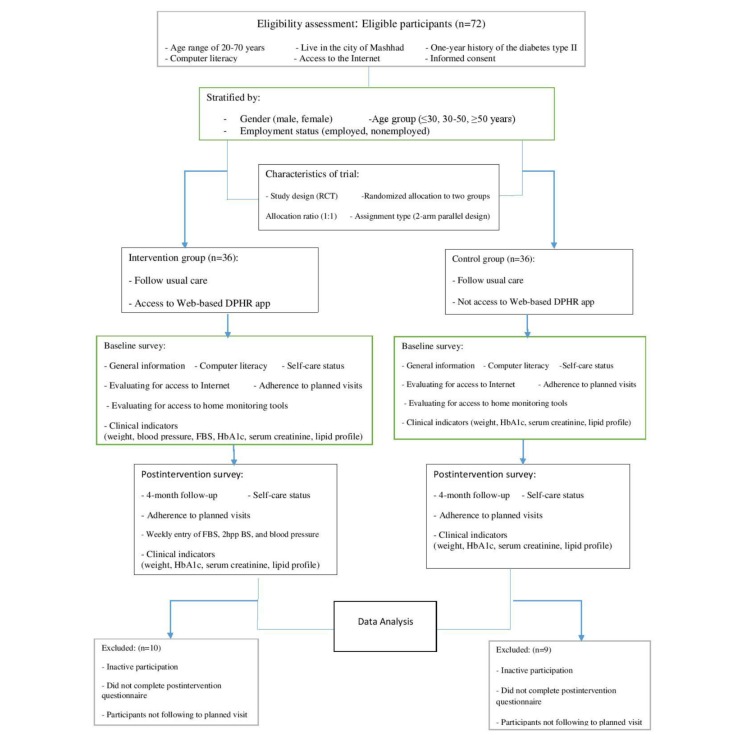
The effect of DPHR on self-care was assessed by using a randomized controlled trial (RCT) protocol for a 2-arm parallel group with a 1:1 allocation ratio. During a 4-month trial period, the control group benefited from the routine care; the intervention group additionally had access to the Web-based DPHR app besides routine care. During the trial, 2 time points at baseline and postintervention were used to evaluate the impact of the DPHR app. A sample size of 72 people was randomly and equally assigned to both the control and intervention groups. The primary outcome measure was the self-care status of the participants.
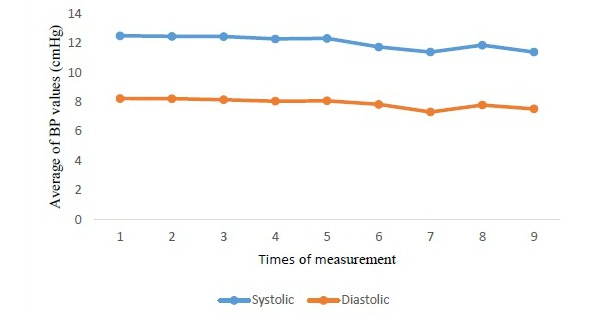
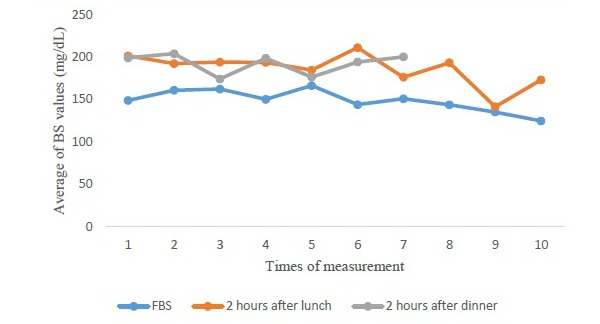
Test results showed that the self-care status in the intervention group in comparison with the control group had a significant difference. In addition, the dimensions of self-care, including normal values, changes trend, the last measured value, and the last time measured values had a significant difference while other dimensions had no significant difference. Furthermore, we found no correlation between Web-based DPHR system and covariates, including scores of weight, glycated hemoglobin (HbA1c), serum creatinine, high-density lipoprotein (HDL), low-density lipoprotein (LDL), total cholesterol, and planned visit adherence, as well as the change trend of mean for blood glucose and blood pressure.
We found that as a result of the Web-based DPHR app, the self-care scores in the intervention group were significantly higher than those of the control group. In total, we found no correlation between the Web-based DPHR app and covariates, including planned visit adherence, HbA1c, serum creatinine, HDL, LDL, total cholesterol, weight, and the change trend of mean for blood glucose and blood pressure.
Iranian Registry of Clinical Trials (IRCT): 2013082914522N1; http://www.irct.ir/searchresult.php?id= 14522&number=1 (Archived by WebCite at http://www.webcitation.org/6cC4PCcau).
慢性或非传染性疾病主要有4种类型。其中,糖尿病是全球主要的治疗关注点之一。此外,伊朗是糖尿病患者发病率最高的国家之一。而且,研究人员基于文献的研究表明,迄今为止,伊朗尚未开展任何研究来评估基于网络的糖尿病个人健康记录(DPHR)与自我护理指标之间的关系。
本研究的目的是检验与对照组相比,基于网络的DPHR对干预组糖尿病患者自我护理状况的影响。
采用随机对照试验(RCT)方案对一个双臂平行组进行1:1分配比例,评估DPHR对自我护理的影响。在为期4个月的试验期内,对照组接受常规护理;干预组除常规护理外,还可使用基于网络的DPHR应用程序。在试验期间,使用基线和干预后的2个时间点来评估DPHR应用程序的影响。72人的样本被随机且平均分配到对照组和干预组。主要结局指标是参与者的自我护理状况。
测试结果表明,干预组的自我护理状况与对照组相比有显著差异。此外,自我护理的维度,包括正常值、变化趋势、最后测量值和最后一次测量时间值有显著差异,而其他维度无显著差异。此外,我们发现基于网络的DPHR系统与协变量之间无相关性,这些协变量包括体重、糖化血红蛋白(HbA1c)、血清肌酐、高密度脂蛋白(HDL)、低密度脂蛋白(LDL)、总胆固醇、计划就诊依从性以及血糖和血压平均值的变化趋势。
我们发现,由于基于网络的DPHR应用程序,干预组的自我护理得分显著高于对照组。总体而言,我们发现基于网络的DPHR应用程序与协变量之间无相关性,这些协变量包括计划就诊依从性、HbA1c、血清肌酐、HDL、LDL、总胆固醇、体重以及血糖和血压平均值的变化趋势。
伊朗临床试验注册中心(IRCT):2013082914522N1;http://www.irct.ir/searchresult.php?id= 14522&number=1(由WebCite存档于http://www.webcitation.org/6cC4PCcau)。