Verdun di Cantogno Elisabetta, Tomlinson Mark, Manuel Laure, Thakur Kunal
Novartis Pharma AG, Basel, Switzerland.
Adelphi Research, Bollington, Cheshire, UK.
Pragmat Obs Res. 2014 Dec 12;5:53-64. doi: 10.2147/POR.S72012. eCollection 2014.
This international survey recorded the opinions of multiple sclerosis (MS) nurses about their role in treatment decision making and about the importance of different attributes of autoinjectors used to deliver first-line parenteral therapy.
The survey involved 52 MS nurses in different practice settings in France, Germany, Italy, the UK, and the USA. Nurses described their role in patient education and in treatment decision making. They also rated the importance of nine prespecified attributes of autoinjectors and stated their preference, both overall and by attribute, for one of two autoinjectors used to deliver interferon β-1b (ExtaviPro 30G and Betacomfort). Nurses' preferences were compared with those previously collected from patients using an identical questionnaire.
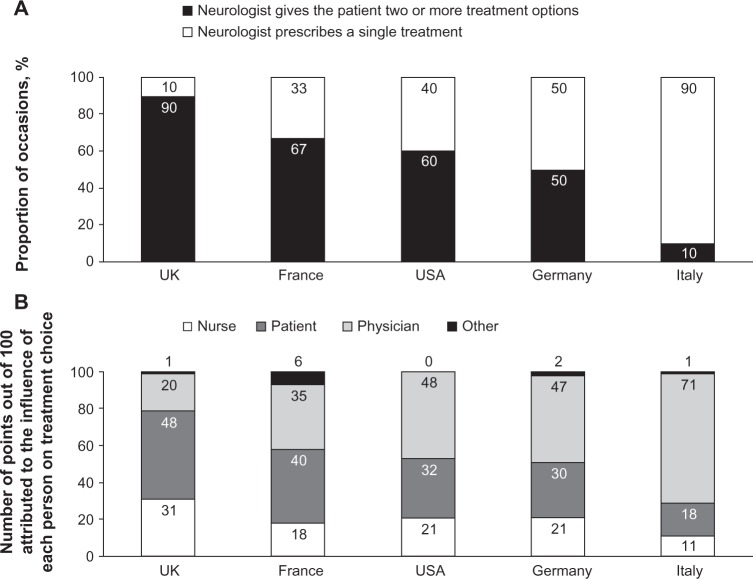
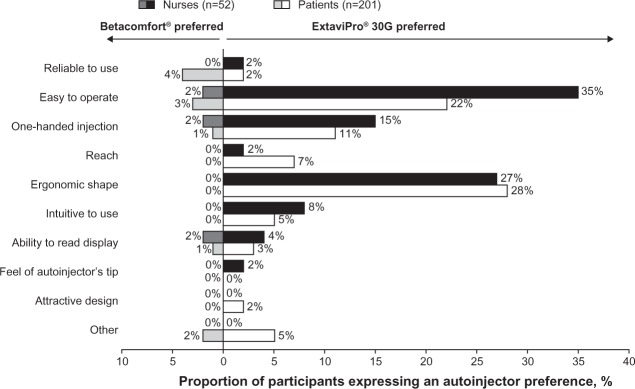
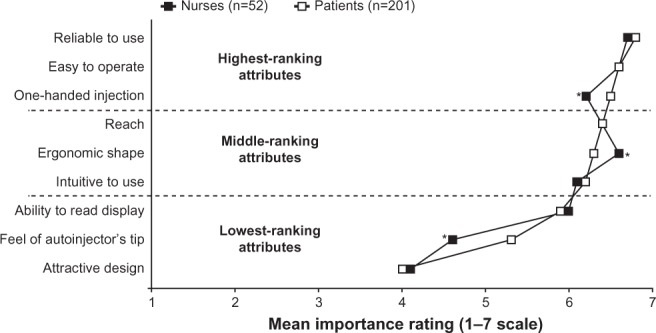
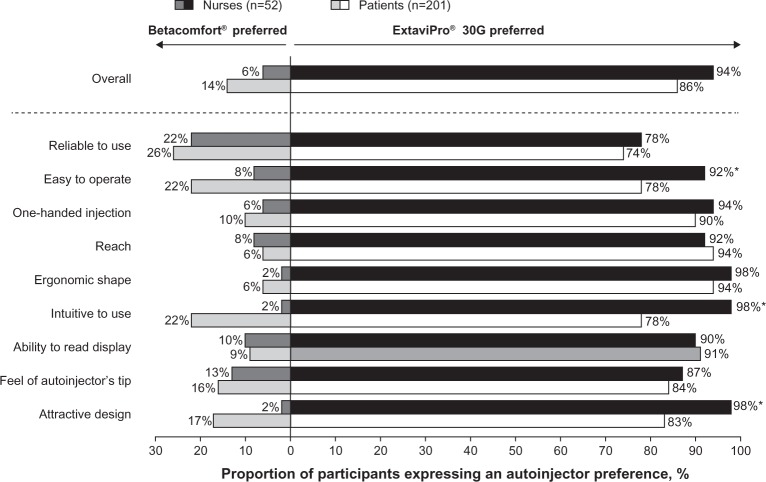
There were pronounced differences between practice settings and between countries in the opinions of MS nurses about their influence on treatment decision making. Nurses considered themselves instrumental in helping patients decide between treatment options offered by neurologists. Of the nine autoinjector attributes, nurses rated "reliable to use" as most important, followed by attributes associated with convenience ("easy to operate," "ergonomic shape," "reach" [of injection sites], and "one-handed injection"). Nurses' and patients' rankings of attributes were closely aligned. For the nine attributes, 74%-98% of nurses preferred ExtaviPro 30G to Betacomfort, 94% preferring ExtaviPro 30G overall. Nurses showed a greater preference than patients for ExtaviPro 30G with respect to "easy to operate" (92% vs 78%), "intuitive to use" (98% vs 78%), and "attractive design" (98% vs 83%; <0.05, all), but preference rates were otherwise similar across the two groups. The most common reasons in both groups for preferring ExtaviPro 30G to Betacomfort were "easy to use" and "ergonomic shape."
MS nurses play a key role in patient guidance and education. Their preferences for ExtaviPro 30G likely reflect their understanding of the challenges patients face when self-administering treatment.
这项国际调查记录了多发性硬化症(MS)护士对于其在治疗决策中的作用以及用于一线胃肠外治疗的自动注射器不同属性的重要性的看法。
该调查涉及法国、德国、意大利、英国和美国不同执业环境中的52名MS护士。护士们描述了他们在患者教育和治疗决策中的作用。他们还对自动注射器的九个预先指定的属性的重要性进行了评分,并说明了他们对用于递送干扰素β-1b的两种自动注射器(ExtaviPro 30G和Betacomfort)之一的总体偏好以及按属性的偏好。护士们的偏好与之前使用相同问卷从患者那里收集到的偏好进行了比较。
MS护士对于其对治疗决策的影响的看法在执业环境之间和国家之间存在明显差异。护士们认为自己在帮助患者在神经科医生提供的治疗方案之间做出决定方面发挥了重要作用。在自动注射器的九个属性中,护士们将“使用可靠”评为最重要,其次是与便利性相关的属性(“易于操作”、“符合人体工程学的形状”、“(注射部位的)可达性”和“单手注射”)。护士和患者对属性的排名密切一致。对于这九个属性,74%-98%的护士更喜欢ExtaviPro 30G而不是Betacomfort,总体上94%的护士更喜欢ExtaviPro 30G。在“易于操作”(92%对78%)、“使用直观”(98%对78%)和“设计吸引人”(98%对83%;均P<0.05)方面,护士比患者更倾向于ExtaviPro 30G,但两组的偏好率在其他方面相似。两组中更喜欢ExtaviPro 30G而不是Betacomfort的最常见原因是“易于使用”和“符合人体工程学的形状”。
MS护士在患者指导和教育中发挥着关键作用。他们对ExtaviPro 30G的偏好可能反映了他们对患者自我给药治疗时所面临挑战的理解。