• 文献检索
  • 文档翻译
  • 深度研究
  • 学术资讯
  • Suppr Zotero 插件Zotero 插件
  • 邀请有礼
  • 套餐&价格
  • 历史记录
应用&插件
Suppr Zotero 插件Zotero 插件浏览器插件Mac 客户端Windows 客户端微信小程序
定价
高级版会员购买积分包购买API积分包
服务
文献检索文档翻译深度研究API 文档MCP 服务
关于我们
关于 Suppr公司介绍联系我们用户协议隐私条款
关注我们

Suppr 超能文献

核心技术专利:CN118964589B侵权必究
粤ICP备2023148730 号-1Suppr @ 2026

文献检索

告别复杂PubMed语法,用中文像聊天一样搜索,搜遍4000万医学文献。AI智能推荐,让科研检索更轻松。

立即免费搜索

文件翻译

保留排版,准确专业,支持PDF/Word/PPT等文件格式,支持 12+语言互译。

免费翻译文档

深度研究

AI帮你快速写综述,25分钟生成高质量综述,智能提取关键信息,辅助科研写作。

立即免费体验

多发性硬化症的治疗选择与经验:神经科医生调查

Treatment selection and experience in multiple sclerosis: survey of neurologists.

作者信息

Hanson Kristin A, Agashivala Neetu, Wyrwich Kathleen W, Raimundo Karina, Kim Edward, Brandes David W

机构信息

UBC: An Express Scripts Company, Dorval, QC, Canada.

Novartis Pharmaceuticals Corporation East Hanover, NJ, USA.

出版信息

Patient Prefer Adherence. 2014 Apr 3;8:415-22. doi: 10.2147/PPA.S53140. eCollection 2014.

DOI:10.2147/PPA.S53140
PMID:24729689
原文链接:https://pmc.ncbi.nlm.nih.gov/articles/PMC3979792/
Abstract

BACKGROUND

Multiple sclerosis (MS) is a complex disease with many therapeutic options. Little is known about how neurologists select particular disease-modifying therapies (DMTs) for their patients.

OBJECTIVE

To understand how neurologists make decisions regarding the prescription of DMTs for patients with MS, and to explore neurologists' experiences with individual DMTs.

METHODS

From December 2012 to January 2013, members of a nationwide physician market research panel were sent an online study invitation with a link to a survey website. Eligible neurologists were included if they currently practice medicine in the United States, and if they treat ≥20 patients with MS.

RESULTS

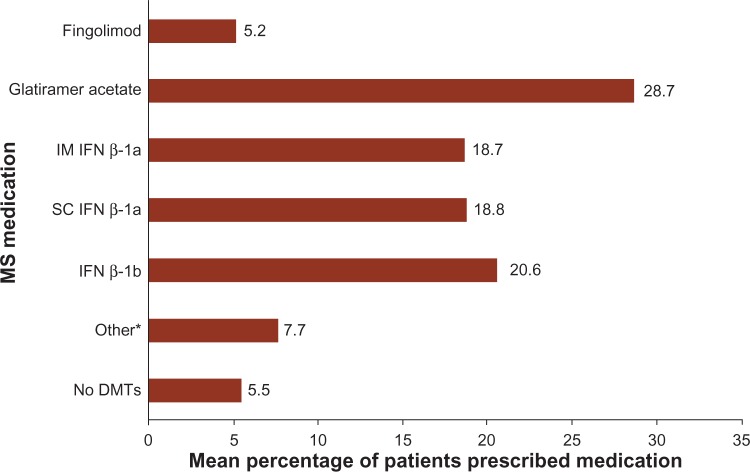
A total of 102 neurologists (n=63 general neurologists; n=39 MS specialists; 81.4% male) completed the survey. The mean (standard deviation) number of years in practice since completing medical training was 16.4 (8.6) years. Overall, the most commonly prescribed DMTs were subcutaneous interferon (IFN) β-1a and glatiramer acetate; approximately 5.5% of patients were untreated. The most important attributes of DMT medication selection were (in order of importance) efficacy, safety, tolerability, patient preference, and convenience. The DMT with the highest neurologist-reported percentage of patients who were "Very/Extremely Satisfied" with their therapy was fingolimod (31.0%), followed by glatiramer acetate (13.9%; P=0.017). Compared with fingolimod (94.0%), significantly fewer (P<0.05) neurologists reported that "All/Most" of their patients were adherent to treatment with glatiramer acetate (78.0%), subcutaneous IFN β-1a (84.0%), and IFN β-1b (75.0%); no significant differences were observed with intramuscular IFN β-1a (92.9%; P=0.75). Patients' calls to neurologists' offices were most commonly related to side effects for all self-injectable DMTs, whereas calls about fingolimod primarily involved insurance coverage issues.

CONCLUSION

Our survey results showed that very few patients with MS did not received any DMT. Among the DMTs available at the time of the survey, neurologists reported that patients were most satisfied with, and adherent to, fingolimod, but these patients also faced more problems with insurance coverage when compared with those taking self-injectable DMTs.

摘要

背景

多发性硬化症(MS)是一种有多种治疗选择的复杂疾病。关于神经科医生如何为患者选择特定的疾病修正疗法(DMTs),人们知之甚少。

目的

了解神经科医生如何就MS患者的DMT处方做出决策,并探讨神经科医生使用个别DMT的经验。

方法

2012年12月至2013年1月,向全国范围内的医生市场研究小组成员发送了带有调查网站链接的在线研究邀请。符合条件的神经科医生包括目前在美国行医且治疗≥20例MS患者的医生。

结果

共有102名神经科医生(n = 63名普通神经科医生;n = 39名MS专科医生;81.4%为男性)完成了调查。自完成医学培训以来的平均(标准差)执业年限为16.4(8.6)年。总体而言,最常处方的DMT是皮下注射干扰素(IFN)β-1a和醋酸格拉替雷;约5.5%的患者未接受治疗。DMT药物选择的最重要属性(按重要性排序)是疗效、安全性、耐受性、患者偏好和便利性。神经科医生报告的患者对其治疗“非常/极其满意”比例最高的DMT是芬戈莫德(31.0%),其次是醋酸格拉替雷(13.9%;P = 0.017)。与芬戈莫德(94.0%)相比,报告其“所有/大多数”患者坚持使用醋酸格拉替雷(78.0%)、皮下注射IFNβ-1a(84.0%)和IFNβ-1b(75.0%)治疗的神经科医生明显较少(P<0.05);肌肉注射IFNβ-1a(92.9%;P = 0.75)未观察到显著差异。患者致电神经科医生办公室最常见的原因是所有自我注射DMT的副作用,而关于芬戈莫德的致电主要涉及保险覆盖问题。

结论

我们的调查结果显示,极少有MS患者未接受任何DMT治疗。在调查时可用的DMT中,神经科医生报告患者对芬戈莫德最满意且依从性最高,但与使用自我注射DMT的患者相比,这些患者在保险覆盖方面也面临更多问题。
https://cdn.ncbi.nlm.nih.gov/pmc/blobs/ec79/3979792/5a01f48a2c7f/ppa-8-415Fig1.jpg

相似文献

1
Treatment selection and experience in multiple sclerosis: survey of neurologists.多发性硬化症的治疗选择与经验:神经科医生调查
Patient Prefer Adherence. 2014 Apr 3;8:415-22. doi: 10.2147/PPA.S53140. eCollection 2014.
2
Current and future trends in multiple sclerosis management: Near East perspective.多发性硬化症管理的现状和未来趋势:近东视角。
Mult Scler Relat Disord. 2023 Aug;76:104800. doi: 10.1016/j.msard.2023.104800. Epub 2023 Jun 5.
3
Persistence with and adherence to fingolimod compared with other disease-modifying therapies for the treatment of multiple sclerosis: a retrospective US claims database analysis.与其他改善病情疗法相比,芬戈莫德治疗多发性硬化症的持续用药和依从性:一项美国索赔数据库回顾性分析
J Med Econ. 2014 Oct;17(10):696-707. doi: 10.3111/13696998.2014.940422. Epub 2014 Jul 23.
4
Compliance to fingolimod and other disease modifying treatments in multiple sclerosis patients, a retrospective cohort study.多发性硬化症患者遵从芬戈莫德和其他疾病修正治疗的回顾性队列研究。
BMC Neurol. 2013 Oct 4;13:138. doi: 10.1186/1471-2377-13-138.
5
Treatment satisfaction across injectable, infusion, and oral disease-modifying therapies for multiple sclerosis.多发性硬化症的注射、输注和口服疾病修正治疗的治疗满意度。
Mult Scler Relat Disord. 2017 Nov;18:196-201. doi: 10.1016/j.msard.2017.10.002. Epub 2017 Oct 5.
6
How the COVID-19 Pandemic has changed multiple sclerosis clinical practice: Results of a nationwide provider survey.COVID-19 大流行如何改变多发性硬化症的临床实践:全国性提供者调查结果。
Mult Scler Relat Disord. 2021 Jun;51:102913. doi: 10.1016/j.msard.2021.102913. Epub 2021 Mar 18.
7
Implementing Shared Decision-Making for Multiple Sclerosis: The MS-SUPPORT Tool.实施多发性硬化症的共享决策:MS-SUPPORT 工具。
Mult Scler Relat Disord. 2023 Dec;80:105092. doi: 10.1016/j.msard.2023.105092. Epub 2023 Oct 21.
8
Impact of a switch to fingolimod versus staying on glatiramer acetate or beta interferons on patient- and physician-reported outcomes in relapsing multiple sclerosis: post hoc analyses of the EPOC trial.从醋酸格拉替雷或β干扰素转换为芬戈莫德对复发型多发性硬化症患者及医生报告结局的影响:EPOC试验的事后分析
BMC Neurol. 2014 Nov 26;14:220. doi: 10.1186/s12883-014-0220-1.
9
Work Productivity Outcomes Associated with Ocrelizumab Compared with Other Disease-Modifying Therapies for Multiple Sclerosis.与其他用于治疗多发性硬化症的疾病修正疗法相比,奥瑞珠单抗相关的工作生产力结果。
Neurol Ther. 2021 Jun;10(1):183-196. doi: 10.1007/s40120-020-00224-1. Epub 2020 Nov 26.
10
Challenges in multiple sclerosis care: Results from an international mixed-methods study.多发性硬化症护理中的挑战:一项国际混合方法研究的结果。
Mult Scler Relat Disord. 2021 May;50:102854. doi: 10.1016/j.msard.2021.102854. Epub 2021 Feb 23.

引用本文的文献

1
Behavioural analysis of factors influencing prescribing for neurodegenerative diseases: A rapid review.影响神经退行性疾病处方开具因素的行为分析:一项快速综述。
PLoS One. 2025 May 6;20(5):e0322324. doi: 10.1371/journal.pone.0322324. eCollection 2025.
2
Preferences and Perspectives of Specialist Multiple Sclerosis Nurses and Patients with Multiple Sclerosis Regarding the New RebiSmart 3.0 Autoinjector versus Other Assistive Devices.多发性硬化专科护士和多发性硬化患者对新型RebiSmart 3.0自动注射器与其他辅助设备的偏好和看法。
Med Devices (Auckl). 2024 Feb 19;17:59-71. doi: 10.2147/MDER.S438883. eCollection 2024.
3

本文引用的文献

1
Relapse rates in patients with multiple sclerosis switching from interferon to fingolimod or glatiramer acetate: a US claims database study.从干扰素转换为芬戈莫德或醋酸格拉替雷的多发性硬化症患者的复发率:一项美国索赔数据库研究。
PLoS One. 2014 Feb 6;9(2):e88472. doi: 10.1371/journal.pone.0088472. eCollection 2014.
2
Compliance to fingolimod and other disease modifying treatments in multiple sclerosis patients, a retrospective cohort study.多发性硬化症患者遵从芬戈莫德和其他疾病修正治疗的回顾性队列研究。
BMC Neurol. 2013 Oct 4;13:138. doi: 10.1186/1471-2377-13-138.
3
Comparative effectiveness of fingolimod versus interferons or glatiramer acetate for relapse rates in multiple sclerosis: a retrospective US claims database analysis.
Differences Between General Neurologists and Multiple Sclerosis Specialists in the Management of Multiple Sclerosis Patients: A National Survey.
普通神经科医生与多发性硬化症专科医生在多发性硬化症患者管理方面的差异:一项全国性调查。
Noro Psikiyatr Ars. 2017 Jun 20;56(4):269-272. doi: 10.5152/npa.2017.19387. eCollection 2019 Dec.
4
Enduring Clinical Value of Copaxone® (Glatiramer Acetate) in Multiple Sclerosis after 20 Years of Use.使用20年后,考帕松(醋酸格拉替雷)在多发性硬化症中的持久临床价值。
Mult Scler Int. 2019 Jan 15;2019:7151685. doi: 10.1155/2019/7151685. eCollection 2019.
5
Comparison of preferences of healthcare professionals and MS patients for attributes of disease-modifying drugs: A best-worst scaling.比较医疗保健专业人员和多发性硬化症患者对疾病修正药物属性的偏好:最佳最差标度法。
Health Expect. 2018 Feb;21(1):171-180. doi: 10.1111/hex.12599. Epub 2017 Jul 21.
6
Autoinjector preference in multiple sclerosis and the role of nurses in treatment decisions: results from an international survey in Europe and the USA.多发性硬化症患者的自动注射器偏好及护士在治疗决策中的作用:欧洲和美国国际调查结果
Pragmat Obs Res. 2014 Dec 12;5:53-64. doi: 10.2147/POR.S72012. eCollection 2014.
7
Patient preferences for treatment of multiple sclerosis with disease-modifying therapies: a discrete choice experiment.多发性硬化症疾病修正疗法的患者治疗偏好:一项离散选择实验
Patient Prefer Adherence. 2016 Sep 26;10:1945-1956. doi: 10.2147/PPA.S114619. eCollection 2016.
8
Treatment adherence in multiple sclerosis: a survey of Belgian neurologists.多发性硬化症的治疗依从性:对比利时神经科医生的一项调查。
Patient Prefer Adherence. 2015 Nov 19;9:1669-76. doi: 10.2147/PPA.S91973. eCollection 2015.
9
Patient experience and practice trends in multiple sclerosis - clinical utility of fingolimod.多发性硬化症患者的体验与实践趋势——芬戈莫德的临床效用
Patient Prefer Adherence. 2015 May 21;9:685-93. doi: 10.2147/PPA.S57354. eCollection 2015.
10
Teriflunomide for the treatment of relapsing-remitting multiple sclerosis: patient preference and adherence.特立氟胺治疗复发缓解型多发性硬化症:患者偏好与依从性
Patient Prefer Adherence. 2015 Feb 9;9:265-74. doi: 10.2147/PPA.S61651. eCollection 2015.
比较那他珠单抗与干扰素或醋酸格拉替雷治疗多发性硬化症复发率的效果:一项回顾性美国理赔数据库分析。
Curr Med Res Opin. 2013 Dec;29(12):1647-56. doi: 10.1185/03007995.2013.847411. Epub 2013 Oct 1.
4
Overview of the epidemiology, diagnosis, and disease progression associated with multiple sclerosis.多发性硬化症的流行病学、诊断和疾病进展概述。
Am J Manag Care. 2013 Feb;19(2 Suppl):S15-20.
5
Cost-sharing and initiation of disease-modifying therapy for multiple sclerosis.多发性硬化症的费用分担和疾病修正治疗的启动。
Am J Manag Care. 2012 Aug;18(8):460-4.
6
Systematic review of disease-modifying therapies to assess unmet needs in multiple sclerosis: tolerability and adherence.对疾病修饰疗法的系统评价,以评估多发性硬化症的未满足需求:耐受性和依从性。
Mult Scler. 2012 Jul;18(7):932-46. doi: 10.1177/1352458511433302. Epub 2012 Jan 16.
7
Approaches to the management of agents used for the treatment of multiple sclerosis: consensus statements from a panel of U.S. managed care pharmacists and physicians.多发性硬化症治疗药物的管理方法:美国管理式医疗药剂师和医生小组的共识声明
J Manag Care Pharm. 2012 Jan-Feb;18(1):54-62. doi: 10.18553/jmcp.2012.18.1.54.
8
Patient considerations in the management of multiple sclerosis: development and clinical utility of oral agents.多发性硬化症管理中的患者考量:口服药物的研发与临床应用
Patient Prefer Adherence. 2011 Feb 27;5:101-8. doi: 10.2147/PPA.S10506.
9
Impact of adherence to disease-modifying therapies on clinical and economic outcomes among patients with multiple sclerosis.多发性硬化症患者疾病修正治疗依从性对临床结局和经济结局的影响。
Adv Ther. 2011 Jan;28(1):51-61. doi: 10.1007/s12325-010-0093-7. Epub 2010 Dec 6.
10
Impact of adherence to interferons in the treatment of multiple sclerosis: a non-experimental, retrospective, cohort study.多发性硬化症治疗中干扰素依从性的影响:一项非实验性、回顾性、队列研究。
Clin Drug Investig. 2010;30(2):89-100. doi: 10.2165/11533330-000000000-00000.