Porzsolt Franz, Rocha Natália Galito, Toledo-Arruda Alessandra C, Thomaz Tania G, Moraes Cristiane, Bessa-Guerra Thais R, Leão Mauricio, Migowski Arn, Araujo da Silva André R, Weiss Christel
Health Care Research, Department of General and Visceral Surgery, University Hospital Ulm, Ulm, Germany; Institute of Clinical Economics (ICE) eV, Ulm, Germany.
Department of Physiology and Pharmacology, Biomedical Institute, Universidade Federal Fluminense, Niterói.
Pragmat Obs Res. 2015 Nov 4;6:47-54. doi: 10.2147/POR.S89946. eCollection 2015.
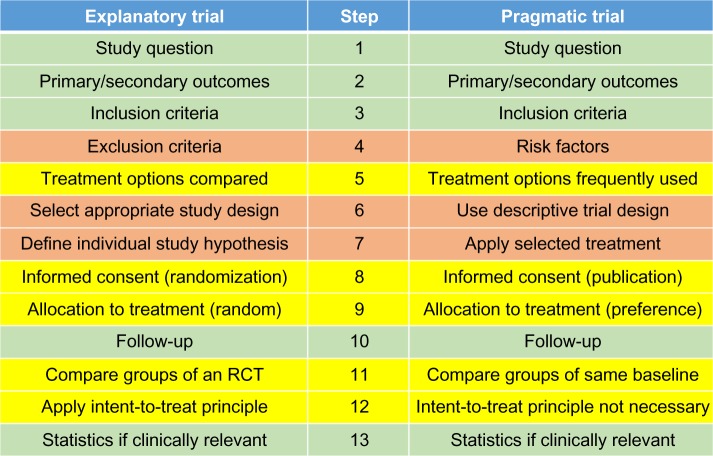
The discussion about the optimal design of clinical trials reflects the perspectives of theory-based scientists and practice-based clinicians. Scientists compare the theory with published results. They observe a continuum from explanatory to pragmatic trials. Clinicians compare the problem they want to solve by completing a clinical trial with the results they can read in the literature. They observe a mixture of what they want and what they get. None of them can solve the problem without the support of the other. Here, we summarize the results of discussions with scientists and clinicians. All participants were interested to understand and analyze the arguments of the other side. As a result of this process, we conclude that scientists tell what they see, a continuum from clear explanatory to clear pragmatic trials. Clinicians tell what they want to see, a clear explanatory trial to describe the expected effects under ideal study conditions and a clear pragmatic trial to describe the observed effects under real-world conditions. Following this discussion, the solution was not too difficult. When we accept what we see, we will not get what we want. If we discuss a necessary change of management, we will end up with the conclusion that two types of studies are necessary to demonstrate efficacy and effectiveness. Efficacy can be demonstrated in an explanatory, ie, a randomized controlled trial (RCT) completed under ideal study conditions. Effectiveness can be demonstrated in an observational, ie, a pragmatic controlled trial (PCT) completed under real-world conditions. It is impossible to design a trial which can detect efficacy and effectiveness simultaneously. The RCTs describe what we may expect in health care, while the PCTs describe what we really observe.
关于临床试验最优设计的讨论反映了基于理论的科学家和基于实践的临床医生的观点。科学家将理论与已发表的结果进行比较。他们观察到从解释性试验到实用性试验的一个连续体。临床医生将他们想要通过完成一项临床试验来解决的问题与他们能在文献中读到的结果进行比较。他们观察到自己想要的和实际得到的混合情况。没有另一方的支持,他们谁也无法解决这个问题。在此,我们总结与科学家和临床医生讨论的结果。所有参与者都有兴趣理解和分析对方的论点。经过这个过程,我们得出结论:科学家讲述他们所看到的,即从清晰的解释性试验到清晰的实用性试验的一个连续体。临床医生讲述他们想要看到的,即一个清晰的解释性试验来描述理想研究条件下的预期效果,以及一个清晰的实用性试验来描述现实世界条件下观察到的效果。经过这次讨论,解决方案并不太难。当我们接受我们所看到的时,我们将得不到我们想要的。如果我们讨论管理上的必要变革,我们最终会得出结论,即需要两种类型的研究来证明疗效和效果。疗效可以在解释性试验中得到证明,即在理想研究条件下完成的随机对照试验(RCT)。效果可以在观察性试验中得到证明,即在现实世界条件下完成的实用性对照试验(PCT)。不可能设计出一个能同时检测疗效和效果的试验。RCT描述了我们在医疗保健中可能期望的情况,而PCT描述了我们实际观察到的情况。