Division of Population Health Sciences, University of Dundee, Kirsty Semple Way, Dundee DD2 4BF, UK.
Trials. 2013 Apr 27;14:115. doi: 10.1186/1745-6215-14-115.
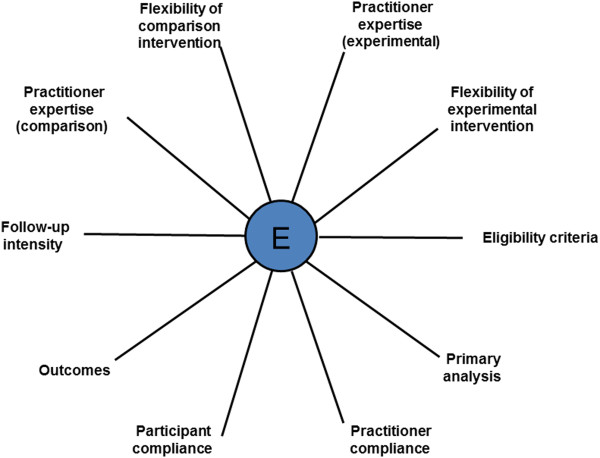
If you want to know which of two or more healthcare interventions is most effective, the randomised controlled trial is the design of choice. Randomisation, however, does not itself promote the applicability of the results to situations other than the one in which the trial was done. A tool published in 2009, PRECIS (PRagmatic Explanatory Continuum Indicator Summaries) aimed to help trialists design trials that produced results matched to the aim of the trial, be that supporting clinical decision-making, or increasing knowledge of how an intervention works. Though generally positive, groups evaluating the tool have also found weaknesses, mainly that its inter-rater reliability is not clear, that it needs a scoring system and that some new domains might be needed. The aim of the study is to: Produce an improved and validated version of the PRECIS tool. Use this tool to compare the internal validity of, and effect estimates from, a set of explanatory and pragmatic trials matched by intervention.
The study has four phases. Phase 1 involves brainstorming and a two-round Delphi survey of authors who cited PRECIS. In Phase 2, the Delphi results will then be discussed and alternative versions of PRECIS-2 developed and user-tested by experienced trialists. Phase 3 will evaluate the validity and reliability of the most promising PRECIS-2 candidate using a sample of 15 to 20 trials rated by 15 international trialists. We will assess inter-rater reliability, and raters' subjective global ratings of pragmatism compared to PRECIS-2 to assess convergent and face validity. Phase 4, to determine if pragmatic trials sacrifice internal validity in order to achieve applicability, will compare the internal validity and effect estimates of matched explanatory and pragmatic trials of the same intervention, condition and participants. Effect sizes for the trials will then be compared in a meta-regression. The Cochrane Risk of Bias scores will be compared with the PRECIS-2 scores of pragmatism.
We have concrete suggestions for improving PRECIS and a growing list of enthusiastic individuals interested in contributing to this work. By early 2014 we expect to have a validated PRECIS-2.
如果您想知道两种或多种医疗干预措施中哪一种最有效,那么随机对照试验是首选设计。然而,随机化并不能保证结果适用于试验以外的情况。2009 年发布的一种工具 PRECIS(实用解释连续指标摘要)旨在帮助试验人员设计出产生与试验目的相匹配的结果的试验,无论是支持临床决策还是增加对干预措施效果的了解。尽管总体上是积极的,但评估该工具的小组也发现了其弱点,主要是其内部评分者间信度不明确、需要评分系统以及可能需要一些新的领域。本研究的目的是:
生成 PRECIS 工具的改进和验证版本。
使用该工具比较一组通过干预措施匹配的解释性和实用试验的内部有效性和效果估计。
该研究有四个阶段。第一阶段包括头脑风暴和引用 PRECIS 的作者的两轮 Delphi 调查。在第二阶段,Delphi 的结果将进行讨论,并由经验丰富的试验人员开发和用户测试替代版本的 PRECIS-2。第三阶段将使用由 15 至 20 名国际试验人员评估的 15 至 20 个试验样本评估最有前途的 PRECIS-2 候选者的有效性和可靠性。我们将评估内部评分者间信度,并评估与 PRECIS-2 相比,试验者对实用性的主观总体评分,以评估收敛和表面有效性。第四阶段,为了确定实用试验是否为了实现适用性而牺牲了内部有效性,将比较同一干预措施、条件和参与者的匹配解释性和实用试验的内部有效性和效果估计。然后将在荟萃回归中比较试验的效果大小。Cochrane 偏倚风险评分将与 PRECIS-2 的实用性评分进行比较。
我们对改进 PRECIS 有具体的建议,并且有越来越多的热心人士有兴趣为此工作做出贡献。到 2014 年初,我们预计将有一个经过验证的 PRECIS-2。