Qiu Zhi-Xia, Gao Wen-Chao, Dai Yu, Zhou Su-Feng, Zhao Jie, Lu Yang, Chen Xi-Jing, Li Ning
Department of Pharmacology of Chinese Materia Medica, China Pharmaceutical University Nanjing, China.
Clinical Pharmacokinetics Research Laboratory, School of Basic Medicine and Clinical Pharmacy, China Pharmaceutical University Nanjing, China.
Front Pharmacol. 2016 Oct 7;7:366. doi: 10.3389/fphar.2016.00366. eCollection 2016.
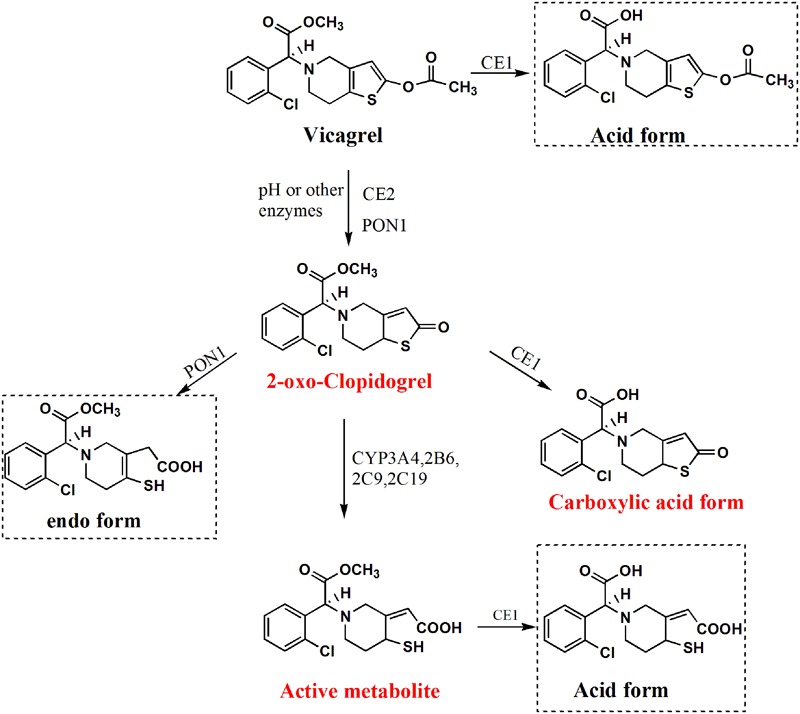
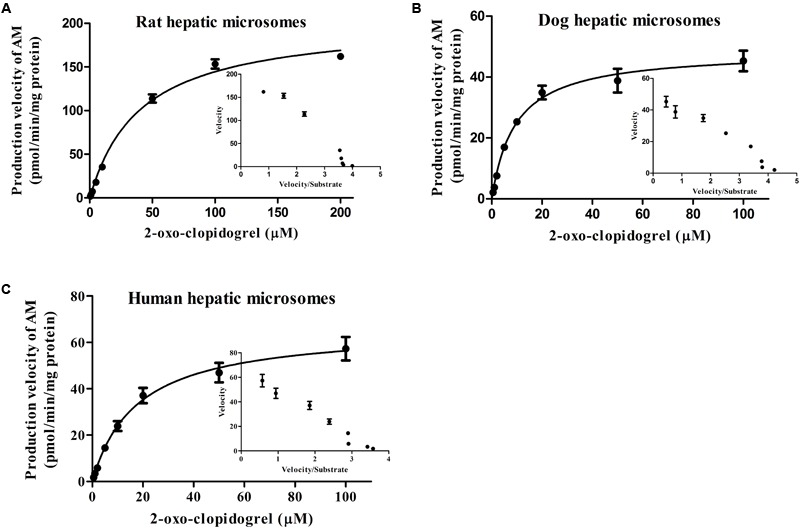
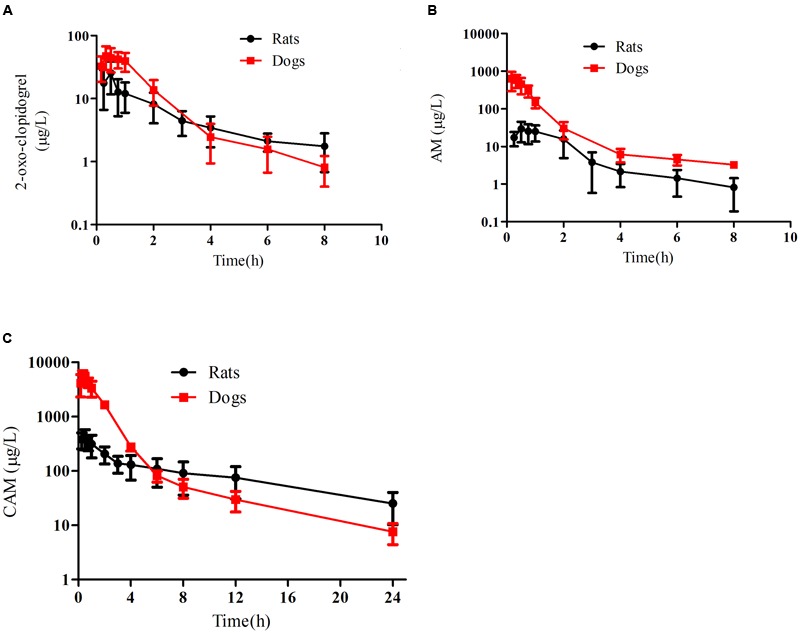
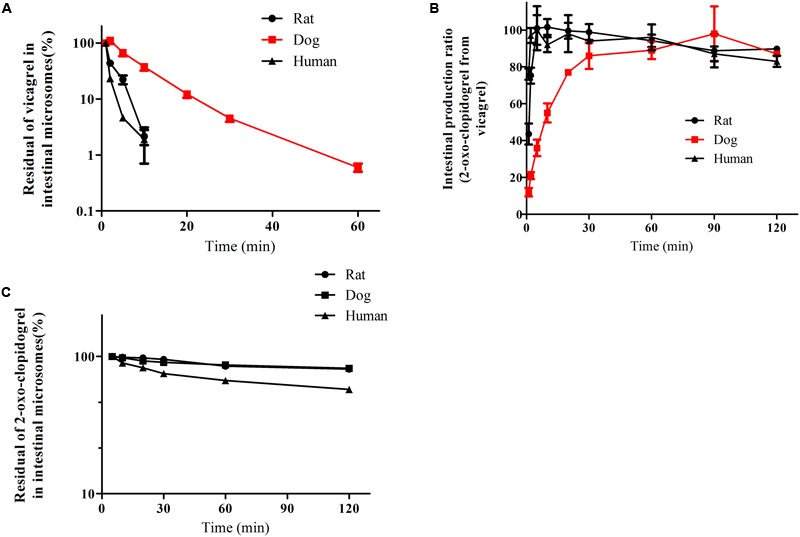
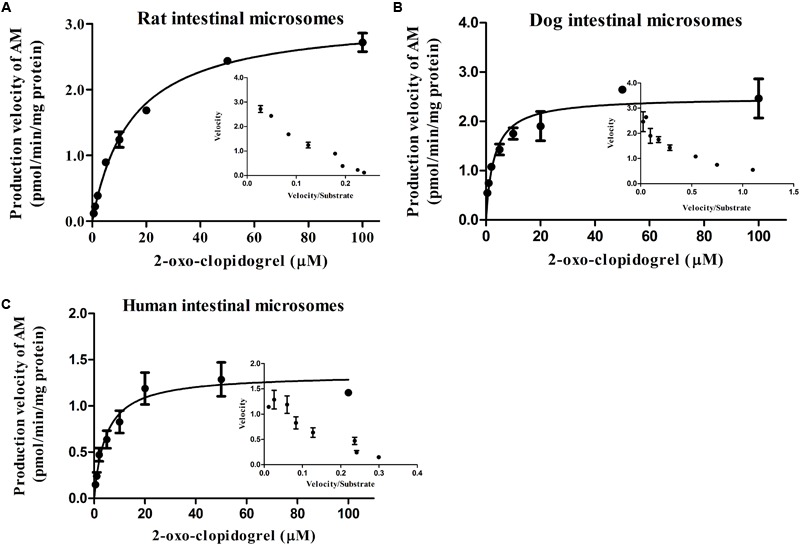
Previously we have found vicagrel, a new acetate derivative of clopidogrel, underwent hydrolysis to 2-oxo-clopidogrel and subsequent conversions to its pharmacological active metabolite (AM) and inactive carboxylic acid metabolite (CAM). This study demonstrated the interspecies differences of the vicagrel bioactivation by comparing the critical vicagrel metabolites formation in rats, dogs and human. The pharmacokinetic studies with rats and dogs were conducted after intragastric administration of vicagrel, followed by metabolism investigation in venous system, intestinal/hepatic microsomes from rats, dogs and human. An obvious disparity was observed in system exposure to AM (99.0 vs. 635.1 μg⋅h/L, < 0.05) and CAM (10119 vs. 2634 μg⋅h/L, < 0.05) in rats and dogs. It was shown that the cleavage of vicagrel was almost completed in intestine with great different clearance (53.28 vs. 3.643 L⋅h⋅kg, < 0.05) in rats and dogs. With no further hydrolysis to CAM, the greatest clearance of AM (3.26 mL⋅h⋅kg) was found in dog intestine. In rat plasma, 2-oxo-clopidogrel was much more extensively hydrolyzed to CAM than in dog and human. Albeit similar hydrolysis clearance and AM production was observed among hepatic microsomes of the three species, the production velocity of CAM ranked highest in dogs (7.55 pmol/min/mg protein). Therefore, the unconformity of AM and CAM exposure cross species mainly came from the metabolism of 2-oxo-clopidogrel associated largely with tissue specificity and interspecies differences of esterases. In human, the pharmacokinetics of vicagrel might be more optimistic due to less inactivation hydrolysis before reaching liver.
此前我们发现,氯吡格雷的一种新型乙酸酯衍生物维卡格雷会水解为2-氧代氯吡格雷,随后转化为其药理活性代谢物(AM)和无活性羧酸代谢物(CAM)。本研究通过比较维卡格雷在大鼠、犬和人类体内关键代谢物的形成情况,证明了维卡格雷生物活化的种间差异。对大鼠和犬进行了维卡格雷灌胃给药后的药代动力学研究,随后在大鼠、犬和人类的静脉系统、肠道/肝微粒体中进行代谢研究。在大鼠和犬中,AM的系统暴露量(99.0对635.1μg·h/L,P<0.05)和CAM的系统暴露量(10119对2634μg·h/L,P<0.05)存在明显差异。结果表明,维卡格雷的裂解在肠道中几乎完成,大鼠和犬的清除率差异很大(53.28对3.643L·h·kg,P<0.05)。由于不再进一步水解为CAM,在犬肠道中发现AM的清除率最高(3.26mL·h·kg)。在大鼠血浆中,2-氧代氯吡格雷比在犬和人类中更广泛地水解为CAM。尽管在三种物种的肝微粒体中观察到相似的水解清除率和AM生成量,但CAM的生成速度在犬中最高(7.55pmol/min/mg蛋白)。因此,种间AM和CAM暴露的不一致主要源于2-氧代氯吡格雷的代谢,这在很大程度上与酯酶的组织特异性和种间差异有关。在人类中,维卡格雷的药代动力学可能更乐观,因为在到达肝脏之前失活水解较少。