Ostergaard Louise, Rudiger Alain, Wellmann Sven, Gammella Elena, Beck-Schimmer Beatrice, Struck Joachim, Maggiorini Marco, Gassmann Max
Institute of Veterinary Physiology, Vetsuisse Faculty, University of Zürich; Zürich Center for Integrative Human Physiology.
Institute of Anesthesiology.
Hypoxia (Auckl). 2014 Sep 11;2:143-151. doi: 10.2147/HP.S57894. eCollection 2014.
A reduced oxygen supply puts patients at risk of tissue hypoxia, organ damage, and even death. In response, several changes are activated that allow for at least partial adaptation, thereby increasing the chances of survival. We aimed to investigate whether the arginine vasopressin marker, copeptin, can be used as a marker of the degree of acclimatization/adaptation in rats exposed to hypoxia.
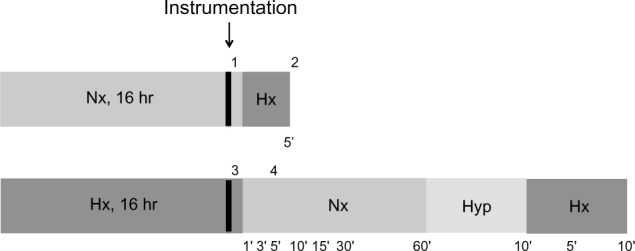
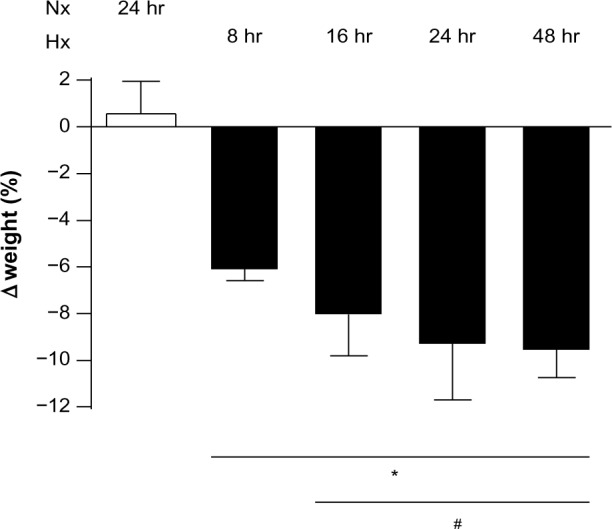
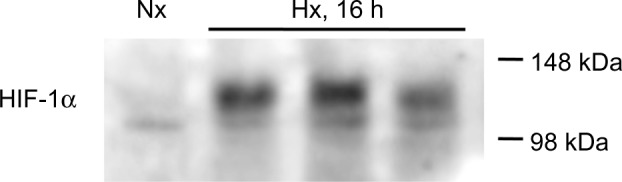
Sprague-Dawley rats were exposed to 10% oxygen for up to 48 hours. Arterial and right ventricular pressures were measured, and blood gas analysis was performed at set time points. Pulmonary changes were investigated by bronchoalveolar lavage, wet and dry weight measurements, and lung histology. Using a newly developed specific rat copeptin luminescence immunoassay, the regulation of vasopressin in response to hypoxia was studied, as was atrial natriuretic peptide (ANP) by detecting mid-regional proANP.
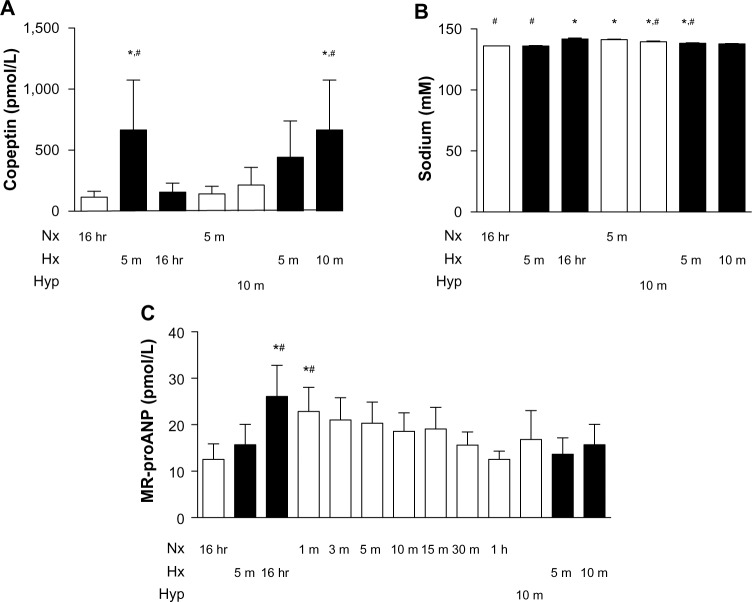
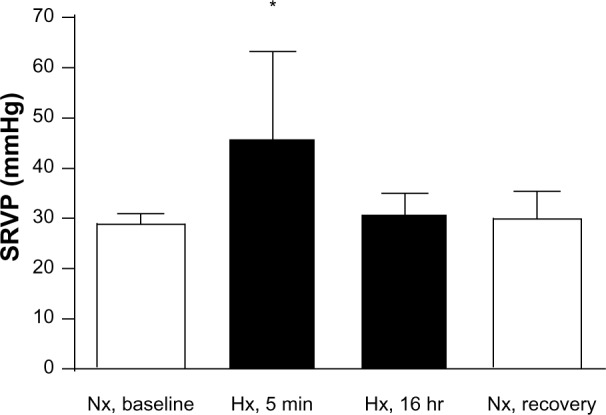
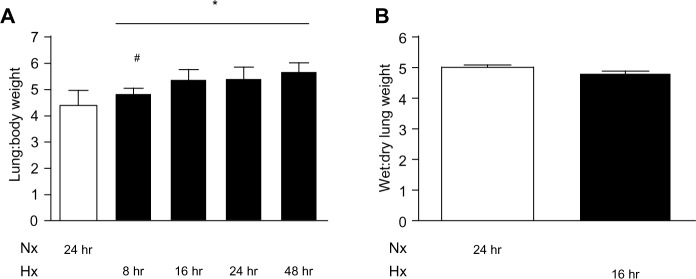
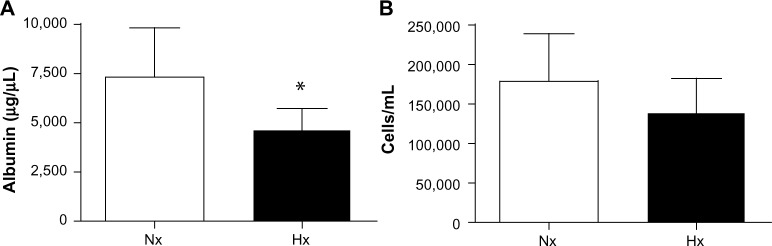
With a decreasing oxygen supply, the rats rapidly became cyanotic and inactive. Despite continued exposure to 10% oxygen, all animals recuperated within 16 hours and ultimately survived. Their systemic blood pressure fell with acute (5 minutes) hypoxia but was partially recovered over time. In contrast, right ventricular pressures increased with acute (5 minutes) hypoxia and normalized after 16 hours. No signs of pulmonary inflammation or edema were found despite prolonged hypoxia. Whereas copeptin levels increased significantly after acute (5 minutes) hypoxia and then returned to near baseline after 16 hours, mid-regional proANP levels were even further increased after 16 hours of exposure to hypoxia.
Plasma copeptin is a sensitive marker of acute (5 minutes) exposure to severe hypoxia, and subsequent regulation can indicate recovery. Copeptin levels can therefore reflect clinical and physiological changes in response to hypoxia and indicate recovery from ongoing hypoxic exposure.
氧气供应减少会使患者面临组织缺氧、器官损伤甚至死亡的风险。作为应对措施,会激活多种变化,以实现至少部分适应,从而增加生存几率。我们旨在研究精氨酸加压素标志物 copeptin 是否可作为缺氧大鼠适应/适应程度的标志物。
将 Sprague-Dawley 大鼠暴露于 10%氧气环境中长达 48 小时。在设定时间点测量动脉压和右心室压,并进行血气分析。通过支气管肺泡灌洗、湿重和干重测量以及肺组织学研究肺部变化。使用新开发的特异性大鼠 copeptin 发光免疫测定法,研究缺氧时加压素的调节情况,同时通过检测中段 proANP 研究心房利钠肽(ANP)。
随着氧气供应减少,大鼠迅速出现青紫和活动减少。尽管持续暴露于 10%氧气环境中,但所有动物在 16 小时内恢复并最终存活。急性(5 分钟)缺氧时其全身血压下降,但随时间部分恢复。相比之下,急性(5 分钟)缺氧时右心室压升高,16 小时后恢复正常。尽管缺氧时间延长,但未发现肺部炎症或水肿迹象。急性(5 分钟)缺氧后 copeptin 水平显著升高,然后在 16 小时后恢复至接近基线水平,而暴露于缺氧 16 小时后中段 proANP 水平甚至进一步升高。
血浆 copeptin 是急性(5 分钟)暴露于严重缺氧的敏感标志物,其后续调节可表明恢复情况。因此,copeptin 水平可反映缺氧时的临床和生理变化,并表明从持续缺氧暴露中恢复。