Baldo Chiara, Casareto Lorena, Renieri Alessandra, Merla Giuseppe, Garavaglia Barbara, Goldwurm Stefano, Pegoraro Elena, Moggio Maurizio, Mora Marina, Politano Luisa, Sangiorgi Luca, Mazzotti Raffaella, Viotti Valeria, Meloni Ilaria, Pellico Maria Teresa, Barzaghi Chiara, Wang Chiuhui Mary, Monaco Lucia, Filocamo Mirella
S.C. Laboratorio di Genetica Umana, E.O. Ospedali Galliera, Genoa, Italy.
Ufficio Coordinamento Network, c/o U.O.S.D. Centro di Diagnostica Genetica e Biochimica delle Malattie Metaboliche, Istituto G. Gaslini, Genoa, Italy.
Orphanet J Rare Dis. 2016 Oct 24;11(1):142. doi: 10.1186/s13023-016-0527-7.
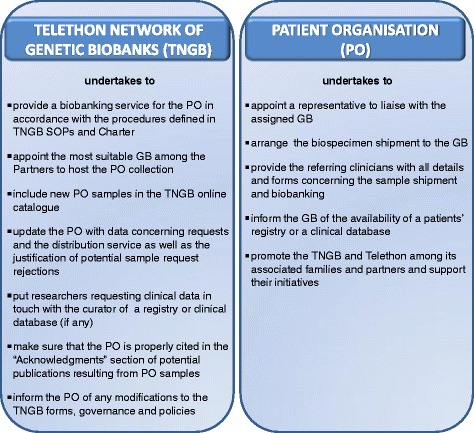
Rare diseases (RDs) are often neglected because they affect a small percentage of the population (6-8 %), which makes research and development of new therapies challenging processes. Easy access to high-quality samples and associated clinical data is therefore a key prerequisite for biomedical research. In this context, Genetic Biobanks are critical to developing basic, translational and clinical research on RDs. The Telethon Network of Genetic Biobanks (TNGB) is aware of the importance of biobanking as a service for patients and has started a dialogue with RD-Patient Organisations via promotion of dedicated meetings and round-tables, as well as by including their representatives on the TNGB Advisory Board. This has enabled the active involvement of POs in drafting biobank policies and procedures, including those concerning ethical issues. Here, we report on our experience with RD-Patient Organisations who have requested the services of existing biobanks belonging to TNGB and describe how these relationships were established, formalised and maintained.
The process of patient engagement has proven to be successful both for lay members, who increased their understanding of the complex processes of biobanking, and for professionals, who gained awareness of the needs and expectations of the people involved. This collaboration has resulted in a real interest on the part of Patient Organisations in the biobanking service, which has led to 13 written agreements designed to formalise this process. These agreements enabled the centralisation of rare genetic disease biospecimens and their related data, thus making them available to the scientific community.
The TNGB experience has proven to be an example of good practice with regard to patient engagement in biobanking and may serve as a model of collaboration between disease-oriented Biobanks and Patient Organisations. Such collaboration serves to enhance awareness and trust and to encourage the scientific community to address research on RDs.
罕见病(RDs)往往被忽视,因为它们仅影响一小部分人口(6 - 8%),这使得新疗法的研发成为具有挑战性的过程。因此,能够轻松获取高质量样本及相关临床数据是生物医学研究的关键前提。在此背景下,遗传生物样本库对于开展罕见病的基础、转化和临床研究至关重要。泰雷松遗传生物样本库网络(TNGB)意识到生物样本库作为一项为患者服务的重要性,并已通过举办专门会议和圆桌会议,以及让患者组织代表加入TNGB咨询委员会,与罕见病患者组织展开对话。这使得患者组织能够积极参与生物样本库政策和程序的起草工作,包括那些涉及伦理问题的政策和程序。在此,我们报告我们与那些请求使用TNGB所属现有生物样本库服务的罕见病患者组织的合作经验,并描述这些关系是如何建立、规范化和维持的。
患者参与过程已证明对普通成员和专业人员都很成功。普通成员增进了对生物样本库复杂过程的理解,专业人员则了解了相关人员的需求和期望。这种合作使患者组织对生物样本库服务产生了真正的兴趣,进而促成了13份旨在使这一过程规范化的书面协议。这些协议实现了罕见遗传疾病生物样本及其相关数据的集中管理,从而使其可供科学界使用。
TNGB的经验已证明是患者参与生物样本库建设的良好实践范例,可作为面向疾病的生物样本库与患者组织之间合作的典范。这种合作有助于提高认识和信任,并鼓励科学界开展罕见病研究。