Aichelman Hannah E, Townsend Joseph E, Courtney Travis A, Baumann Justin H, Davies Sarah W, Castillo Karl D
Department of Marine Sciences University of North Carolina at Chapel Hill Chapel Hill North Carolina.
Department of Marine Sciences University of North Carolina at Chapel Hill Chapel Hill North Carolina; Department of Marine and Environmental Sciences Northeastern University Nahant Massachusetts; Present address: Scripps Institution of Oceanography University of California San Diego La Jolla California.
Ecol Evol. 2016 Aug 31;6(18):6758-6769. doi: 10.1002/ece3.2399. eCollection 2016 Sep.
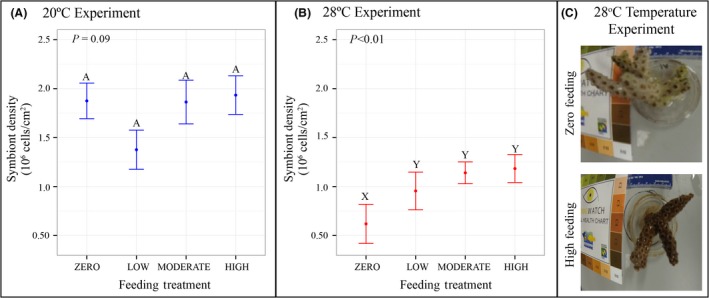
Anthropogenic increases in atmospheric carbon dioxide concentration have caused global average sea surface temperature (SST) to increase by approximately 0.11°C per decade between 1971 and 2010 - a trend that is projected to continue through the 21st century. A multitude of research studies have demonstrated that increased SSTs compromise the coral holobiont (cnidarian host and its symbiotic algae) by reducing both host calcification and symbiont density, among other variables. However, we still do not fully understand the role of heterotrophy in the response of the coral holobiont to elevated temperature, particularly for temperate corals. Here, we conducted a pair of independent experiments to investigate the influence of heterotrophy on the response of the temperate scleractinian coral to thermal stress. Colonies of from Radio Island, North Carolina, were exposed to four feeding treatments (zero, low, moderate, and high concentrations of newly hatched sp. nauplii) across two independent temperature experiments (average annual SST (20°C) and average summer temperature (28°C) for the interval 2005-2012) to quantify the effects of heterotrophy on coral skeletal growth and symbiont density. Results suggest that heterotrophy mitigated both reduced skeletal growth and decreased symbiont density observed for unfed corals reared at 28°C. This study highlights the importance of heterotrophy in maintaining coral holobiont fitness under thermal stress and has important implications for the interpretation of coral response to climate change.
人为导致的大气二氧化碳浓度增加,使得1971年至2010年间全球平均海表温度(SST)以每十年约0.11°C的速度上升,预计这一趋势将持续贯穿21世纪。大量研究表明,海表温度升高会损害珊瑚共生体(刺胞动物宿主及其共生藻类),导致宿主钙化减少、共生体密度降低以及其他变量变化。然而,我们仍未完全了解异养在珊瑚共生体对温度升高的响应中的作用,特别是对于温带珊瑚而言。在此,我们进行了两项独立实验,以研究异养对温带石珊瑚应对热应激的影响。从北卡罗来纳州无线电岛采集的珊瑚群落,在两个独立的温度实验(2005 - 2012年期间的年均海表温度(20°C)和夏季平均温度(28°C))中,接受了四种投喂处理(新孵化的特定无节幼体浓度为零、低、中、高),以量化异养对珊瑚骨骼生长和共生体密度的影响。结果表明,异养减轻了在28°C下饲养的未投喂珊瑚所观察到的骨骼生长减少和共生体密度降低的情况。这项研究突出了异养在热应激下维持珊瑚共生体健康方面的重要性,并对解释珊瑚对气候变化的响应具有重要意义。