Amabebe Emmanuel, Reynolds Steven, Stern Victoria, Stafford Graham, Paley Martyn, Anumba Dilly O C
Academic Unit of Reproductive and Developmental Medicine, University of Sheffield , Sheffield , UK.
Academic Unit of Radiology, University of Sheffield , Sheffield , UK.
Front Med (Lausanne). 2016 Oct 10;3:48. doi: 10.3389/fmed.2016.00048. eCollection 2016.
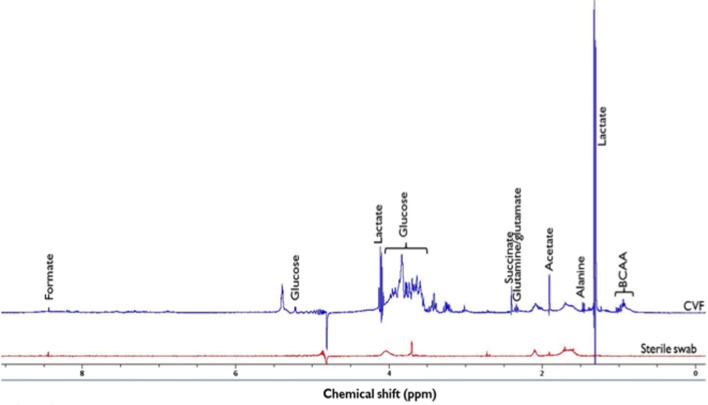
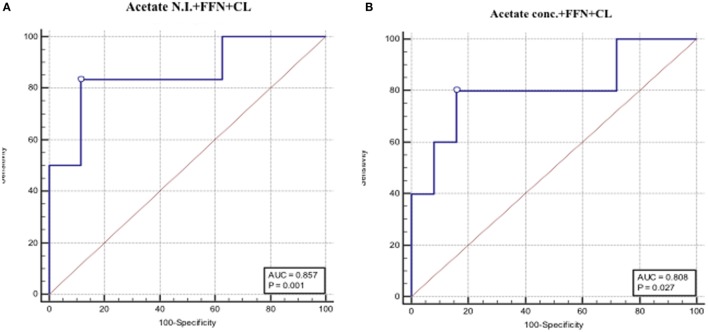
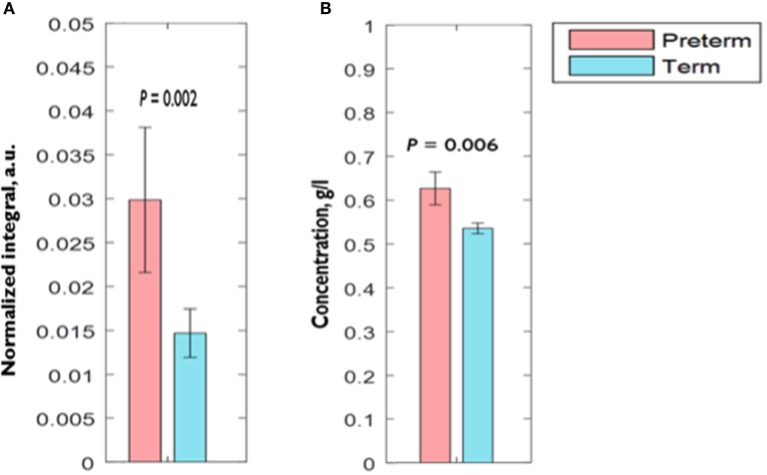
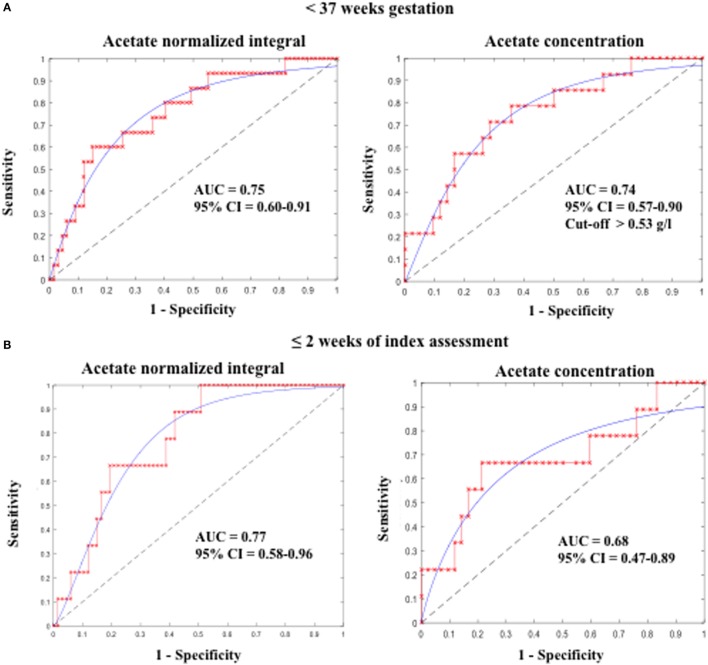
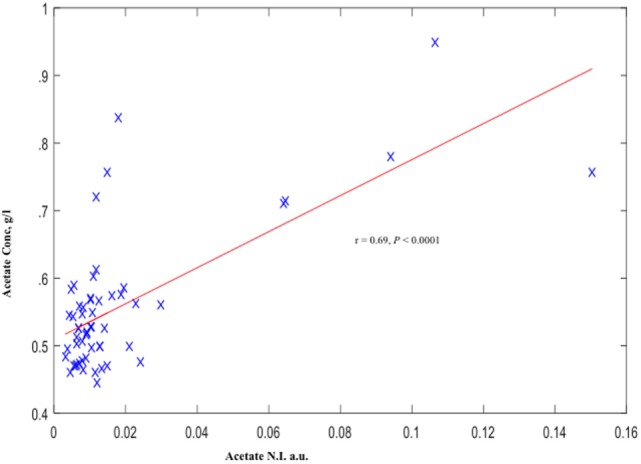
Changes in vaginal microbiota that is associated with preterm birth (PTB) leave specific metabolite fingerprints that can be detected in the cervicovaginal fluid (CVF) using metabolomics techniques. In this study, we characterize and validate the CVF metabolite profile of pregnant women presenting with symptoms of threatened preterm labor (PTL) by both H-nuclear magnetic resonance spectroscopy (NMR) and enzyme-based spectrophotometry. We also determine their predictive capacity for PTB, singly, and in combination, with current clinical screening tools - cervicovaginal fetal fibronectin (FFN) and ultrasound cervical length (CL). CVF was obtained by high-vaginal swabs from 82 pregnant women with intact fetal membranes presenting between 24 and 36 weeks gestation with symptoms of threatened, but not established, PTL. Dissolved CVF samples were scanned with a 400 MHz NMR spectrometer. Acetate and other metabolites were identified in the NMR spectrum, integrated for peak area, and normalized to the total spectrum integral. To confirm and validate our observations, acetate concentrations (AceConc) were also determined from a randomly-selected subset of the same samples ( = 57), by spectrophotometric absorption of NADH using an acetic acid assay kit. CVF FFN level, transvaginal ultrasound CL, and vaginal pH were also ascertained. Acetate normalized integral and AceConc were significantly higher in the women who delivered preterm compared to their term counterparts ( = 0.002 and = 0.006, respectively). The H-NMR-derived acetate integrals were strongly correlated with the AceConc estimated by spectrophotometry ( = 0.69; < 0.0001). Both methods were equally predictive of PTB <37 weeks (acetate integral: AUC = 0.75, 95% CI = 0.60-0.91; AceConc: AUC = 0.74, 95% CI = 0.57-0.90, optimal predictive cutoff of >0.53 g/l), and of delivery within 2 weeks of the index assessment (acetate integral: AUC = 0.77, 95% CI = 0.58-0.96; AceConc: AUC = 0.68, 95% CI = 0.5-0.9). The predictive accuracy of CVF acetate was similar to CL and FFN. The combination of CVF acetate, FFN, and ultrasound CL in a binary logistic regression model improved the prediction of PTB compared to the three markers individually, but CVF acetate offered no predictive improvement over ultrasound CL combined with CVF FFN. Elevated CVF acetate in women with symptoms of PTL appears predictive of preterm delivery, as well as delivery within 2 weeks of presentation. An assay of acetate in CVF may prove of clinical utility for predicting PTB.
与早产(PTB)相关的阴道微生物群变化会留下特定的代谢物指纹图谱,使用代谢组学技术可在宫颈阴道液(CVF)中检测到这些指纹图谱。在本研究中,我们通过氢核磁共振波谱(NMR)和酶促分光光度法对有先兆早产(PTL)症状的孕妇的CVF代谢物谱进行了表征和验证。我们还单独以及联合当前临床筛查工具——宫颈阴道胎儿纤连蛋白(FFN)和超声测量的宫颈长度(CL),确定了它们对PTB的预测能力。通过高阴道拭子从82名胎膜完整的孕妇中获取CVF,这些孕妇在妊娠24至36周时出现先兆但未确诊的PTL症状。用400 MHz NMR光谱仪扫描溶解后的CVF样本。在NMR光谱中鉴定出乙酸盐和其他代谢物,对峰面积进行积分,并将其归一化为总光谱积分。为了确认和验证我们的观察结果,还使用乙酸检测试剂盒通过分光光度法吸收NADH,从同一随机选择的样本子集(n = 57)中测定乙酸盐浓度(AceConc)。还确定了CVF的FFN水平、经阴道超声测量的CL以及阴道pH值。与足月分娩的女性相比,早产女性的乙酸盐归一化积分和AceConc显著更高(分别为P = 0.002和P = 0.006)。NMR衍生的乙酸盐积分与分光光度法估计的AceConc高度相关(r = 0.69;P < 0.0001)。两种方法对<37周的PTB的预测能力相同(乙酸盐积分:AUC = 0.75,95% CI = 0.60 - 0.91;AceConc:AUC = 0.74,95% CI = 0.57 - 0.90,最佳预测临界值>0.53 g/l),以及对指数评估后2周内分娩的预测能力相同(乙酸盐积分:AUC = 0.77,95% CI = 0.58 - 0.96;AceConc:AUC = 0.68,95% CI = 0.5 - 0.9)。CVF乙酸盐的预测准确性与CL和FFN相似。在二元逻辑回归模型中,将CVF乙酸盐、FFN和超声测量的CL联合使用,与单独使用这三个标志物相比,提高了对PTB的预测能力,但与超声测量的CL联合CVF FFN相比,CVF乙酸盐并没有提供更好的预测效果。有PTL症状的女性CVF中乙酸盐升高似乎可预测早产以及就诊后2周内分娩。对CVF中的乙酸盐进行检测可能对预测PTB具有临床实用性。