Huezo-Diaz Curtis P, Uppugunduri C R S, Muthukumaran J, Rezgui M A, Peters C, Bader P, Duval M, Bittencourt H, Krajinovic Maja, Ansari Marc
Department of Pediatrics, Onco-Haematology Unit, Geneva University Hospital, Geneva, Switzerland.
CANSEARCH Research Laboratory, Department of Pediatrics, Faculty of Medicine, University of Geneva, Geneva, Switzerland.
Pharmacogenomics J. 2018 Jan;18(1):64-69. doi: 10.1038/tpj.2016.65. Epub 2016 Oct 25.
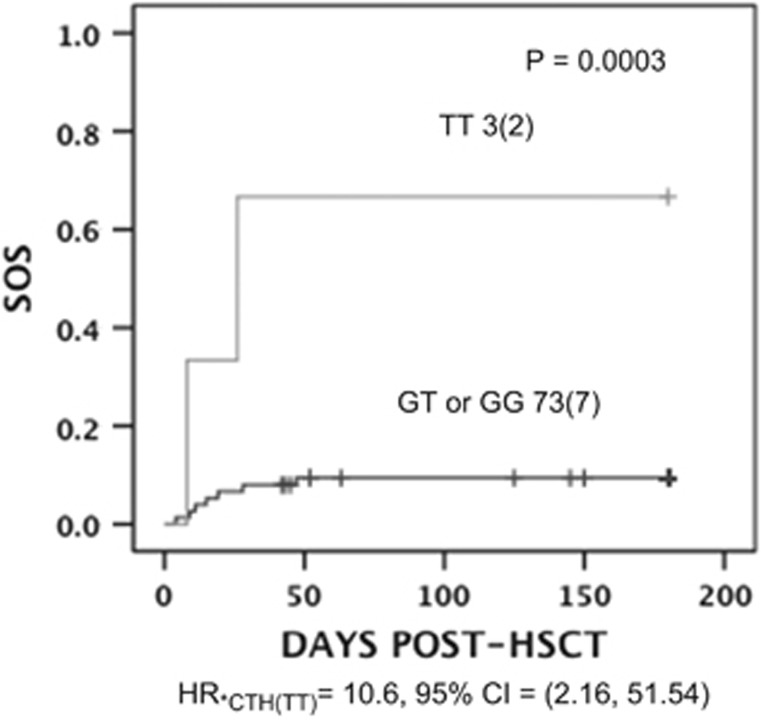
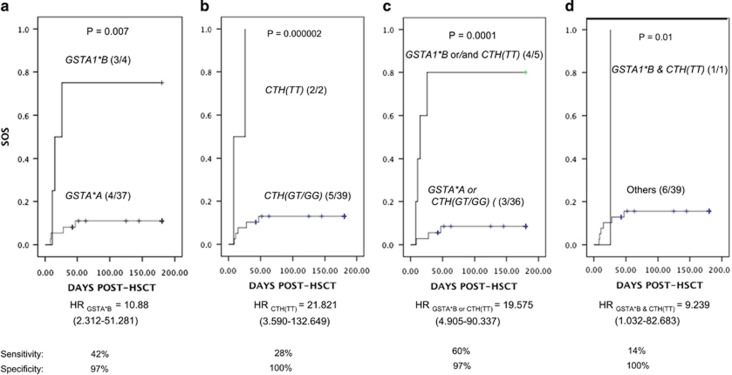
Sinusoidal obstruction syndrome (SOS) is a severe complication of hematopoietic stem cell transplantation (HSCT) that can be fatal, often attributed to the conditioning regimen prior to HSCT. We evaluated the association of SOS risk with gene variants in cystathionase (CTH), an enzyme involved in glutathione synthesis, in 76 children receiving intravenous busulfan (Bu) before HSCT. Our results indicated an association with CTHc.1364 G>T (OR=10.6, 95% confidence interval (CI)=2.16, 51.54) and SOS risk, which was sex dependent (female patients, OR=21.82, 95% CI=3.590-132.649). The interaction between CTHc.1364 G>T and another risk variant (GSTA1B) was explored. A recessive model with the use of GSTA1B*B and CTH c.1364 TT genotypes proved to be useful at predicting SOS occurrence, indicating the possibility of using these gene variants as markers of SOS occurrence and to further individualize preemptive treatment aimed at reducing SOS incidence.
窦性阻塞综合征(SOS)是造血干细胞移植(HSCT)的一种严重并发症,可能致命,通常归因于HSCT前的预处理方案。我们评估了76例在HSCT前接受静脉注射白消安(Bu)的儿童中,SOS风险与胱硫醚酶(CTH,一种参与谷胱甘肽合成的酶)基因变异之间的关联。我们的结果表明,CTH c.1364 G>T(比值比[OR]=10.6,95%置信区间[CI]=2.16, 51.54)与SOS风险相关,且存在性别依赖性(女性患者,OR=21.82,95%CI=3.590 - 132.649)。我们还探讨了CTH c.1364 G>T与另一个风险变异(GSTA1B)之间的相互作用。使用GSTA1B*B和CTH c.1364 TT基因型的隐性模型被证明可用于预测SOS的发生,这表明有可能将这些基因变异用作SOS发生的标志物,并进一步使旨在降低SOS发生率的预防性治疗个体化。