• 文献检索
  • 文档翻译
  • 深度研究
  • 学术资讯
  • Suppr Zotero 插件Zotero 插件
  • 邀请有礼
  • 套餐&价格
  • 历史记录
应用&插件
Suppr Zotero 插件Zotero 插件浏览器插件Mac 客户端Windows 客户端微信小程序
定价
高级版会员购买积分包购买API积分包
服务
文献检索文档翻译深度研究API 文档MCP 服务
关于我们
关于 Suppr公司介绍联系我们用户协议隐私条款
关注我们

Suppr 超能文献

核心技术专利:CN118964589B侵权必究
粤ICP备2023148730 号-1Suppr @ 2026

文献检索

告别复杂PubMed语法,用中文像聊天一样搜索,搜遍4000万医学文献。AI智能推荐,让科研检索更轻松。

立即免费搜索

文件翻译

保留排版,准确专业,支持PDF/Word/PPT等文件格式,支持 12+语言互译。

免费翻译文档

深度研究

AI帮你快速写综述,25分钟生成高质量综述,智能提取关键信息,辅助科研写作。

立即免费体验

预防性口服葡萄糖凝胶用于有新生儿低血糖风险的新生儿:一项随机对照剂量探索试验(Pre-hPOD研究)

Prophylactic Oral Dextrose Gel for Newborn Babies at Risk of Neonatal Hypoglycaemia: A Randomised Controlled Dose-Finding Trial (the Pre-hPOD Study).

作者信息

Hegarty Joanne Elizabeth, Harding Jane Elizabeth, Gamble Gregory David, Crowther Caroline Anne, Edlin Richard, Alsweiler Jane Marie

机构信息

Liggins Institute, University of Auckland, Auckland, New Zealand.

Newborn Services, National Women's Health, Auckland, New Zealand.

出版信息

PLoS Med. 2016 Oct 25;13(10):e1002155. doi: 10.1371/journal.pmed.1002155. eCollection 2016 Oct.

DOI:10.1371/journal.pmed.1002155
PMID:27780197
原文链接:https://pmc.ncbi.nlm.nih.gov/articles/PMC5079625/
Abstract

BACKGROUND

Neonatal hypoglycaemia is common, affecting up to 15% of newborns, and can cause brain damage. Currently, there are no strategies, beyond early feeding, to prevent neonatal hypoglycaemia. Our aim was to determine a dose of 40% oral dextrose gel that will prevent neonatal hypoglycaemia in newborn babies at risk.

METHODS AND FINDINGS

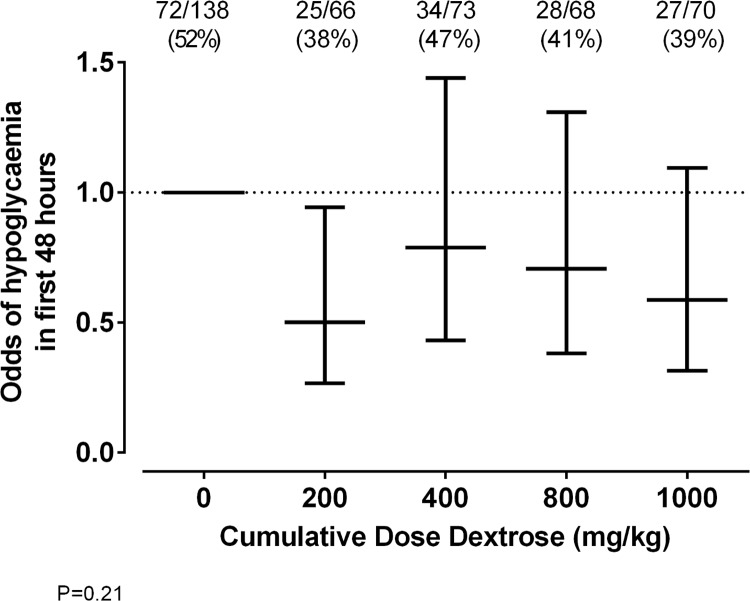
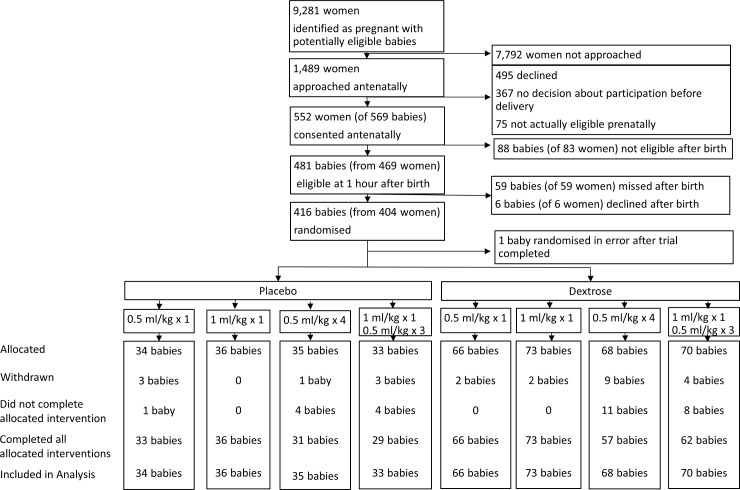
We conducted a randomised, double-blind, placebo-controlled dose-finding trial of buccal dextrose gel to prevent neonatal hypoglycaemia at two hospitals in New Zealand. Babies at risk of hypoglycaemia (infant of a mother with diabetes, late preterm delivery, small or large birthweight, or other risk factors) but without indication for admission to a neonatal intensive care unit (NICU) were randomly allocated either to one of four treatment groups: 40% dextrose at one of two doses (0.5 ml/kg = 200 mg/kg, or 1 ml/kg = 400 mg/kg), either once at 1 h of age or followed by three additional doses of dextrose (0.5 ml/kg before feeds in the first 12 h); or to one of four corresponding placebo groups. Treatments were administered by massaging gel into the buccal mucosa. The primary outcome was hypoglycaemia (<2.6 mM) in the first 48 h. Secondary outcomes included admission to a NICU, admission for hypoglycaemia, and breastfeeding at discharge and at 6 wk. Prespecified potential dose limitations were tolerance of gel, time taken to administer, messiness, and acceptability to parents. From August 2013 to November 2014, 416 babies were randomised. Compared to babies randomised to placebo, the risk of hypoglycaemia was lowest in babies randomised to a single dose of 200 mg/kg dextrose gel (relative risk [RR] 0.68; 95% confidence interval [CI] 0.47-0.99, p = 0.04) but was not significantly different between dose groups (p = 0.21). Compared to multiple doses, single doses of gel were better tolerated, quicker to administer, and less messy, but these limitations were not different between dextrose and placebo gel groups. Babies who received any dose of dextrose gel were less likely to develop hypoglycaemia than those who received placebo (RR 0.79; 95% CI 0.64-0.98, p = 0.03; number needed to treat = 10, 95% CI 5-115). Rates of NICU admission were similar (RR 0.64; 95% CI 0.33-1.25, p = 0.19), but admission for hypoglycaemia was less common in babies randomised to dextrose gel (RR 0.46; 95% CI 0.21-1.01, p = 0.05). Rates of breastfeeding were similar in both groups. Adverse effects were uncommon and not different between groups. A limitation of this study was that most of the babies in the trial were infants of mothers with diabetes (73%), which may reduce the applicability of the results to babies from other risk groups.

CONCLUSIONS

The incidence of neonatal hypoglycaemia can be reduced with a single dose of buccal 40% dextrose gel 200 mg/kg. A large randomised trial (Hypoglycaemia Prevention with Oral Dextrose [hPOD]) is under way to determine the effects on NICU admission and later outcomes.

TRIAL REGISTRATION

Australian New Zealand Clinical Trials Registry ACTRN12613000322730.
https://cdn.ncbi.nlm.nih.gov/pmc/blobs/390e/5079625/a007211e9537/pmed.1002155.g003.jpg
https://cdn.ncbi.nlm.nih.gov/pmc/blobs/390e/5079625/92edd06fe39d/pmed.1002155.g001.jpg
https://cdn.ncbi.nlm.nih.gov/pmc/blobs/390e/5079625/7975c3ea1f7e/pmed.1002155.g002.jpg
https://cdn.ncbi.nlm.nih.gov/pmc/blobs/390e/5079625/a007211e9537/pmed.1002155.g003.jpg
https://cdn.ncbi.nlm.nih.gov/pmc/blobs/390e/5079625/92edd06fe39d/pmed.1002155.g001.jpg
https://cdn.ncbi.nlm.nih.gov/pmc/blobs/390e/5079625/7975c3ea1f7e/pmed.1002155.g002.jpg
https://cdn.ncbi.nlm.nih.gov/pmc/blobs/390e/5079625/a007211e9537/pmed.1002155.g003.jpg
摘要

背景

新生儿低血糖很常见,影响高达15%的新生儿,并可能导致脑损伤。目前,除了早期喂养外,没有预防新生儿低血糖的策略。我们的目的是确定一种40%口服葡萄糖凝胶的剂量,该剂量将预防有风险的新生儿发生低血糖。

方法和结果

我们在新西兰的两家医院进行了一项随机、双盲、安慰剂对照的剂量探索试验,以研究颊部葡萄糖凝胶预防新生儿低血糖的效果。有低血糖风险的婴儿(母亲患有糖尿病、晚期早产、出生体重过小或过大或有其他风险因素)但无入住新生儿重症监护病房(NICU)指征的,被随机分配到四个治疗组之一:两种剂量之一的40%葡萄糖(0.5 ml/kg = 200 mg/kg,或1 ml/kg = 400 mg/kg),在1小时龄时给药一次,或随后再额外给药三次葡萄糖(在最初12小时内每次喂奶前0.5 ml/kg);或四个相应的安慰剂组之一。通过将凝胶按摩到颊黏膜来给药。主要结局是出生后48小时内的低血糖(<2.6 mM)。次要结局包括入住NICU、因低血糖入院以及出院时和6周时的母乳喂养情况。预先设定的潜在剂量限制因素包括凝胶的耐受性、给药所需时间、脏乱程度以及父母的接受度。从2013年8月至2014年11月,416名婴儿被随机分组。与随机分配到安慰剂组的婴儿相比,随机分配到单剂量200 mg/kg葡萄糖凝胶的婴儿发生低血糖的风险最低(相对风险[RR] 0.68;95%置信区间[CI] 0.47 - 0.99,p = 0.04),但各剂量组之间无显著差异(p = 0.21)。与多次给药相比,单剂量凝胶的耐受性更好、给药更快且更不脏乱,但葡萄糖凝胶组和安慰剂凝胶组在这些限制方面并无差异。接受任何剂量葡萄糖凝胶的婴儿发生低血糖的可能性低于接受安慰剂的婴儿(RR 0.79;95% CI 0.64 - 0.98,p = 0.03;需治疗人数 = 10,95% CI 5 - 115)。NICU入住率相似(RR 0.64;95% CI 0.33 - 1.25,p = 0.19),但随机分配到葡萄糖凝胶组的婴儿因低血糖入院的情况较少见(RR 0.46;95% CI 0.21 - 1.01,p = 0.05)。两组的母乳喂养率相似。不良反应不常见,且组间无差异。本研究的一个局限性是试验中的大多数婴儿是母亲患有糖尿病的婴儿(73%),这可能会降低研究结果对其他风险组婴儿的适用性。

结论

单剂量颊部200 mg/kg的40%葡萄糖凝胶可降低新生儿低血糖的发生率。一项大型随机试验(口服葡萄糖预防低血糖[hPOD])正在进行,以确定其对入住NICU及后续结局的影响。

试验注册

澳大利亚新西兰临床试验注册中心ACTRN12613000322730。

相似文献

1
Prophylactic Oral Dextrose Gel for Newborn Babies at Risk of Neonatal Hypoglycaemia: A Randomised Controlled Dose-Finding Trial (the Pre-hPOD Study).预防性口服葡萄糖凝胶用于有新生儿低血糖风险的新生儿:一项随机对照剂量探索试验(Pre-hPOD研究)
PLoS Med. 2016 Oct 25;13(10):e1002155. doi: 10.1371/journal.pmed.1002155. eCollection 2016 Oct.
2
Randomised trial of neonatal hypoglycaemia prevention with oral dextrose gel (hPOD): study protocol.口服葡萄糖凝胶预防新生儿低血糖的随机试验(hPOD):研究方案
BMC Pediatr. 2015 Sep 16;15:120. doi: 10.1186/s12887-015-0440-6.
3
Evaluation of oral dextrose gel for prevention of neonatal hypoglycemia (hPOD): A multicenter, double-blind randomized controlled trial.口服葡萄糖凝胶预防新生儿低血糖症(hPOD)的评估:一项多中心、双盲、随机对照试验。
PLoS Med. 2021 Jan 28;18(1):e1003411. doi: 10.1371/journal.pmed.1003411. eCollection 2021 Jan.
4
Dextrose gel for neonatal hypoglycaemia (the Sugar Babies Study): a randomised, double-blind, placebo-controlled trial.葡萄糖凝胶治疗新生儿低血糖症(Sugar Babies 研究):一项随机、双盲、安慰剂对照试验。
Lancet. 2013 Dec 21;382(9910):2077-83. doi: 10.1016/S0140-6736(13)61645-1. Epub 2013 Sep 25.
5
Oral dextrose gel to prevent hypoglycaemia in at-risk neonates.口服葡萄糖凝胶预防高危新生儿低血糖
Cochrane Database Syst Rev. 2021 May 17;5(5):CD012152. doi: 10.1002/14651858.CD012152.pub3.
6
Oral dextrose gel to prevent hypoglycaemia in at-risk neonates.口服葡萄糖凝胶预防高危新生儿低血糖症。
Cochrane Database Syst Rev. 2023 Nov 28;11(11):CD012152. doi: 10.1002/14651858.CD012152.pub4.
7
Oral dextrose gel for the treatment of hypoglycaemia in newborn infants.口服葡萄糖凝胶治疗新生儿低血糖症。
Cochrane Database Syst Rev. 2022 Mar 18;3(3):CD011027. doi: 10.1002/14651858.CD011027.pub3.
8
Two-year outcomes after dextrose gel prophylaxis for neonatal hypoglycaemia.葡萄糖凝胶预防新生儿低血糖症的两年结局。
Arch Dis Child Fetal Neonatal Ed. 2021 May;106(3):278-285. doi: 10.1136/archdischild-2020-320305. Epub 2020 Nov 4.
9
Oral dextrose gel for the treatment of hypoglycaemia in newborn infants.口服葡萄糖凝胶用于治疗新生儿低血糖症。
Cochrane Database Syst Rev. 2016 May 4(5):CD011027. doi: 10.1002/14651858.CD011027.pub2.
10
Variations in New Zealand and Australian guidelines for the management of neonatal hypoglycaemia: A secondary analysis from the hypoglycaemia Prevention with Oral Dextrose gel Trial (hPOD).新西兰和澳大利亚新生儿低血糖管理指南的差异:口服葡萄糖凝胶预防低血糖试验(hPOD)的二次分析。
J Paediatr Child Health. 2022 May;58(5):820-829. doi: 10.1111/jpc.15846. Epub 2021 Dec 6.

引用本文的文献

1
Effectiveness of oral dextrose gel for neonates at risk of hypoglycemia: A systematic review, meta-analysis, and GRADE assessment of randomized controlled trials.口服葡萄糖凝胶对有低血糖风险新生儿的有效性:一项随机对照试验的系统评价、荟萃分析和GRADE评估
J Perinatol. 2025 Aug 20. doi: 10.1038/s41372-025-02387-x.
2
Improving blood glucose in late preterm and small for gestational age infants: the use of dextrose 40% gel.改善晚期早产儿和小于胎龄儿的血糖水平:使用40%葡萄糖凝胶。
Front Pediatr. 2025 Jun 24;13:1591567. doi: 10.3389/fped.2025.1591567. eCollection 2025.
3
Three is Better Than Two: Dose-related Efficacy of Dextrose Gel for Neonatal Hypoglycemia in At-Risk Infants, a Quality Improvement Initiative.

本文引用的文献

1
Randomised trial of neonatal hypoglycaemia prevention with oral dextrose gel (hPOD): study protocol.口服葡萄糖凝胶预防新生儿低血糖的随机试验(hPOD):研究方案
BMC Pediatr. 2015 Sep 16;15:120. doi: 10.1186/s12887-015-0440-6.
2
Re-evaluating "transitional neonatal hypoglycemia": mechanism and implications for management.重新评估“过渡性新生儿低血糖症”:机制及其对管理的意义
J Pediatr. 2015 Jun;166(6):1520-5.e1. doi: 10.1016/j.jpeds.2015.02.045. Epub 2015 Mar 25.
3
In-hospital formula use increases early breastfeeding cessation among first-time mothers intending to exclusively breastfeed.
三比二好:葡萄糖凝胶对高危婴儿新生儿低血糖的剂量相关疗效,一项质量改进计划。
J Perinatol. 2025 Apr 12. doi: 10.1038/s41372-025-02298-x.
4
Associations between growth and childhood body composition in very preterm, late preterm and term children.极早产儿、晚期早产儿和足月儿的生长与儿童期身体成分之间的关联。
Acta Paediatr. 2025 May;114(5):1030-1042. doi: 10.1111/apa.17534. Epub 2024 Dec 9.
5
Delivery room dextrose gel for preterm hypoglycaemia (the GEHPPI study): a randomised placebo-controlled trial.用于早产低血糖的产房葡萄糖凝胶(GEHPPI研究):一项随机安慰剂对照试验。
Arch Dis Child Fetal Neonatal Ed. 2025 Apr 17;110(3):319-325. doi: 10.1136/archdischild-2024-327313.
6
Prophylactic dextrose gel use in newborns at risk for hypoglycemia.预防性使用葡萄糖凝胶预防低血糖的新生儿。
J Perinatol. 2024 Nov;44(11):1640-1646. doi: 10.1038/s41372-024-02133-9. Epub 2024 Oct 3.
7
Oral dextrose gel for hypoglycemia in a well-baby nursery: a baby-friendly initiative.用于健康婴儿护理室低血糖的口服葡萄糖凝胶:一项爱婴举措。
J Perinatol. 2024 Sep 14. doi: 10.1038/s41372-024-02114-y.
8
Neonatal Hypoglycemia and Neurocognitive Function at School Age: A Prospective Cohort Study.新生儿低血糖症与学龄期神经认知功能:一项前瞻性队列研究。
J Pediatr. 2024 Sep;272:114119. doi: 10.1016/j.jpeds.2024.114119. Epub 2024 May 28.
9
Neonatal hypoglycaemia.新生儿低血糖症
BMJ Med. 2024 Apr 9;3(1):e000544. doi: 10.1136/bmjmed-2023-000544. eCollection 2024.
10
Dextrose gel prophylaxis for neonatal hypoglycaemia and neurocognitive function at early school age: a randomised dosage trial.葡萄糖凝胶预防新生儿低血糖症及其对早期学龄期神经认知功能的影响:一项随机剂量试验。
Arch Dis Child Fetal Neonatal Ed. 2024 Jun 19;109(4):421-427. doi: 10.1136/archdischild-2023-326452.
住院期间使用配方奶会增加首次母乳喂养且打算纯母乳喂养母亲的早期断奶率。
J Pediatr. 2014 Jun;164(6):1339-45.e5. doi: 10.1016/j.jpeds.2013.12.035. Epub 2014 Feb 14.
4
Dextrose gel for neonatal hypoglycaemia (the Sugar Babies Study): a randomised, double-blind, placebo-controlled trial.葡萄糖凝胶治疗新生儿低血糖症(Sugar Babies 研究):一项随机、双盲、安慰剂对照试验。
Lancet. 2013 Dec 21;382(9910):2077-83. doi: 10.1016/S0140-6736(13)61645-1. Epub 2013 Sep 25.
5
Predictors and consequences of in-hospital formula supplementation for healthy breastfeeding newborns.健康母乳喂养新生儿院内配方奶补充的预测因素及后果
J Hum Lact. 2013 Nov;29(4):527-36. doi: 10.1177/0890334412474719. Epub 2013 Feb 25.
6
Breastfeeding and health outcomes for the mother-infant dyad.母乳喂养与母婴健康结局。
Pediatr Clin North Am. 2013 Feb;60(1):31-48. doi: 10.1016/j.pcl.2012.09.010. Epub 2012 Nov 3.
7
Breastfeeding and the use of human milk: an analysis of the American Academy of Pediatrics 2012 Breastfeeding Policy Statement.母乳喂养与母乳使用:对美国儿科学会2012年母乳喂养政策声明的分析
Breastfeed Med. 2012 Oct;7(5):323-4. doi: 10.1089/bfm.2012.0067. Epub 2012 Sep 4.
8
Incidence of neonatal hypoglycemia in babies identified as at risk.新生儿低血糖症在被认为有风险的婴儿中的发生率。
J Pediatr. 2012 Nov;161(5):787-91. doi: 10.1016/j.jpeds.2012.05.022. Epub 2012 Jun 23.
9
Postnatal glucose homeostasis in late-preterm and term infants.晚期早产儿和足月新生儿的产后血糖稳态。
Pediatrics. 2011 Mar;127(3):575-9. doi: 10.1542/peds.2010-3851. Epub 2011 Feb 28.
10
Screening guidelines for newborns at risk for low blood glucose.低血糖风险新生儿的筛查指南。
Paediatr Child Health. 2004 Dec;9(10):723-740. doi: 10.1093/pch/9.10.723.