König Julia, Schmid Sabine, Löser Eva, Neumann Olaf, Buchholz Stefan, Kästner Ralph
Lehrstuhl für Klinische und Biologische Psychologie, Katholische Universität Eichstätt-Ingolstadt, Eichstätt, Germany;
Klinikum Ingolstadt, Ingolstadt, Germany.
Eur J Psychotraumatol. 2016 Oct 24;7:32377. doi: 10.3402/ejpt.v7.32377. eCollection 2016.
There has been increasing research on posttraumatic stress disorder (PTSD) following childbirth in the last two decades. The literature on predictors of who develops posttraumatic stress symptoms (PSS) suggests that both vulnerability and birth factors have an influence, but many studies measure predictors and outcomes simultaneously.
In this context, we aimed to examine indirect and direct effects of predictors of PSS, which were measured longitudinally.
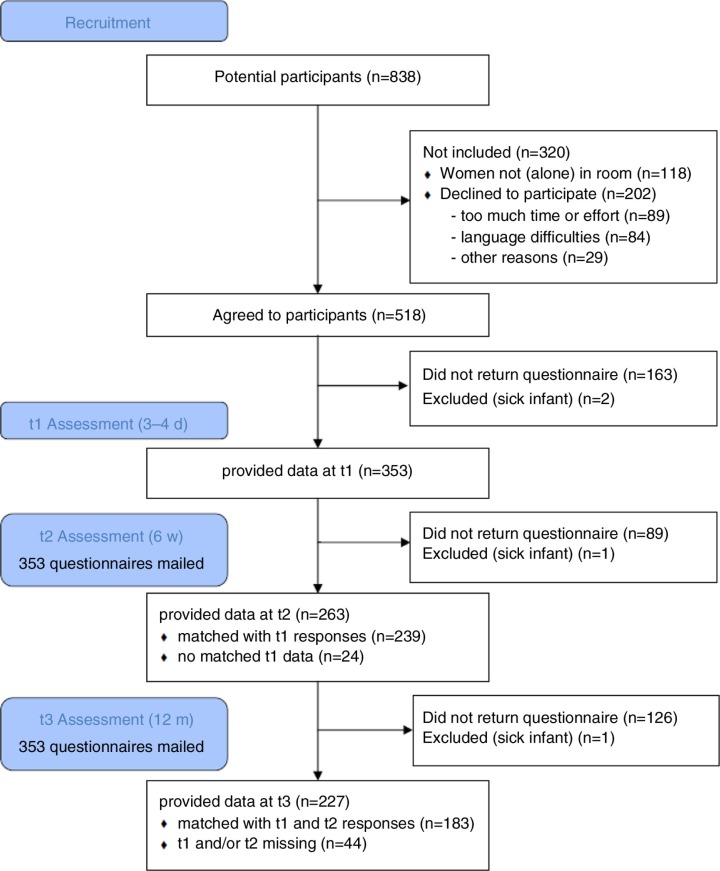
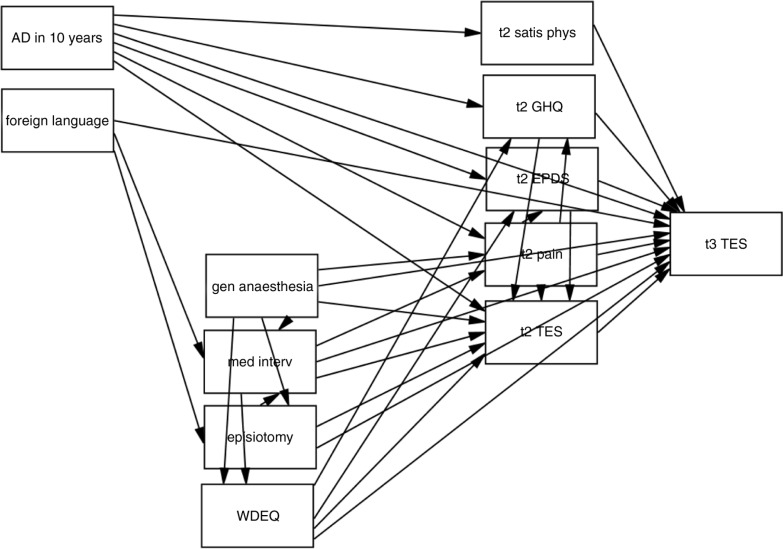
We assessed women within the first days (=353), 6 weeks, and 12 months (=183) after having given birth to a healthy infant. The first assessment included questions on demographics, pregnancy, and birth experience. The second and third assessments contained screenings for postpartum depression, PTSD, and general mental health problems, as well as assessing social support and physical well-being. We analysed our data using structural equation modelling techniques (=277).
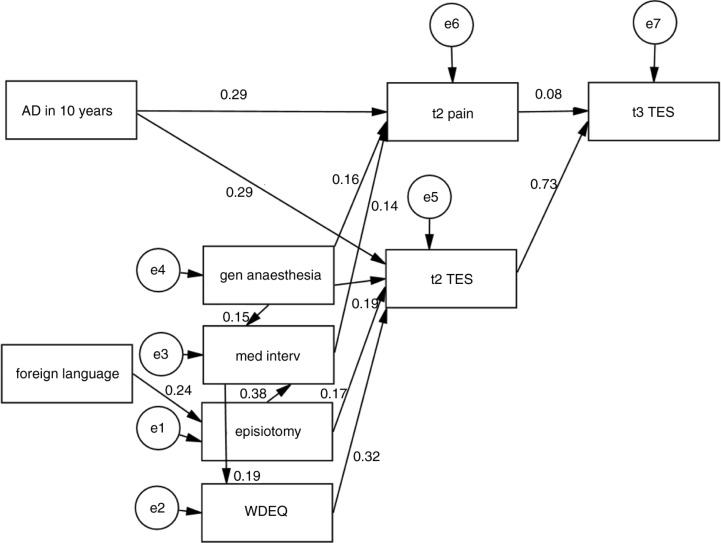
Our final model showed good fit and was consistent with a diathesis-stress model of PSS. Women who had used antidepressant medication in the 10 years before childbirth had higher PSS at 6 weeks, independent of birth experiences. Subjective birth experience was the early predictor with the highest total effect on later PSS. Interestingly, a probable migration background also had a small but significant effect on PSS via more episiotomies. The null results for social support may have been caused by a ceiling effect.
Given that we measured predictors at different time points, our results lend important support to the etiological model, namely, that there is a vulnerability pathway and a stress pathway leading to PSS. PSS and other psychological measures stayed very stable between 6 weeks and 1 year postpartum, indicating that it is possible to identify women developing problems early.
Our results are consistent with a diathesis-stress model: vulnerability (antidepressant use in the previous 10 years) influenced posttraumatic stress symptoms at 6 weeks and 1 year, independently of stress (birth-related variables). The strongest predictor of posttraumatic stress symptoms 1 year postpartum was posttraumatic stress symptoms 6 weeks postpartum. This means that women who develop problems could be identified during routinely offered postpartum care. Women with a probable migration background experienced more PSS 1 year after the birth, which was an indirect effect through more episiotomies and more PSS after 6 weeks.
在过去二十年中,关于产后创伤后应激障碍(PTSD)的研究越来越多。关于哪些人会出现创伤后应激症状(PSS)的预测因素的文献表明,易感性和分娩因素都有影响,但许多研究同时测量预测因素和结果。
在此背景下,我们旨在研究纵向测量的PSS预测因素的间接和直接影响。
我们在分娩出健康婴儿后的头几天(=353名)、6周和12个月(=183名)对女性进行了评估。第一次评估包括有关人口统计学、怀孕和分娩经历的问题。第二次和第三次评估包括产后抑郁症、PTSD和一般心理健康问题的筛查,以及对社会支持和身体健康的评估。我们使用结构方程建模技术(=277)分析了我们的数据。
我们的最终模型显示拟合良好,与PSS的素质-应激模型一致。分娩前10年内使用过抗抑郁药物的女性在6周时的PSS较高,与分娩经历无关。主观分娩经历是对后期PSS总效应最高的早期预测因素。有趣的是,可能的移民背景也通过更多的会阴切开术对PSS产生了虽小但显著的影响。社会支持的零结果可能是由天花板效应引起的。
鉴于我们在不同时间点测量了预测因素,我们的结果为病因模型提供了重要支持,即存在导致PSS的易感性途径和应激途径。PSS和其他心理测量指标在产后6周和1年之间保持非常稳定,这表明有可能早期识别出出现问题的女性。
我们的结果与素质-应激模型一致:易感性(过去10年使用抗抑郁药物)独立于应激(与分娩相关的变量)影响6周和1年时的创伤后应激症状。产后1年创伤后应激症状的最强预测因素是产后6周的创伤后应激症状。这意味着可以在常规的产后护理期间识别出出现问题的女性。可能有移民背景的女性在分娩后1年经历了更多的PSS,这是通过更多的会阴切开术和6周后更多的PSS产生的间接影响。