Cruz Mario Augusto Ferreira, Cruz Josilda Ferreira, Macena Larissa Baracho, de Santana Demetrius Silva, Oliveira Cristiane Costa da Cunha, Lima Sonia Oliveira, Franca Alex Vianey Callado
Department of Medicine, Tiradentes University, Aracaju 49032-490, Sergipe, Brazil.
Sergipe Federal University, Sao Cristovao 49100-000, Sergipe, Brazil.
Gastroenterology Res. 2015 Oct;8(5):260-264. doi: 10.14740/gr685w. Epub 2015 Oct 21.
Nonalcoholic fatty liver disease (NAFLD) is among the most common chronic diseases of the modern world with a wide variety of factors including genetic, environmental and metabolic. The aim of this study was to verify the association between the degrees of hepatic steatosis at the abdominal ultrasound and the values of aminotransferases (aspartate aminotransferase (AST) and alanine transferase (ALT)), gamma glutamyl transpeptidase (GGT) and homeostasis model assessment-insulin resistance (HOMA-IR) index.
A prospective, descriptive survey study, using a quantitative analytical examination, was conducted from July 2013 to July 2014. In the statistical analysis, values were expressed as median, first and third quartiles. We used the nonparametric Kruskal-Wallis test to compare the medians between the degrees of steatosis, adopted a statistical significance of 5% (P ≤ 0.05) and used the statistical program SPSS 22.0.
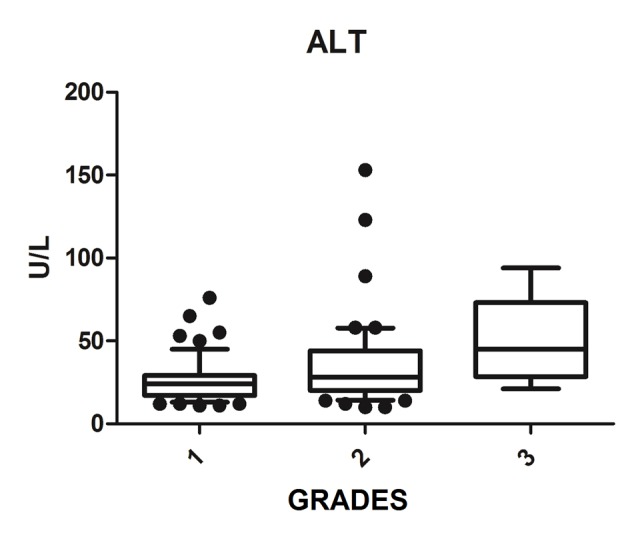
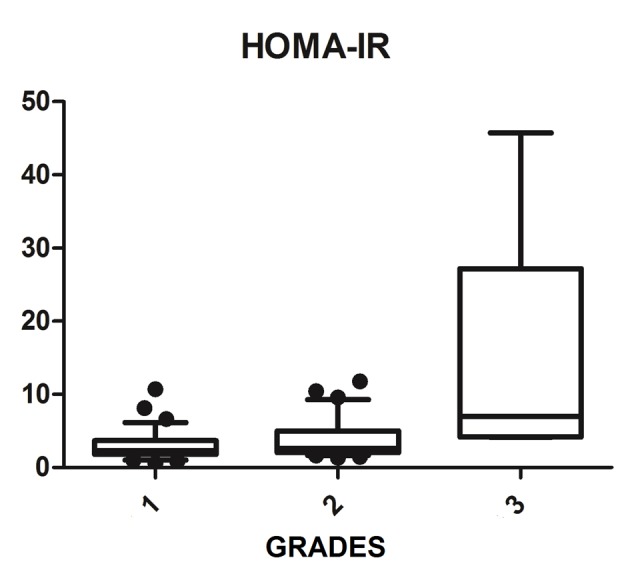
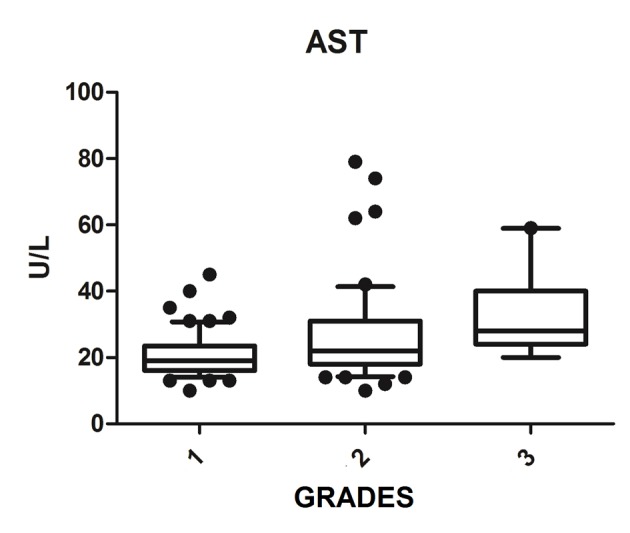
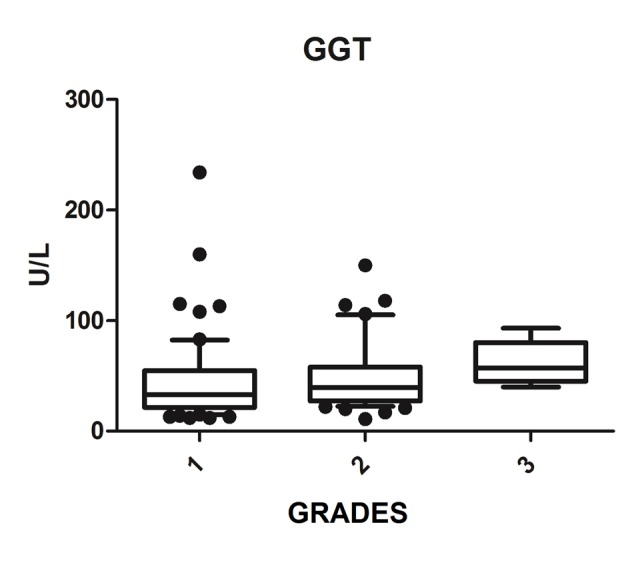
We diagnosed 233/800 (29.1%) patients with hepatic steatosis on routine ultrasound, and 65.7% were female. Regarding degrees, 119 had grade 1 (51.0%), 94 grade 2 (40.4%) and 20 grade 3 (8.6%). The median age of the patients with grade 1, 2 or 3 did not vary significantly (P > 0.05). The median body mass index (BMI), although clinically important because of its elevation, did not differ significantly (P > 0.05). ALT levels increased as the degree of hepatic steatosis has advanced as well as the levels of AST, GGT and HOMA-IR. AST values showed a greater association with the severity of fatty liver (P = 0.0001) than the ALT (P = 0.001).
ALT, AST, GGT and HOMA-IR are associated to the degrees of hepatic steatosis on ultrasound and can help in the selection of patients for the liver histological evaluation.
非酒精性脂肪性肝病(NAFLD)是现代世界最常见的慢性病之一,其发病受多种因素影响,包括遗传、环境和代谢因素。本研究旨在验证腹部超声检查的肝脂肪变性程度与转氨酶(天冬氨酸转氨酶(AST)和丙氨酸转氨酶(ALT))、γ-谷氨酰转肽酶(GGT)及稳态模型评估-胰岛素抵抗(HOMA-IR)指数之间的相关性。
2013年7月至2014年7月开展了一项前瞻性描述性调查研究,采用定量分析检测方法。在统计分析中,数据以中位数、第一四分位数和第三四分位数表示。我们使用非参数Kruskal-Wallis检验比较脂肪变性程度之间的中位数,采用5%的统计学显著性水平(P≤0.05),并使用统计软件SPSS 22.0。
在常规超声检查中,我们诊断出233/800(29.1%)例患者存在肝脂肪变性,其中65.7%为女性。在程度方面,119例为1级(51.0%),94例为2级(40.4%),20例为3级(8.6%)。1级、2级或3级患者的年龄中位数无显著差异(P>0.05)。尽管体重指数(BMI)因升高而具有临床意义,但其差异也无统计学显著性(P>0.05)。随着肝脂肪变性程度加重,ALT水平以及AST、GGT和HOMA-IR水平均升高。与ALT(P=0.001)相比,AST值与脂肪肝严重程度的相关性更强(P=0.0001)。
ALT、AST、GGT和HOMA-IR与超声检查的肝脂肪变性程度相关,有助于选择患者进行肝脏组织学评估。