Di Stefano Marco, Paulsen Jonas, Lien Tonje G, Hovig Eivind, Micheletti Cristian
SISSA, International School for Advanced Studies, Trieste, I-34136, Italy.
Institute of Basic Medical Sciences, University of Oslo, Oslo, 0317, Norway.
Sci Rep. 2016 Oct 27;6:35985. doi: 10.1038/srep35985.
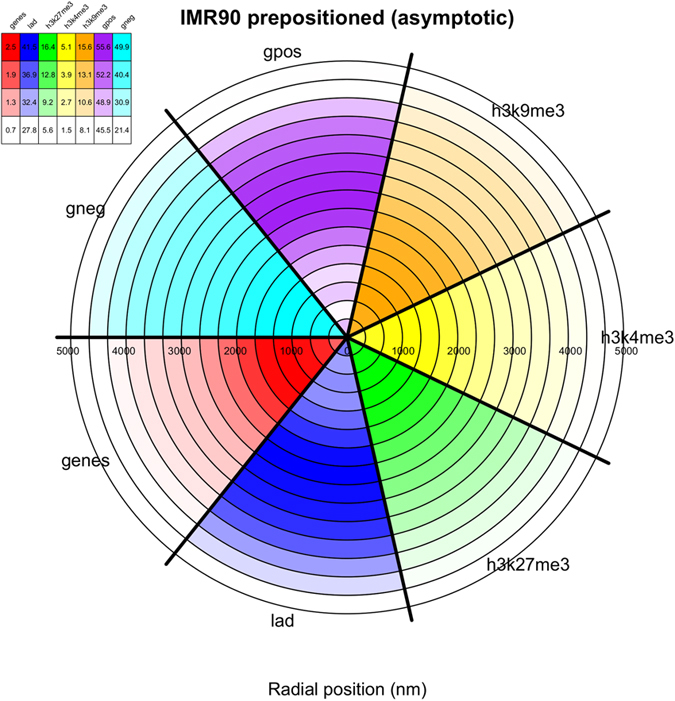
Combining genome-wide structural models with phenomenological data is at the forefront of efforts to understand the organizational principles regulating the human genome. Here, we use chromosome-chromosome contact data as knowledge-based constraints for large-scale three-dimensional models of the human diploid genome. The resulting models remain minimally entangled and acquire several functional features that are observed in vivo and that were never used as input for the model. We find, for instance, that gene-rich, active regions are drawn towards the nuclear center, while gene poor and lamina associated domains are pushed to the periphery. These and other properties persist upon adding local contact constraints, suggesting their compatibility with non-local constraints for the genome organization. The results show that suitable combinations of data analysis and physical modelling can expose the unexpectedly rich functionally-related properties implicit in chromosome-chromosome contact data. Specific directions are suggested for further developments based on combining experimental data analysis and genomic structural modelling.
将全基因组结构模型与现象学数据相结合,是理解调控人类基因组组织原则的前沿研究方向。在此,我们将染色体间接触数据用作人类二倍体基因组大规模三维模型的基于知识的约束条件。所得模型的纠缠程度降至最低,并呈现出一些在体内观察到的功能特征,而这些特征从未被用作模型的输入。例如,我们发现富含基因的活跃区域被拉向核中心,而基因贫乏且与核纤层相关的区域则被推向核周边。在添加局部接触约束后,这些以及其他特性依然存在,这表明它们与基因组组织的非局部约束条件具有兼容性。结果表明,数据分析与物理建模的适当结合能够揭示染色体间接触数据中隐含的、出人意料的丰富功能相关特性。基于实验数据分析与基因组结构建模的结合,我们还提出了进一步发展的具体方向。