Yen Yung-Feng, Chen Marcelo, Jen Ian, Lan Yu-Ching, Chuang Pei-Hung, Liu Yen-Ling, Lee Yun, Chen Yi-Ming Arthur
*Department of Internal Medicine, Section of Infectious Diseases, Taipei City Hospital, Taipei, Taiwan; †School of Medicine, National Yang-Ming University, Taipei, Taiwan; ‡Center for Infectious Disease and Cancer Research, Kaohsiung Medical University, Kaohsiung, Taiwan; §Department of Urology, Mackay Memorial Hospital, Taipei, Taiwan; ‖Department of Cosmetic Applications and Management, Mackay Junior College of Medicine, Nursing and Management, Taipei, Taiwan; ¶Department and Institute of Public Health, National Yang-Ming University, Taipei, Taiwan; #Department of Health Risk Management, China Medical University, Taichung, Taiwan; **Center for Prevention and Treatment of Occupational Injury and Diseases, Taipei Veterans General Hospital, Taipei, Taiwan; ††Division of Clinical Toxicology and Occupational Medicine, Department of Medicine, Taipei Veterans General Hospital, Taipei, Taiwan; and ‡‡Department of Microbiology and Institute of Medical Research, College of Medicine, Kaohsiung Medical University, Kaohsiung, Taiwan.
J Acquir Immune Defic Syndr. 2017 Feb 1;74(2):117-125. doi: 10.1097/QAI.0000000000001216.
HIV-associated vasculopathy and opportunistic infections (OIs) might cause vascular atherosclerosis and aneurysmal arteriopathy, which could increase the risk of incident stroke. However, few longitudinal studies have investigated the link between HIV and incident stroke. This cohort study evaluated the association of HIV and OIs with incident stroke.
We identified adults with HIV infection in 2000-2012, using the Taiwan National Health Insurance Research Database. A control cohort without HIV infection, matched for age and sex, was selected for comparison. Stroke incidence until December 31, 2012 was then ascertained for all patients. A time-dependent Cox regression model was used to determine the association between OIs and incident stroke among patients with HIV.
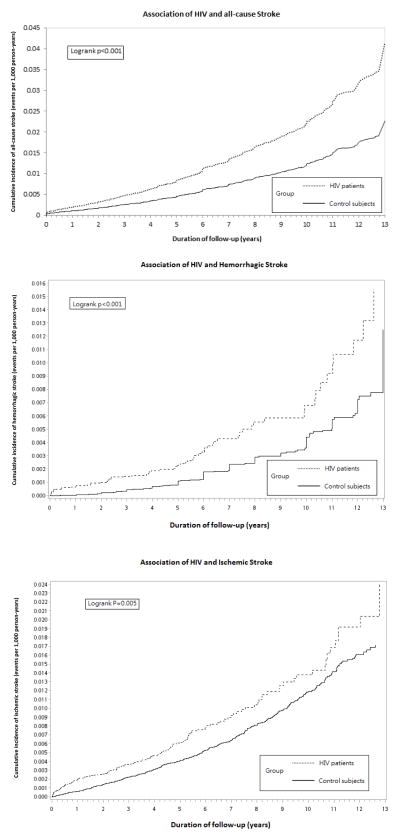
Among a total of 106,875 patients (21,375 patients with HIV and 85,500 matched controls), stroke occurred in 927 patients (0.87%) during a mean follow-up period of 5.44 years, including 672 (0.63%) ischemic strokes and 255 (0.24%) hemorrhagic strokes. After adjusting for other covariates, HIV infection was an independent risk factor for incident all-cause stroke [adjusted hazard ratio (AHR) 1.83; 95% confidence interval (CI): 1.58 to 2.13]. When the type of stroke was considered, HIV infection increased the risks of ischemic (AHR 1.33; 95% CI: 1.09 to 1.63) and hemorrhagic stroke (AHR 2.01; 95% CI: 1.51 to 2.69). The risk of incident stroke was significantly higher in patients with HIV with cryptococcal meningitis (AHR 4.40; 95% CI: 1.38 to 14.02), cytomegalovirus disease (AHR 2.79; 95% CI: 1.37 to 5.67), and Penicillium marneffei infection (AHR 2.90; 95% CI: 1.16 to 7.28).
Patients with HIV had an increased risk of stroke, particularly those with cryptococcal meningitis, cytomegalovirus, or P. marneffei infection.
HIV 相关血管病变和机会性感染(OIs)可能导致血管动脉粥样硬化和动脉瘤性动脉病变,这可能会增加发生中风的风险。然而,很少有纵向研究调查 HIV 与中风发生之间的联系。这项队列研究评估了 HIV 和 OIs 与中风发生之间的关联。
我们使用台湾国民健康保险研究数据库,确定了 2000 年至 2012 年期间感染 HIV 的成年人。选择年龄和性别相匹配的无 HIV 感染的对照队列进行比较。然后确定所有患者截至 2012 年 12 月 31 日的中风发病率。使用时间依赖性 Cox 回归模型来确定 HIV 患者中 OIs 与中风发生之间的关联。
在总共 106,875 名患者(21,375 名 HIV 患者和 85,500 名匹配对照)中,在平均 5.44 年的随访期内,927 名患者(0.87%)发生了中风,包括 672 例(0.63%)缺血性中风和 255 例(0.24%)出血性中风。在调整其他协变量后,HIV 感染是全因中风发生的独立危险因素[调整后的危险比(AHR)1.83;95%置信区间(CI):1.58 至 2.13]。当考虑中风类型时,HIV 感染增加了缺血性中风(AHR 1.33;95%CI:1.09 至 1.63)和出血性中风(AHR 2.01;95%CI:1.51 至 2.69)的风险。HIV 合并隐球菌性脑膜炎(AHR 4.40;95%CI:1.38 至 14.02)、巨细胞病毒病(AHR 2.79;95%CI:1.37 至 5.67)和马尔尼菲篮状菌感染(AHR 2.90;95%CI:1.16 至 7.28)的患者发生中风的风险显著更高。
HIV 患者发生中风的风险增加,特别是那些合并隐球菌性脑膜炎、巨细胞病毒或马尔尼菲篮状菌感染的患者。